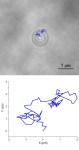
 Most of us have a sub-conscious understanding of the forces that control the interaction of objects in the size scale in which we exist, i.e. from millimetres through to metres. In this size scale gravitational and inertial forces dominate the interactions of bodies. However, at the size scale that we cannot see, even when we use an optical microscope, the forces that the dominate the behaviour of objects interacting with one another are different. There was a hint of this change in behaviour observed in our studies of the diffusion of nanoparticles [see ‘Slow moving nanoparticles‘ on December 13th, 2017], when we found that the movement of nanoparticles less than 100 nanometres in diameter was independent of their size. Last month we published another article in one of the Nature journals, Scientific Reports, on ‘The influence of inter-particle forces on diffusion at the nanoscale‘, in which we have demonstrated by experiment that Van der Waals forces and electrostatic forces are the dominant forces at the nanoscale. These forces control the diffusion of nanoparticles as well as surface adhesion, friction and colloid stability. This finding is significant because the ionic strength of the medium in which the particles are moving will influence the strength of these forces and hence the behaviour of the nanopartices. Since biological fluids contain ions, this will be important in understanding and predicting the behaviour of nanoparticles in biological applications where they might be used for drug delivery, or have a toxicological impact, depending on their composition.
Van der Waals forces are weak attractive forces between uncharged molecules that are distance dependent. They are named after a Dutch physicist, Johannes Diderik van der Waals (1837-1923). Electrostatic forces occur between charged particles or molecules and are usually repulsive with the result that van der Waals and electrostatic forces can balance each other, or not depending on the circumstances.
Sources:
Giorgi F, Coglitore D, Curran JM, Gilliland D, Macko P, Whelan M, Worth A & Patterson EA, The influence of inter-particle forces on diffusion at the nanoscale, Scientific Reports, 9:12689, 2019.
Coglitore D, Edwardson SP, Macko P, Patterson EA, Whelan MP, Transition from fractional to classical Stokes-Einstein behaviour in simple fluids, Royal Society Open Science, 4:170507, 2017. doi: 10.1098/rsos.170507.
Patterson EA & Whelan MP, Tracking nanoparticles in an optical microscope using caustics. Nanotechnology, 19 (10): 105502, 2009.
Image: from Giorgi et al 2019, figure 1 showing a photograph of a caustic (top) generated by a 50 nm gold nanoparticle in water taken with the optical microscope adjusted for Kohler illumination and closing the condenser field aperture to its minimum following method of Patterson and Whelan with its 2d random walk over a period of 3 seconds superimposed and a plot of the same walk (bottom).
 For some years I have been practising and teaching the principles of ‘Procedural Justice’ and ‘Fair Process’ in leadership. For me, it is an intuitive approach that involves listening to people, making a decision, then explaining the decision and resultant expectations to everyone concerned. It was given a name and attributed to two researchers at INSEAD Chan Kim and Renée Mauborgne when I attended the Center for Creative Leadership in Greensboro, North Carolina in 2008. However, last weekend, I discovered that it is much older because it forms part of the advice to abbots in ‘The Rule of St Benedict‘ written around 540. In chapter 3, entitled ‘Summoning the brothers for consultation’, Benedict says ‘whenever any important matters need to be dealt with in the monastery, the abbot should gather the whole community together and set out the agenda in person. When he has listened to the brothers’ advice, he should consider it carefully and then do what he decides is best.’ So long before Kim and Mauborgne discovered the effectiveness of this approach, Benedictine abbots were using it to run hugely successful abbeys, such as Fountains Abbey in Yorkshire where I came across a copy of ‘The Rule of St Benedict’.


 Realize Engineering