Category Archives: MyResearch

Real-time label-free tracking of bacteriophages interacting with bacteria

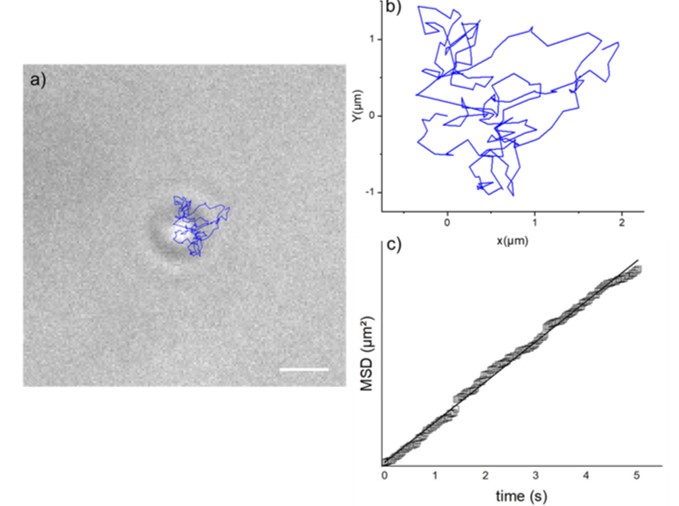
(a) Two-dimensional random dynamics (blue line) of a pelp20 bacteriophage monitored for a period of 5 s. Scale bar, 2 µm. (b) A plot of the same dynamics and (c) the mean square displacement (MSD) of the random walk. The MSD of the random walk is represented by square data points, and a linear fit (black line) has been applied to the data.

(a) Two-dimensional random dynamics (blue line) of a pelp20 bacteriophage monitored for a period of 5 s. Scale bar, 2 µm. (b) A plot of the same dynamics and (c) the mean square displacement (MSD) of the random walk. The MSD of the random walk is represented by square data points, and a linear fit (black line) has been applied to the data (Figure 4 from https://royalsocietypublishing.org/view-large/figure/20098614/rsif.2026.0250.f004.tif)

I was excited last month when our latest research on tracking nano-entities was published by the Journal of the Royal Society Interface.  The paper describes the real-time and label-free tracking of bacteriophages, or phages, in an optical microscope using caustics (see right thumbnail).  Phages are of interest due to the potential applications in biotechnology and medicine.  They selectively infect and replicate within bacteria and play an important role in regulating bacterial populations across many ecosystems.  I have written previously about the threat of antimicrobial resistant (AMR) infections and our research on the real-time tracking of individual bacterium that could be responsible for such infections [see ‘Label-free real-time tracking of individual bacterium‘ on January 25th, 2023].  In this newly published paper, we describe tracking phages as they interact with and compromise bacteria (see bottom thumbnail) using the same technique, optical caustics [see ‘Caustics‘ on October 15th, 2024 and application to ‘Nanoparticle motion through heterogeneous hydrogels‘ on November 6th, 2024 and to ‘Corona-induced transition from molecular to particle motion in biological media‘ on December 4th, 2024]. Traditionally, phages have been monitored using fluorescent labelling because their size is nanometric which renders them invisible in a conventional optical microscope.  However, chemically attaching labels to nano entities has been shown to influence their dynamics.  Hence, this new study represents a significant advance that will accelerate the real-time observation of phage-bacteria interactions which will enable the development of phage-based diagnostics and antimicrobial therapies.

Sources:

Francesco Giorgi, Samuel Chenery, Liberty Duignan, Joanne L. Fothergill, Eann Patterson, Judith M. Curran; Elucidating bacteriophage dynamics and interactions with real-time label-free optical imaging. J R Soc Interface 1 May 2026; 23 (238): 20260250. https://doi.org/10.1098/rsif.2026.0250

Details of E. coli bacteria: (a) not exposed (reprinted from [17]) and (b,c) exposed to a population of EcoLiv25 phages in solution. In (b), the arrow points at the supposed presence of a phage attached to the bacterium’s external membrane, while in (c), the arrows point at the compromised sections of the bacterium’s external membrane as a result of phage infection. Scale bars, 2 µm.

Details of E. coli bacteria: (a) not exposed and (b,c) exposed to a population of EcoLiv25 phages in solution. In (b), the arrow points at the supposed presence of a phage attached to the bacterium’s external membrane, while in (c), the arrows point at the compromised sections of the bacterium’s external membrane as a result of phage infection. Scale bars, 2 µm (Figure 6 from https://royalsocietypublishing.org/view-large/figure/20098622/rsif.2026.0250.f006.tif).

Extra! Extra!

Extra! Extra! Read all about it!  As newspaper vendors used to shout.  The Pint of Science Festival is happening across the UK in the week beginning Monday 18th May for three evenings in venues in 43 locations.  I am talking on the first evening, May 18th, in Lime Street Social (51 Lime Street, L1 1JQ) on ‘I Sell Here, Sir, What all World Desires to have – POWER’.  My title is a quote from Matthew Boulton, who with James Watt, set up a factory in Birmingham to produce steam engines in the 18th century.  I am going to talk about producing nuclear power units in a factory (see ‘Commoditization of civil nuclear power’ on June 5th, 2024).  If you would like to come to the event and hear three other speakers besides me and have a pint or two then please register at https://pintofscience.co.uk/events/liverpool/.

Perched blocks and muskoxen

Greenland has been in the news recently and as a consequence more people know about it than when I visited there about 45 years ago (see ‘Ice bores and what they can tell us‘ on January 12th, 2022).  I was part of a small expedition that spent a short Arctic summer on the Bersaekerbrae glacier in North East Greenland.  We air-freighted our equipment from Glasgow to Reykjavík in Iceland where we charted an aircraft to fly us, our equipment and supplies to Mestersvik, in Scoresby Land, Greenland.  Mestersvik was a couple of huts and a runway on the edge of Davy Sound where, by chance, there was a helicopter.  I cannot remember why the helicopter was there; however, we persuaded the pilot to lift our supplies and equipment to our basecamp on the glacier which saved us back-packing everything in several day-long treks.  We camped on the edge of the glacier while we undertook a series of scientific studies.  Amongst other things, we counted muskoxen and measured how structures either sunk into the glacier ice or ended up perched on towers of ice (perched blocks), depending on the relative rate of melting of the ice around and beneath them.  These two studies generated my first published research papers – I narrowly missed becoming a zoologist or glaciologist!  While there has been only very limited exploitation of Greenland’s natural resources, the ecology of Greenland is being altered massively by the exploitation of natural resources elsewhere.  Climate change caused by carbon emissions has led to the melting of the Greenland ice sheet, which between 1972 and 2023, lost on average 119 billion tonnes of ice per year, contributing a total of 17.3 mm to sea level rise, according to the EU’s Copernicus Programme.

Research papers:

Patterson EA. Sightings of muskoxen in northern Scoresby Land, Greenland. Arctic, 37(1):61-3. 1984.

Patterson EA. A mathematical model for perched block formation. J. Glaciology, 30(106):296-301, 1984.


Passive nanorheology measurements

What do marshmallows, jelly (or Jell-O), cream cheese and Chinese soup dumplings have in common?  They are often made with gelatin.  Gelatin is derived from the skin and bones of cattle and pigs through the partial hydrolysis of collagen.  Gelatin is a physical hydrogel meaning that it consists of a three-dimensional network of polymer molecules in which a large amount of water is absorbed, as much as 90% in gelatin.  These polymer molecules are cross-linked by hydrogen bonds, hydrophobic interactions and chain entanglements.  External stimuli, such as temperature, can change the level of cross-linking causing the material to transition between its solid, liquid and gel states.  This is why jelly sets in the fridge and melts when it’s heated up – the cross-links holding the molecules together break down.  This type of responsive behaviour allows the properties of hydrogels to be controlled at the micro and sub-micron scale for a host of applications including tissue engineering, drug delivery, water treatment, wearable technologies, and supercapacitors.  However, the design and manufacture of soft hydrogels can be challenging due to the lack of technology for measuring the local properties.  Current quantitative techniques for measuring the properties of hydrogels usually focus on bulk properties and provide little data about local variations or real-time responses to external stimuli.  My colleagues and I have used gold nanoparticles as probes in hydrogels to map the properties at the microscale of thermosensitive hydrogels undergoing real-time transition from the solid to gel phases [see ‘Passive nanorheological tool to characterise hydrogels’].  This is an extension, or perhaps more accurately an application, of our earlier work on tracking nanoparticles through the vitreous humour of the eye [see ‘Nanoparticle motion-through heterogeneous hydrogels’ on November 6th, 2024].  The novel technique, which yields passive nanorheological measurements, allows us to evaluate local viscosity, identify time-varying heterogeniety and monitor dynamic phase transitions at the micro through to nano scale.  The significant challenges of other techniques, such as weak signals due to high water content and the dynamism of hydrogels, are overcome with a fast, inexpensive and user-friendly technology.  Although, even with these advantages, you are unlikely to use it when you are making jelly or roasting marshmallows over the campfire; however, it is really useful for understanding the transport of drugs through biological hydrogels or designing manufacturing processes for artificial tissue.

Reference

Moira Lorenzo Lopez, Victoria R. Kearns, Eann A. Patterson & Judith M. Curran, Passive nanorheological tool to characterise hydrogels, Nanoscale, 2025,17, 15338-15347.

Image: Figure 5 from the above reference showing a hydrogel transitioning to a gel phase as result of an increase in temperature with 100 nm diameter gold nanoparticles with some particles (yellow arrows) at the interface between phases.  The image was taken in an inverted optical microscope set up for tracking the nanoparticles.