Author Archives: Eann Patterson

Preparing for winter

I had been queueing slowly up the steps to board a plane thinking about nothing in particular when, as I stepped into the plane, one of cabin staff said to me ‘Are you getting ready for winter?’  I looked at her somewhat perplexed because it was only September, and she pointed to the book that I was holding ready to read on the flight home.  It was ‘Winter’ by Ali Smith.  It is a novel with much to say on many issues.

One of the central characters in the novel, Art writes a blog and someone challenges him to write about a real thing, something that he remembers happening and not a blog thing.  He describes a real childhood memory and when it is suggested that he should write about it, his response is he could never put something like that on-line because ‘it’s way to real’.  I have some empathy with Art, because it can be difficult writing about your thoughts and memories for anyone to read.  However, I have noticed that the readership of the blog goes up when I do write about such things [see for example ‘Thinking more clearly by writing weekly‘ on May 2nd, 2018 or ‘Depressed by exams‘ on January 31st, 2018].  So, if people are interested  perhaps I should do it more often.

Another passage that resonated with me was about age.  The narrator is her sixties, which I will be soon, and comments that ‘You never stop being yourself on the inside whatever age people think you are by looking at you from the outside.’  I think that this is true but perhaps difficult to reconcile with consciousness being an accumulation of sensory experiences [see ‘Is there a real ‘you’ or ‘I’‘ on March 6th, 2019]

Source: Ali Smith, Winter, London: Penguin Books, 2018 (see pages 188-9 for Art recalling his childhood memory and page 251 for discussion about being in your sixties).

Same problems in a different language

I spent a lot of time on trains last week.  I left Liverpool on Tuesday evening for Bristol and spent Wednesday at Airbus in Filton discussing the implementation of the technologies being developed in the EU Clean Sky 2 projects MOTIVATE and DIMES.  On Wednesday evening I travelled to Bracknell and on Thursday gave a seminar at Syngenta on model credibility in predictive toxicology before heading home to Liverpool.  But, on Friday I was on the train again, to Manchester this time, to listen to a group of my PhD students presenting their projects to their peers in our new Centre for Doctoral Training called Growing skills for Reliable Economic Energy from Nuclear, or GREEN.  The common thread, besides the train journeys, is the Fidelity And Credibility of Testing and Simulation (FACTS).  My research group is working on how we demonstrate the fidelity of predictions from models, how we establish trust in both predictions from computational models and measurements from experiments that are often also ‘models’ of the real world.  The issues are similar whether we are considering the structural performance of aircraft [as on Wednesday], the impact of agro-chemicals [as on Thursday], or the performance of fusion energy and the impact of a geological disposal site [as on Friday] (see ‘Hierarchical modelling in engineering and biology‘ on March 14th, 2018) .  The scientific and technical communities associated with each application talk a different language, in the sense that they use different technical jargon and acronyms; and they are surprised and interested to discover that similar problems are being tackled by communities that they rarely think about or encounter.

Size matters

Most of us have a sub-conscious understanding of the forces that control the interaction of objects in the size scale in which we exist, i.e. from millimetres through to metres.  In this size scale gravitational and inertial forces dominate the interactions of bodies.  However, at the size scale that we cannot see, even when we use an optical microscope, the forces that the dominate the behaviour of objects interacting with one another are different.  There was a hint of this change in behaviour observed in our studies of the diffusion of nanoparticles [see ‘Slow moving nanoparticles‘ on December 13th, 2017], when we found that the movement of nanoparticles less than 100 nanometres in diameter was independent of their size.  Last month we published another article in one of the Nature journals, Scientific Reports, on ‘The influence of inter-particle forces on diffusion at the nanoscale‘, in which we have demonstrated by experiment that Van der Waals forces and electrostatic forces are the dominant forces at the nanoscale.  These forces control the diffusion of nanoparticles as well as surface adhesion, friction and colloid stability.  This finding is significant because the ionic strength of the medium in which the particles are moving will influence the strength of these forces and hence the behaviour of the nanopartices.  Since biological fluids contain ions, this will be important in understanding and predicting the behaviour of nanoparticles in biological applications where they might be used for drug delivery, or have a toxicological impact, depending on their composition.

Van der Waals forces are weak attractive forces between uncharged molecules that are distance dependent.  They are named after a Dutch physicist, Johannes Diderik van der Waals (1837-1923).  Electrostatic forces occur between charged particles or molecules and are usually repulsive with the result that van der Waals and electrostatic forces can balance each other, or not depending on the circumstances.

Sources:

Giorgi F, Coglitore D, Curran JM, Gilliland D, Macko P, Whelan M, Worth A & Patterson EA, The influence of inter-particle forces on diffusion at the nanoscale, Scientific Reports, 9:12689, 2019.

Coglitore D, Edwardson SP, Macko P, Patterson EA, Whelan MP, Transition from fractional to classical Stokes-Einstein behaviour in simple fluids, Royal Society Open Science, 4:170507, 2017. doi: .

Patterson EA & Whelan MP, Tracking nanoparticles in an optical microscope using caustics. Nanotechnology, 19 (10): 105502, 2009.

Image: from Giorgi et al 2019, figure 1 showing a photograph of a caustic (top) generated by a 50 nm gold nanoparticle in water taken with the optical microscope adjusted for Kohler illumination and closing the condenser field aperture to its minimum following method of Patterson and Whelan with its 2d random walk over a period of 3 seconds superimposed and a plot of the same walk (bottom).

Trees are amongst the slowest moving beings with which we share our world

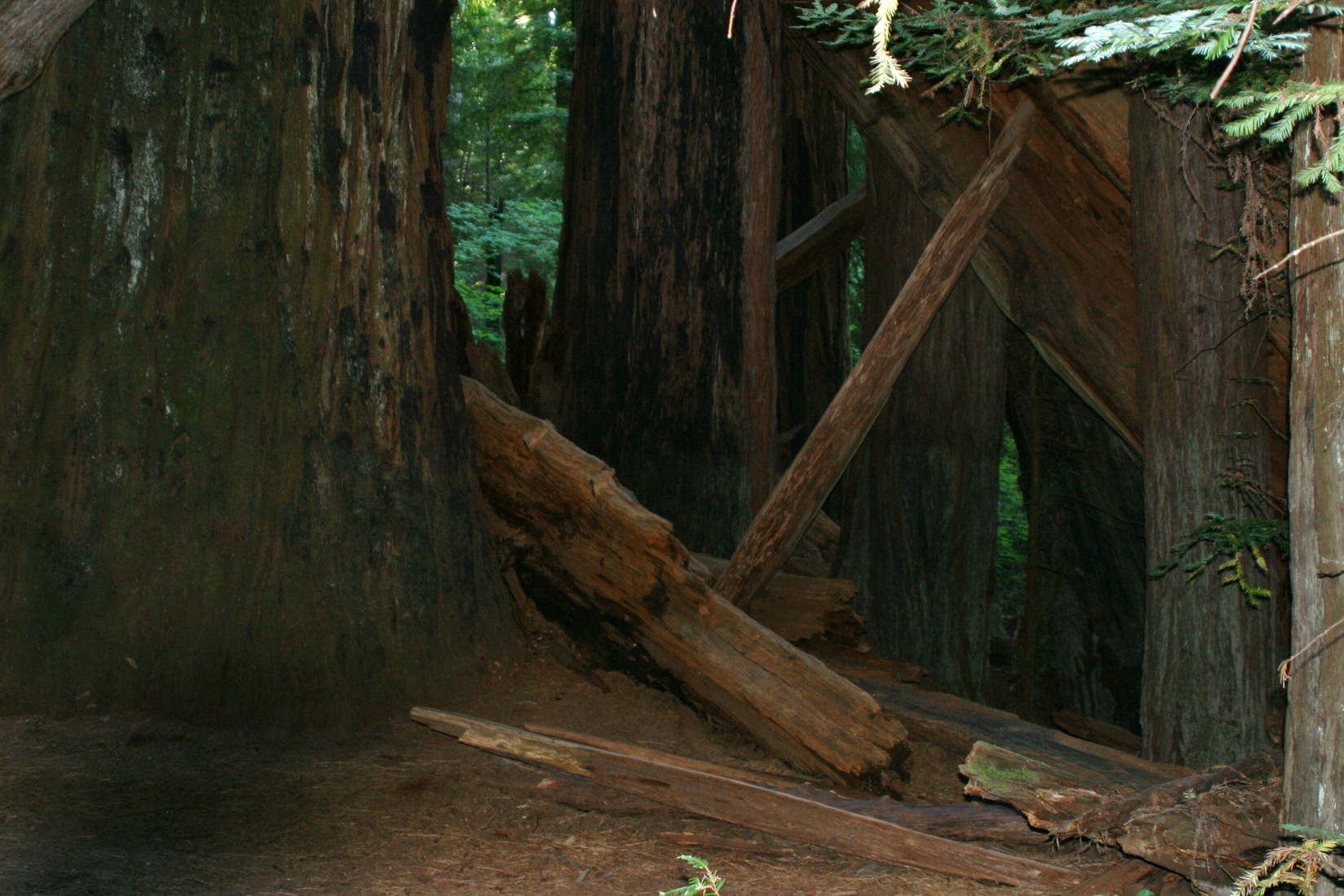
Last month I mentioned that I started reading ‘Overstory’ by Richard Powers on my trip back from the US [see ‘When an upgrading is downgrading‘ on August 21st, 2019].  I only finished it about ten days ago because I have not had much time to read and it is a long book at 629 pages.  It is a well-written book including some quotable passages, but one that I particularly liked which seems relevant in this era of polarised perspectives: ‘The best arguments in the world won’t change a person’s mind.  The only thing that can is a good story.’  And, Richard Powers tells a good story about the destruction of the ecosystem, on which we are dependent, as a result of large-scale felling of ancient forests.  The emphasis should be on ‘ancient’ because time for trees appears to run at a different speed than for humans.  While we can observe the seasonal changes in an ancient woodland, we are barely conscious on the growth and movement of the woodland.  When we read Shakespeare’s lines in Macbeth about ‘Great Birnam wood to high Dunsinane Hill shall come’,  we think of it moving over the landscape at the speed of an army of people, whereas woods move so slowly that we do not live long enough to notice the change.  For instance, there is a spruce tree in Sweden that is 9,500 years old.  Our spatial understanding of a tree also leads to a misconception because we can only see the overstory, i.e. what is happening above ground; so, we think that each trunk is an individual tree, whereas for many types of tree many apparently individual trunks belong to the same organism with an extensive understory below ground which might be thousands of years old.  All trees are involved in a substantial understory communicating with each other in ways that we can barely imagine let alone comprehend.  Most of the ancient forests in Europe were cut down before science revealed the scale and complexity of life in them; yet, we still continue to fell forests as if there was an inexhaustible supply rather than one that could take as long to replicate as humans have been recording our history.

If you would like to arguments about trees then read ‘The Hidden Life of Trees’ by Paul Wohlleben, London: William Collins, 2017 (my title is a quote from this book).  If you are unconvinced then read the ‘Overstory’ by Richard Powers, London: Penguin (Vintage), 2019.