Tag Archives: science

Crack tip plasticity in reactor steels

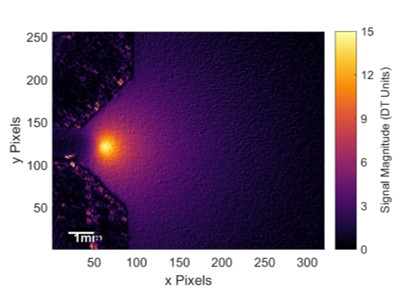
Amplitude of temperature in steel due to a cyclic load with a crack growing from left to right along the horizontal centre line with the stress concentration at its tip exhibiting the peak values. The wedge shapes in the left corners are part of the system.

At this time of year the flow into my inbox is augmented daily by prospective PhD students sending me long emails describing how their skills, qualifications and interests perfectly match the needs of my research group, or sometimes someone else’s group if they have not been careful in setting up their mass mailing.  At the moment, I have four PhD projects for which I am looking for outstanding students; so, because it will help prospective students and might interest my other readers but also because I am short of ideas for the blog, I plan to describe one project per week for the next month.

The first project is about the effect of hydrogen on crack tip plasticity in reactor steels.  Fatigue cracks grow in steels by coalescing imperfections in the microstructure of the material until small voids are formed in areas of high stress.  When these voids connect together a crack is formed.  Repeated loading and unloading of the material provides the energy to move the imperfections, known as dislocations, and geometric features in structures are stress concentrators which focus this energy causing cracks to be formed in their vicinity.  The movement of dislocations causes permanent, or plastic deformation of the material.  The sharp geometry of a crack tip becomes a stress concentrator creating a plastic zone in which dislocations pile up and voids form allowing the crack to extend [see post on ‘Alan Arnold Griffith‘ on April 26th, 2017].  It is possible to detect the thermal energy released during plastic deformation using a technique known as thermoelastic stress analysis [see ‘Counting photons to measure stress‘ on November 18th 2015] as well as to measure the stress field associated with the propagating crack [1].  One of my current PhD students has been using this technique to investigate the effect of irradiation damage on the growth of cracks in stainless steel used in nuclear reactors.  We use an ion accelerator at the Dalton Cumbrian Facility to introduce radiation damage into specimens the size of a postage stamp and afterwards apply cyclic loads and watch the fatigue crack grow using our sensitive infra-red cameras.  We have found that the irradiation reduced the rate of crack growth and we will be publishing a paper on it shortly [and a PhD thesis].  In the new project, our industrial sponsors want us to explore the effect of hydrogen on crack growth in irradiated steel, because the presence of hydrogen is known to accelerate fatigue crack growth [2] which is believe to happen as a result of hydrogen atoms disrupting the formation of dislocations at the microscale and localising plasticity at crack tip on the mesoscale.  However, these ideas have not been demonstrated in experiments, so we plan to do this using thermoelastic stress analysis and to investigate the combined influence of hydrogen and irradiation by developing a process for pre-charging the steel specimens with hydrogen using an electrolytic cell and irradiating them using the ion accelerator.  Both hydrogen and radiation are present in a nuclear reactor and hence the results will be relevant to predicting the safe working life of nuclear reactors.

The PhD project is fully-funded for UK and EU citizens as part of a Centre for Doctoral Training and will involve a year of specialist training followed by three years of research.  For more information following this link.

References:

  1. Yang, Y., Crimp, M., Tomlinson, R.A., Patterson, E.A., 2012, Quantitative measurement of plastic strain field at a fatigue crack tip, Proc. R. Soc. A., 468(2144):2399-2415.
  2. Matsunaga, H., Takakuwa, O., Yamabe, J., & Matsuoka, S., 2017, Hydrogen-enhanced fatigue crack growth in steels and its frequency dependence. Phil. Trans. R. Soc. A, 375(2098), 20160412
Nuclear winter school

I spent the first full-week of January 2019 at a Winter School for a pair of Centres for Doctoral Training focussed on Nuclear Energy (see NGN CDT & ICO CDT).  Together the two centres involve eight UK universities and most of the key players in the UK industry.  So, the Winter School offers an opportunity for researchers in nuclear science and engineering, from academia and industry, to gather together for a week and share their knowledge and experience with more than 80 PhD students.  Each student gives a report on the progress of their research to the whole gathering as either a short oral presentation or a poster.  It’s an exhausting but stimulating week for everyone due to both the packed programmme and the range of subjects covered from fundamental science through to large-scale engineering and socio-economic issues.

Here are a few things that caught my eye:

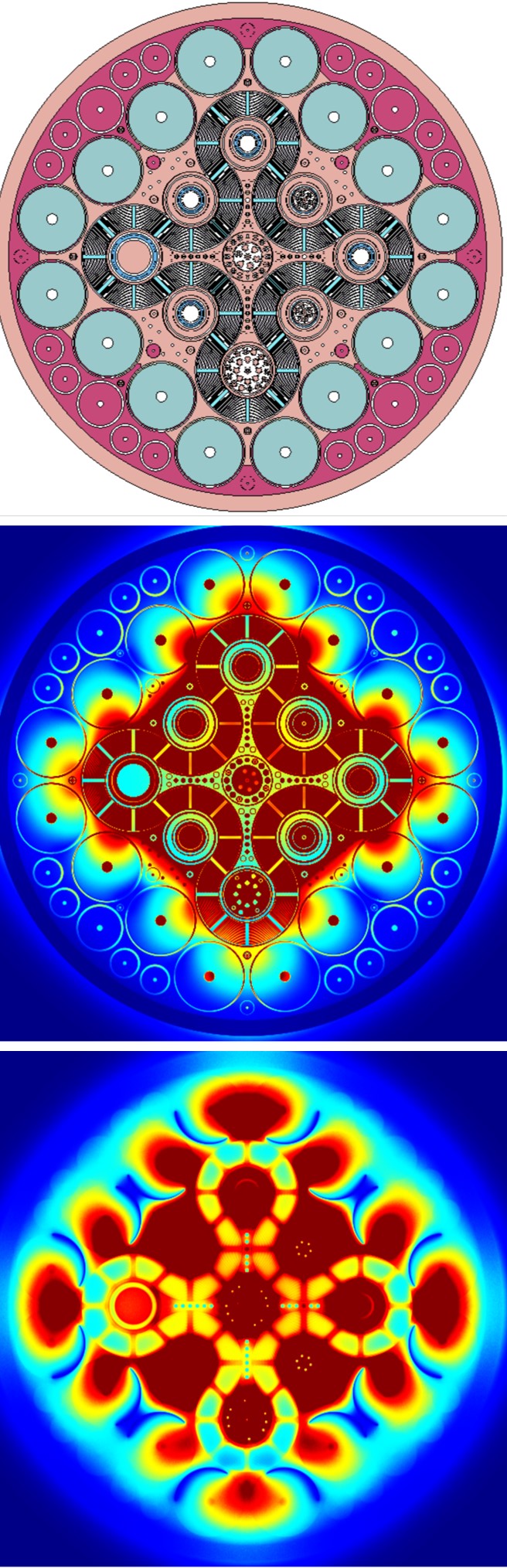
First, the images in the thumbnail above which Paul Cosgrove from the University of Cambridge used to introduce his talk on modelling thermal and neutron fluxes.  They could be from an art gallery but actually they are from the VTT Technical Research Centre of Finland and show the geometry of an advanced test reactor [ATR] (top); the rate of collisions in the ATR (middle); and the neutron density distribution (bottom).

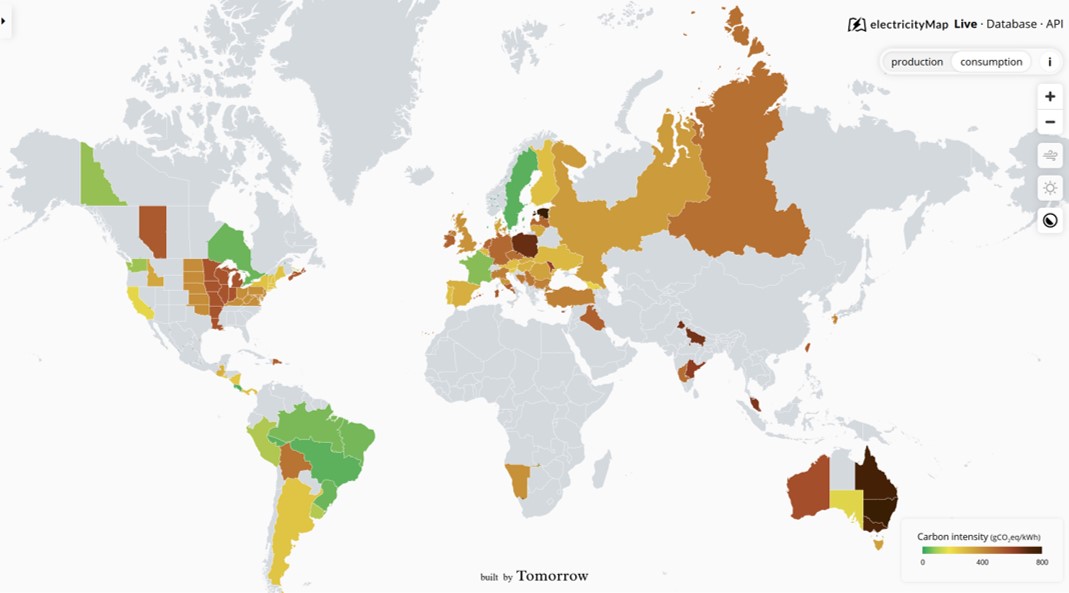
Second, a great app for your phone called electricityMap that shows you a live map of global carbon emissions and when you click on a country it reveals the sources of electricity by type, i.e. nuclear, gas, wind etc, as well as imports and exports of electricity.  Dame Sue Ion told us about it during her key-note lecture.  I think all politicians and journalists need it installed on their phones to check their facts before they start talking about energy policy.

Third, the scale of the concrete infrastructure required in current designs of nuclear power stations compared to the reactor vessel where the energy is generated.  The pictures show the construction site for the Vogtle nuclear power station in Georgia, USA (left) and the reactor pressure vessel being lowered into position (right).  The scale of nuclear power stations was one of the reasons highlighted by Steve Smith from Algometrics for why investors are not showing much interest in them (see ‘Small is beautiful and affordable in nuclear power-stations‘ on January 14th, 2015).  Amongst the other reasons are: too expensive (about £25 billion), too long to build (often decades), too back-end loaded (i.e. no revenue until complete), too complicated (legally, economically & socially), too uncertain politically, too toxic due to poor track record of returns to investors, too opaque in terms of management of industry.  That’s quite a few challenges for the next generation of nuclear scientists and engineers to tackle.  We are making a start by creating design tools that will enable mass-production of nuclear power stations (see ‘Enabling or disruptive technology for nuclear engineering?‘ on January 28th, 2015) following the processes used to produce other massive engineering structures, such as the Airbus A380 (see Integrated Digital Nuclear Design Programme); but the nuclear industry has to move fast to catch up with other sectors of the energy business, such as gas-fired powerstations or wind turbines.  If it were to succeed then the energy market would be massively transformed.


Wearing your heart on your sleeve

Many people are increasingly using their mobile phones as mental prostheses to extend the capacity of their brains [see ‘Science fiction becomes reality‘ on October 12th, 2016].  This does not just include tracking their appointments in a calender app or using a search engine to track down a piece of information that they have temporarily forgotten; but also recording their activities and preferences via social media apps.  Many of us are happy to share our thoughts with those close to us but we take it for granted that we are in complete control of what is shared and with whom.  So, unexpected or unauthorised sharing of our personal information via these mental prostheses can cause shock and embarrassment.  Now, spare a thought for the giant cuttlefish whose neurons are directly connected to about ten million chromatophores in its skin.  Each chromatophore is sack of pigment that can be shrunk or expanded to show its particular colour.  In giant cuttlefish the chromatophores are red, yellow and black/brown.  Beneath the chromatophores is a layer of iridophores, which manipulate the wavelengths of light using layers of plates to produce blues and greens and below these cells are leucophores that reflect light outwards through the iridophores and chromatophores.  In effect, the cuttlefish is wearing an Ultra-High Definition TV screen with about 10 million pixels directly connected to its brain.  Even when resting calmly, a cuttlefish’s skin can be pulsing with complex patterns of colour; perhaps this is similar to the way our minds can be teeming with activity even when we are sitting quietly apparently doing nothing.  Imagine what it would be like if all of those thoughts were displayed on a giant television screen.  It would give a whole new meaning to the phrase ‘to wear your heart on your sleeve’.

Source:

Peter Godfrey-Smith, Other Minds: The Octopus and the Evolution of Intelligent Life, London: William Collins, 2018.

Image: https://splimm.com/2017/01/10/cuttlefish-cabin-fever/

Making things happen

Engineers make things happen and no one notices them when everything works reliably and smoothly.  You could replace engineers in that sentence by managers.  Managers are responsible for people and organisations while engineers are responsible for the systems that underpin modern life.  You can pair scientists and leaders in the same way.  Scientists discover new knowledge which sets a direction for the future of technology while leaders create a vision for their organisation which also sets the direction for the future.  Then engineers and managers turn the imagined futures into reality. Of course the divisions are fuzzy.  Some of us would be considered engineering scientists because we work at the interface between science and engineering.  And many engineers spend more time managing people and organisations than practising engineering.  However, the bottom-line is that engineers and managers are responsible for the functioning of modern society and deserve greater recognition for their successes; if only to ensure a continuous and diverse flow of talented young people into the professions.  So, here are two Liverpool engineers that have made the news recently for their contributions to engineering: Chris Sutcliffe who was awarded  a prestigious Silver Medal from the Royal Academy of Engineering for his role in driving the development of metal 3D printed implants for use in human and veterinary surgery; and Kate Black who was named as one of the Top 50 Women in Engineering for her work on the development of novel functional materials, using inkjet printing, for the manufacture of electronic and optoelectronic devices.

See ‘Happenstance, not engineering?‘ on November 9th, 2016 for an explanation of why people are quick to assign blame when things go wrong and slow to praise when things go well – it’s all about the relative number of sites in the brain capable of blame and praise.