Tag Archives: science

Slow-motion multi-tasking leads to productive research

Most of my academic colleagues focus their research activity on a relatively narrow field and many have established international reputations in their chosen field of study.  However, my own research profile is broad, including recently-published studies on the motion of nanoparticles, damage propagation in composites and stress analysis in aerospace components  as well as current research on the fidelity and credibility simulations and tests (FACTS) in the aerospace, biomedical and nuclear industries.  My breadth of interests makes it difficult to categorise me or to answer the inevitable question about what research I do.  And, I have always felt the need to excuse or apologise for the breadth and explain by making  tenuous connections between my diverse research activities. However, apparently my slow-motion multi-tasking is a characteristic of many high-performing artists and scientists.  Mihaly Csikszentmihalyi has proposed that slowly changing back and forth between different projects is a standard practice amongst people with high levels of originality and creativity.  Scientists that work on several problems at once and frequently refocus their research tend to enjoy the longest and most productive careers according to another study by Bernice Eiduson.

So, no more excusing or apologising for my range of research interests.  It is merely slow-motion multi-tasking to achieve a long and productive career characterised by original and creative research!

Sources:

Tim Harford, Holidays hold the secret to unleashing creativity, FT Weekend, Opinion 25/26 August 2018.

Root‐Bernstein RS, Bernstein M, Gamier H. Identification of scientists making long‐term, high‐impact contributions, with notes on their methods of working. Creativity Research Journal.  6(4):329-43, 1993.

Mapping atoms

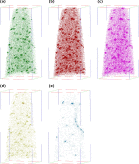
Typical atom maps of P, Cu, Mn, Ni & Si (clockwise from bottom centre) in 65x65x142 nm sample of steel from Styman et al, 2015.

A couple of weeks ago I wrote about the opening plenary talk at the NNL Sci-Tec conference [‘The disrupting benefit of innovation’ on May 23rd, 2018].  One of the innovations discussed at the conference was the applications of atom probe tomography for understanding the mechanisms underpinning material behaviour.  Atom probe tomography produces three-dimensional maps of the location and type of individual atoms in a sample of material.  It is a destructive technique that uses a high energy pulse to induce field evaporation of ions from the tip of a needle-like sample.  A detector senses the position of the ions and their chemical identity is found using a mass spectrometer.  Only small samples can be examined, typically of the order of 100nm.

A group led by Jonathan Hyde at NNL have been exploring the use of atom probe tomography to understand the post-irradiation annealing of weld material in reactor pressure vessels and to examine the formation of bubbles of rare gases in fuel cladding which trap hydrogen causing material embrittlement.  A set of typical three-dimensional maps of atoms is shown in the thumb-nail from a recent paper by the group (follow the link for the original image).

It is amazing that we can map the location of atoms within a material and we are just beginning to appreciate the potential applications of this capability.  As another presenter at the conference said: ‘Big journeys begin with Iittle steps’.

BTW it was rewarding to see one of our alumni from our CPD course [see ‘Leadership is like shepherding’ on May 10th, 2017] presenting this work at the conference.

Source:

Styman PD, Hyde JM, Parfitt D, Wilford K, Burke MG, English CA & Efsing P, Post-irradiation annealing of Ni-Mn-Si-enriched clusters in a neutron-irradiated RPV steel weld using atom probe tomography, J. Nuclear Materials, 459:127-134, 2015.

Third time lucky

At the end of last year my research group had articles published by the Royal Society’s journal  Open Science in two successive months [see ‘Press Release!‘ on November 15th, 2017 and ‘Slow moving nanoparticles‘ on December 13th, 2017].  I was excited about both publications because I had only had one article published before by the Royal Society and because the Royal Society issues a press release whenever it publishes a new piece of science.  However, neither press release generated any interest from anyone; probably because science does not sell newspapers (or attract viewers) unless it is bad news or potentially life-changing.  And our work on residual stress around manufactured holes in aircraft or on the motion of nanoparticles does not match either of these criteria.

Last month, we did it again with an article on ‘An experimental study on the manufacture and characterization of in-plane fibre-waviness defects in composites‘.  Third time lucky, because this time our University press office were interested enough to write a piece for the news page of the University website, entitled ‘Engineers develop new method to recreate fibre waviness defects in lab‘.  Fibre waviness is an issue in the manufacture of structural components of aircraft using carbon fibre reinforced composites because kinks or waves in the fibres can cause structural weaknesses.  As part of his PhD, supported by Airbus and the UK Engineering and Physical Sciences Research Council (EPSRC), Will Christian developed an innovative technique to generate defects in our lab so that we can gain a better understanding of them. Read the article or the press release to find out more!

Image shows fracture through a waviness-defect in the top-ply of a carbon-fibre laminate observed in a microscope following sectioning after failure.

Reference:

Christian WJR, DiazDelaO FA, Atherton K & Patterson EA, An experimental study on the manufacture and characterisation of in-plane fibre-waviness defects in composites, R. Soc. open sci. 5:180082, 2018.