Tag Archives: innovation

Jigsaw puzzling without a picture

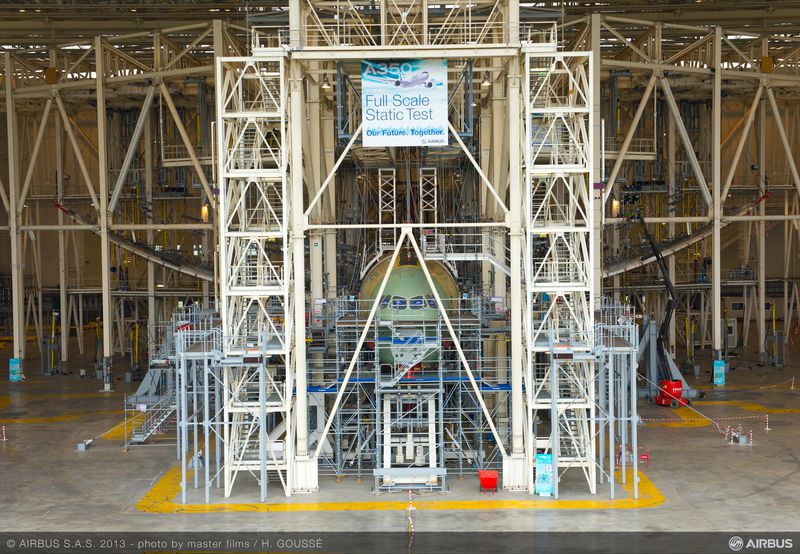
A350 XWB passes Maximum Wing Bending test

A350 XWB passes Maximum Wing Bending test

Research sometimes feels like putting together a jigsaw puzzle without the picture or being sure you have all of the pieces.  The pieces we are trying to fit together at the moment are (i) image decomposition of strain fields [see ‘Recognising strain’ on October 28th 2015] that allows fields containing millions of data values to be represented by a feature vector with only tens of elements which is useful for comparing maps or fields of predictions from a computational model with measurements made in the real-world; (ii) evaluation of the variation in measurement uncertainty over a field of view of measured displacements or strains in a large structure [see ‘Industrial uncertainty’ on December 12th 2018] which provides information about the quality of the measurements; and (iii) a probabilistic validation metric that provides a measure of how well predictions from a computational model represent measurements made in the real world [see ‘Million to one’ on November 21st 2018].  We have found some of the missing pieces of the jigsaw, for example we have established how to represent the distribution of measurement uncertainty in the feature vector domain [see ‘From strain measurements to assessing El Niño events’ on March 17th 2021] so that it can be used to assess the significance of differences between measurements and predictions represented by their feature vectors – this connects (i) and (ii) together.  Very recently we have demonstrated a generic technique for performing image decomposition of irregularly shaped fields of data or data fields with holes [see Christian et al, 2021] which extends the applicability of our method for comparing measurements and predictions to real-world objects rather than idealised shapes.  This allows (i) to be used in industrial applications but we still have to work out how to connect this to the probabilistic metric in (iii) while also incorporating spatially-varying uncertainty.  These techniques can be used in a wide range of applications, as demonstrated in our recent work on El Niño events [see Alexiadis et al, 2021], because, by treating all fields of data as images, the techniques are agnostic about the source and format of the data.  However, at the moment, our main focus is on their application to ground tests on aircraft structures as part of the Smarter Testing project in collaboration with Airbus, Centre for Modelling & Simulation, Dassault Systèmes, GOM UK Ltd, and the National Physical Laboratory with funding from the Aerospace Technology Institute.  Together we are working towards digital continuity across virtual and physical testing of aircraft structures to provide live data fusion and enable condition-led inspections, test control and validation of computational models.  We anticipate these advances will reduce time and costs for physical tests and accelerate the development of new designs of aircraft that will contribute to global sustainability targets (the aerospace industry has committed to reduce CO2 emissions to 50% of 2005 levels by 2050).  The Smarter Testing project has an ambitious goal which reveals that our pieces of the jigsaw puzzle belong to a small section of a much larger one.

For more on the Smarter Testing project see:

https://www.aerospacetestinginternational.com/news/structural-testing/smarter-testing-research-program-to-link-virtual-and-physical-aerospace-testing.html

https://www.aerospacetestinginternational.com/opinion/how-integrating-the-virtual-and-physical-will-make-aerospace-testing-and-certification-smarter.html

References

Alexiadis A, Ferson S, Patterson EA. Transformation of measurement uncertainties into low-dimensional feature vector space. Royal Society open science. 8(3):201086, 2021.

Christian WJ, Dean AD, Dvurecenska K, Middleton CA, Patterson EA. Comparing full-field data from structural components with complicated geometries. Royal Society open science. 8(9):210916, 2021.

Image: http://www.airbus.com/galleries/photo-gallery

Our last DIMES

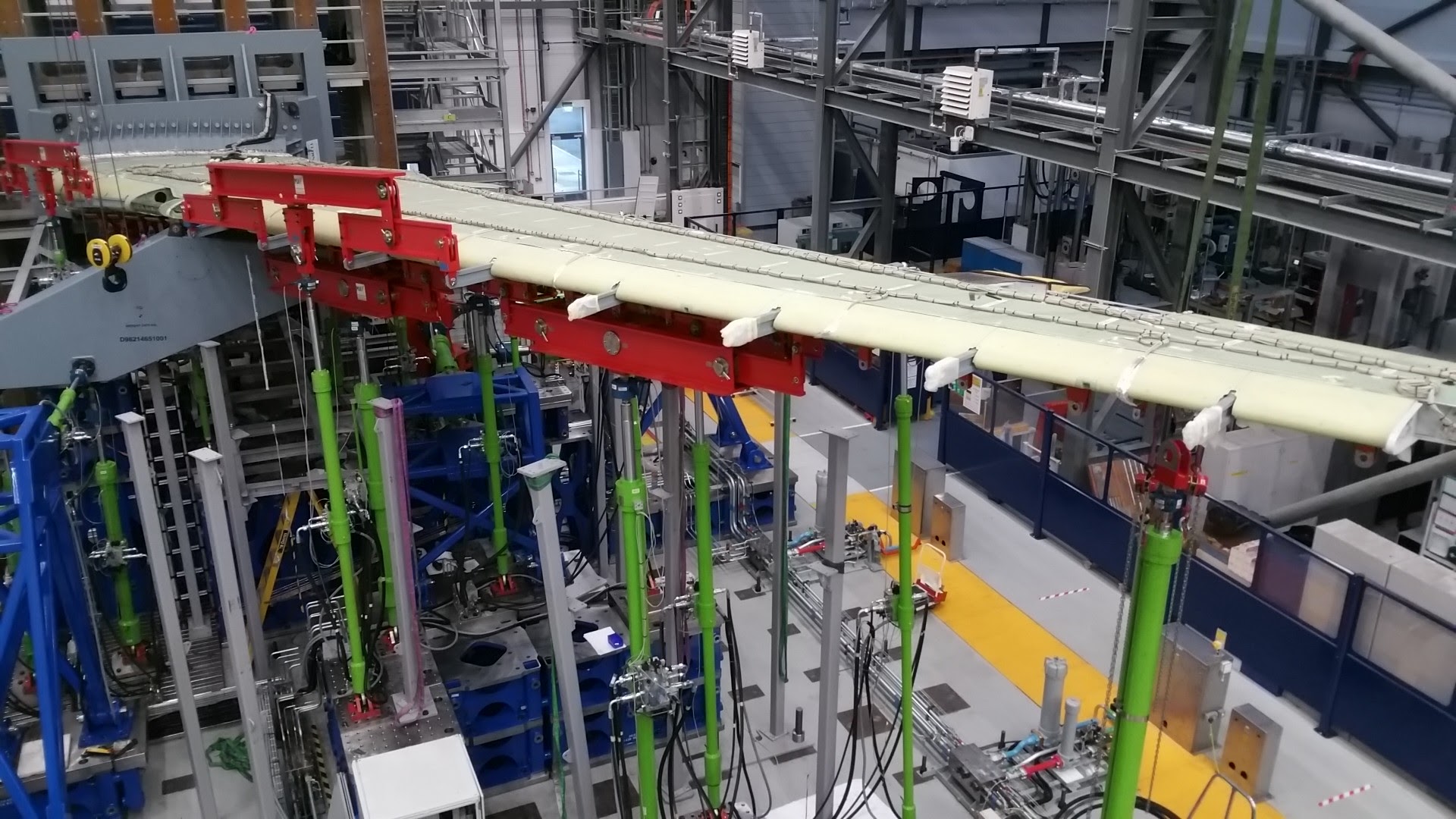
Photograph of wing test in AWICThirty-three months ago (see ‘Finding DIMES‘ on February 6th, 2019) we set off at a gallop ‘to develop and demonstrate an automated measurement system that integrates a range of measurement approaches to enable damage and cracks to be detected and monitored as they originate at multi-material interfaces in an aircraft assembly’. The quotation is taken directly from the aim of the DIMES project which was originally planned and funded as a two-year research programme. Our research, in particular the demonstration element, has been slowed down by the pandemic and we resorted to two no-cost extensions, initially for three months and then for six months to achieve the project aim.   Two weeks ago, we held our final review meeting, and this week we will present our latest results in the third of a series of annual workshops hosted by Airbus, the project’s topic manager.   The DIMES system combines visual and infrared cameras with resistance strain gauges and fibre Bragg gratings to detect 1 mm cracks in metals and damage indications in composites that are only 6 mm in diameter.  We had a concept design by April 2019 (see ‘Joining the dots‘ on July 10th, 2019) and a detailed design by August 2019.  Airbus supplied us with a section of A320 wing, and we built a test-bench at Empa in Zurich in which we installed our prototype measurement system in the last quarter of 2019 (see ‘When seeing nothing is a success‘ on December 11th, 2019).  Then, the pandemic intervened and we did not finish testing until May 2021 by which time, we had also evaluated it for monitoring damage in composite A350 fuselage panels (see ‘Noisy progressive failure of a composite panel‘ on June 30th, 2021).  In parallel, we have installed our ‘DIMES system’ in ground tests on an aircraft wing at Airbus in Filton (see image) and, using a remote installation, in a cockpit at Airbus in Toulouse (see ‘Most valued player performs remote installation‘ on December 2nd, 2020), as well as an aircraft at NRC Aerospace in Ottawa (see ‘An upside to lockdown‘ on April 14th 2021).   Our innovative technology allows condition-led monitoring based on automated damage detection and enables ground tests on aircraft structures to be run 24/7 saving about 3 months on each year-long test.

The University of Liverpool is the coordinator of the DIMES project and the other partners are Empa, Dantec Dynamics GmbH and Strain Solutions Ltd.

The DIMES project has received funding from the Clean Sky 2 Joint Undertaking under the European Union’s Horizon 2020 research and innovation programme under grant agreement No. 820951.

The opinions expressed in this blog post reflect only the author’s view and the Clean Sky 2 Joint Undertaking is not responsible for any use that may be made of the information it contains.

Dressing up your digital twin

My research includes work on developing digital twins [see ‘Digital twins that thrive in the real world‘ on June 9th, 2021] of aircraft, power stations and other engineering systems.  And I am aware of similar work in other disciplines [see ‘Digital twins could put at risk what it means to be human‘ on November 18th, 2020]; but I was surprised to learn about the demand for digital clothing.  Three-dimensional virtual spaces or metaverses exist in computer games, chat rooms and more recently virtual spaces designed for socialising and shopping that are populated by avatars that need to wear something.  So, some fashion brands are producing digital clothing and charging you for the privilege of attiring your avatar with their logo.  In other words, you can buy clothes that don’t exist for people who are not real.  However, DressX has gone a step further producing a ‘digital-only collection’ of clothing for your digital twin or, at the moment, two-dimensional images of real people.  So, now you can buy clothes that don’t exist, superimpose them on pictures of real people, and upload the results to social media.  Perhaps it’s not as crazy as it seems at first because it might alleviate the need for fast fashion to produce single-use real clothes at enormous cost to the environment.  However, dressing up your digital twin does not seem to offer the same level of anticipation and excitement as getting dressed up yourself. (Except in a lockdown? Ed)

Source: Alexander Fury, Virtual fashion: the next frontier?, FT Weekend, 28/29 August 2021.

When you invent the ship, you also invent the shipwreck

I recently came across this quote from Paul Virilio, a French philosopher who lived from 1932 to 2018.  Actually, it is only the first part of a statement he made during an interview with Philippe Petit in 1996.  ‘When you invent the ship, you also invent the shipwreck; when you invent the plane you also invent the plane crash; and when you invent electricity, you invent electrocution. Every technology carries its own negativity, which is invented at the same time as technical progress.’  These events have a catastrophic level of negativity; however, there is a more insidious form of negativity induced by every new technology. It arises as a consequence of the second law of thermodynamics which demands that the entropy of the universe increases in all real processes.  In other words, that the degree of disorder in the universe is increased every time we use technology to do something useful, in fact whenever anything happens the second law ensures some negativity.  This implies that the capacity to do something useful, often measured in terms of energy, is decreased not just by doing the useful thing but also by creating disorder.  Technology helps us to do more useful things more quickly; but the downside is that faster processes tend to create more entropy and disorder.  Most of this negativity is not as obvious as a shipwreck or plane crash but instead often takes the form of pollution that eventually and inexorably disrupts the world making it a less hospitable home for us and the rest of nature.  The forthcoming COP26 conference is generating much talk about the need for climate action but very little about the reality that we cannot avoid the demands of the second law and hence need to rethink how, when and what technology we use.

Sources:

Elaine Moore, When Big Dating leaves you standing, FT Weekend, July 8th, 2021.

Paul Virilio, and Petit Philippe. Politics of the Very Worst, New York: Semiotext(e), 1999, p. 89 (available from https://mitpress.mit.edu/books/politics-very-worst).