Tag Archives: innovation

Our last DIMES

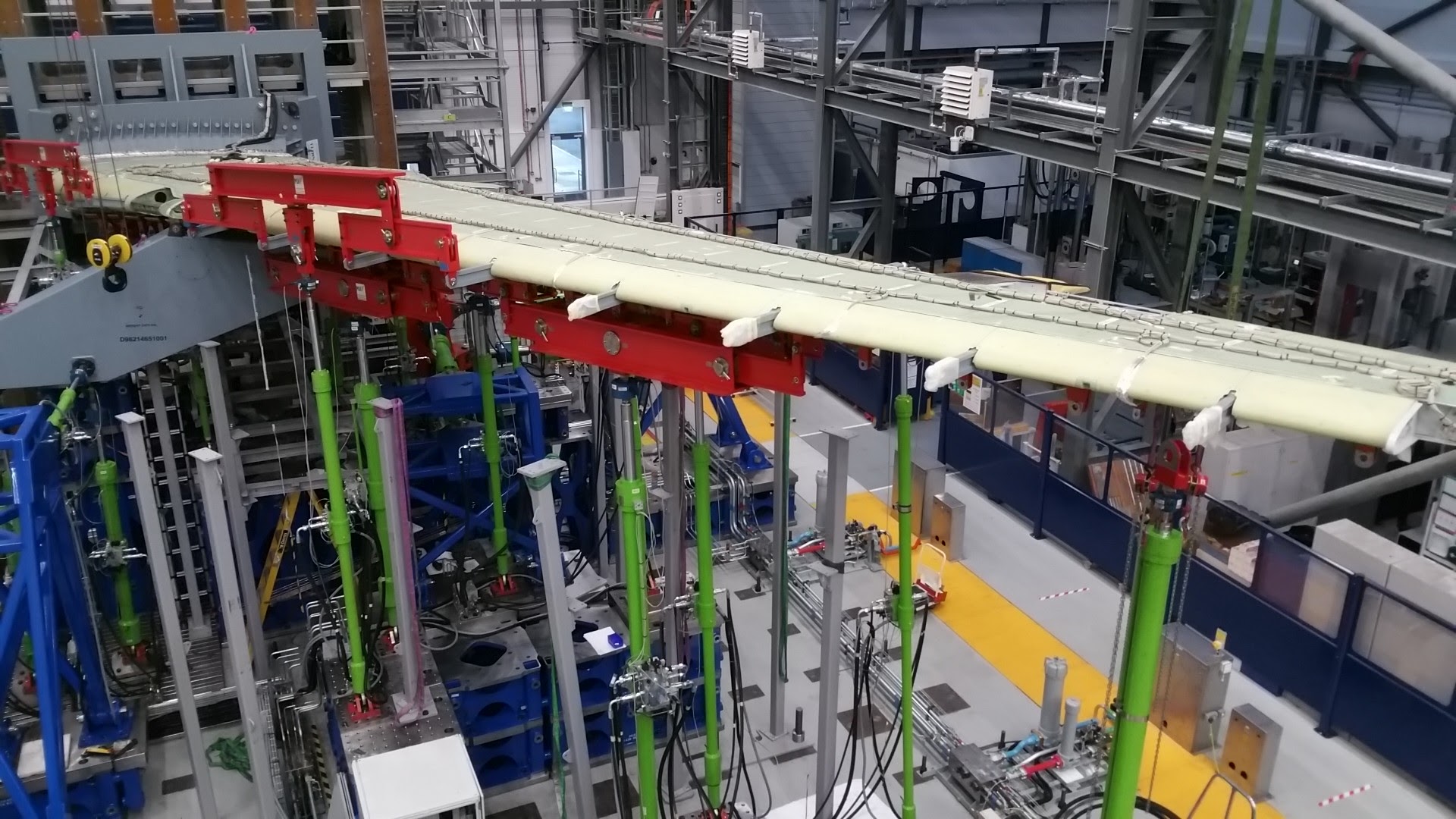
Photograph of wing test in AWICThirty-three months ago (see ‘Finding DIMES‘ on February 6th, 2019) we set off at a gallop ‘to develop and demonstrate an automated measurement system that integrates a range of measurement approaches to enable damage and cracks to be detected and monitored as they originate at multi-material interfaces in an aircraft assembly’. The quotation is taken directly from the aim of the DIMES project which was originally planned and funded as a two-year research programme. Our research, in particular the demonstration element, has been slowed down by the pandemic and we resorted to two no-cost extensions, initially for three months and then for six months to achieve the project aim.   Two weeks ago, we held our final review meeting, and this week we will present our latest results in the third of a series of annual workshops hosted by Airbus, the project’s topic manager.   The DIMES system combines visual and infrared cameras with resistance strain gauges and fibre Bragg gratings to detect 1 mm cracks in metals and damage indications in composites that are only 6 mm in diameter.  We had a concept design by April 2019 (see ‘Joining the dots‘ on July 10th, 2019) and a detailed design by August 2019.  Airbus supplied us with a section of A320 wing, and we built a test-bench at Empa in Zurich in which we installed our prototype measurement system in the last quarter of 2019 (see ‘When seeing nothing is a success‘ on December 11th, 2019).  Then, the pandemic intervened and we did not finish testing until May 2021 by which time, we had also evaluated it for monitoring damage in composite A350 fuselage panels (see ‘Noisy progressive failure of a composite panel‘ on June 30th, 2021).  In parallel, we have installed our ‘DIMES system’ in ground tests on an aircraft wing at Airbus in Filton (see image) and, using a remote installation, in a cockpit at Airbus in Toulouse (see ‘Most valued player performs remote installation‘ on December 2nd, 2020), as well as an aircraft at NRC Aerospace in Ottawa (see ‘An upside to lockdown‘ on April 14th 2021).   Our innovative technology allows condition-led monitoring based on automated damage detection and enables ground tests on aircraft structures to be run 24/7 saving about 3 months on each year-long test.

The University of Liverpool is the coordinator of the DIMES project and the other partners are Empa, Dantec Dynamics GmbH and Strain Solutions Ltd.

The DIMES project has received funding from the Clean Sky 2 Joint Undertaking under the European Union’s Horizon 2020 research and innovation programme under grant agreement No. 820951.

The opinions expressed in this blog post reflect only the author’s view and the Clean Sky 2 Joint Undertaking is not responsible for any use that may be made of the information it contains.

Dressing up your digital twin

My research includes work on developing digital twins [see ‘Digital twins that thrive in the real world‘ on June 9th, 2021] of aircraft, power stations and other engineering systems.  And I am aware of similar work in other disciplines [see ‘Digital twins could put at risk what it means to be human‘ on November 18th, 2020]; but I was surprised to learn about the demand for digital clothing.  Three-dimensional virtual spaces or metaverses exist in computer games, chat rooms and more recently virtual spaces designed for socialising and shopping that are populated by avatars that need to wear something.  So, some fashion brands are producing digital clothing and charging you for the privilege of attiring your avatar with their logo.  In other words, you can buy clothes that don’t exist for people who are not real.  However, DressX has gone a step further producing a ‘digital-only collection’ of clothing for your digital twin or, at the moment, two-dimensional images of real people.  So, now you can buy clothes that don’t exist, superimpose them on pictures of real people, and upload the results to social media.  Perhaps it’s not as crazy as it seems at first because it might alleviate the need for fast fashion to produce single-use real clothes at enormous cost to the environment.  However, dressing up your digital twin does not seem to offer the same level of anticipation and excitement as getting dressed up yourself. (Except in a lockdown? Ed)

Source: Alexander Fury, Virtual fashion: the next frontier?, FT Weekend, 28/29 August 2021.

When you invent the ship, you also invent the shipwreck

I recently came across this quote from Paul Virilio, a French philosopher who lived from 1932 to 2018.  Actually, it is only the first part of a statement he made during an interview with Philippe Petit in 1996.  ‘When you invent the ship, you also invent the shipwreck; when you invent the plane you also invent the plane crash; and when you invent electricity, you invent electrocution. Every technology carries its own negativity, which is invented at the same time as technical progress.’  These events have a catastrophic level of negativity; however, there is a more insidious form of negativity induced by every new technology. It arises as a consequence of the second law of thermodynamics which demands that the entropy of the universe increases in all real processes.  In other words, that the degree of disorder in the universe is increased every time we use technology to do something useful, in fact whenever anything happens the second law ensures some negativity.  This implies that the capacity to do something useful, often measured in terms of energy, is decreased not just by doing the useful thing but also by creating disorder.  Technology helps us to do more useful things more quickly; but the downside is that faster processes tend to create more entropy and disorder.  Most of this negativity is not as obvious as a shipwreck or plane crash but instead often takes the form of pollution that eventually and inexorably disrupts the world making it a less hospitable home for us and the rest of nature.  The forthcoming COP26 conference is generating much talk about the need for climate action but very little about the reality that we cannot avoid the demands of the second law and hence need to rethink how, when and what technology we use.

Sources:

Elaine Moore, When Big Dating leaves you standing, FT Weekend, July 8th, 2021.

Paul Virilio, and Petit Philippe. Politics of the Very Worst, New York: Semiotext(e), 1999, p. 89 (available from https://mitpress.mit.edu/books/politics-very-worst).

Digital twins that thrive in the real-world

Decorative image

Windows of the Soul II [3D video art installation: http://www.haigallery.com/sonia-falcone/%5D

Digital twins are becoming ubiquitous in many areas of engineering [see ‘Can you trust your digital twin?‘ on November 23rd, 2016].  Although at the same time, the terminology is becoming blurred as digital shadows and digital models are treated as if they are synonymous with digital twins.  A digital model is a digitised replica of physical entity which lacks any automatic data exchange between the entity and its replica.  A digital shadow is the digital representation of a physical object with a one-way flow of information from the object to its representation.  But a digital twin is a functional representation with a live feedback loop to its counterpart in the real-world.  The feedback loop is based on a continuous update to the digital twin about the condition and performance of the physical entity based on data from sensors and on analysis from the digital twin about the performance of the physical entity.  This enables a digital twin to provide a service to many stakeholders.  For example, the users of a digital twin of an aircraft engine could include the manufacturer, the operator, the maintenance providers and the insurers.  These capabilities imply digital twins are themselves becoming products which exist in a digital context that might connect many digital products thus forming an integrated digital environment.  I wrote about integrated digital environments when they were a concept and the primary challenges were technical in nature [see ‘Enabling or disruptive technology for nuclear engineering?‘ on January 28th, 2015].  Many of these technical challenges have been resolved and the next set of challenges are economic and commercial ones associated with launching digital twins into global markets that lack adequate understanding, legislation, security, regulation or governance for digital products.  In collaboration with my colleagues at the Virtual Engineering Centre, we have recently published a white paper, entitled ‘Transforming digital twins into digital products that thrive in the real world‘ that reviews these issues and identifies the need to establish digital contexts that embrace the social, economic and technical requirements for the appropriate use of digital twins [see ‘Digital twins could put at risk what it means to be human‘ on November 18th, 2020].