Tag Archives: design

More than human

Decorative imageIn his recent book, ‘The Place of Tides’, James Rebanks writes ‘the age of humans will pass.  Perhaps the end has already begun though it may take a long time to play out’.  I grew up when nuclear armageddon appeared to be the major threat to the future of life on Earth and it remains a major threat, especially given current tensions between nations.  However, other threats have gained prominence including both a massive asteroid impact, on the scale of the one that caused the extinction of the dinosaurs 66 million years ago, and climate change, which caused the largest mass extinction, killing 95% of all species, about 252 million years ago.  The current extinction rate is between 100 and 1000 times greater than the natural rate and is being driven by the overexploitation of the Earth’s resources by humans leading to habitat destruction and climate change.  Humans are part of a complex ecosystem, or system of systems, including soil systems with interactions between microorganisms, plants and decaying matter; pollination systems characterised by co-dependence between plants and pollinators; and, aquatic systems connecting rivers, lakes and oceans by the movement of water, nutrients and migratory species.  The overexploitation of these systems to support our 21st century lifestyle is starting to cause systemic failures that are the underlying cause of the increasing rate of species extinction and it is difficult, if not impossible, to predict when it will be our turn.  In his 1936 book, ‘Where Life is Better: An Unsentimental American Journey’, James Rorty observes that the most dangerous fact he has come across is ‘the overwhelming fact of our lazy, irresponsible, adolescent inability to face the truth or tell it’.  Not much has changed in nearly one hundred years, except that the global population has increased fourfold from about 2.2 billion to 8.2 billion with a corresponding increase in the exploitation of the Earth for energy, food and satisfying our materialistic desires.  A recent exhibition at the Design Museum in London, encouraged us to think beyond human-centred design and to consider the impact of our designs on all the species on the planet.  A process sometimes known as life-centred design or interspecies design.  What if designs could help other species to flourish, as well as humans?

References:

Rebanks, James, The place of tides, London: Penguin, 2025.

Rorty, James, Where life is better: an unsentimental journey.  New York, Reynal & Hitchcock, 1936.  (I have not read this book but it was quoted by Joanna Pocock in ‘Greyhound’, Glasgow: Fitzcarraldo Editions, HarperCollins Publishers, 2025, which I have read and enjoyed).

Image: Photograph of Pei yono uhutipo (Spirit of the path) by Sheraonawe Hakihiiwe, a member of the Yanomami Indigenous community who live in the Venezuelan and Brazilian Amazon. One of a series of his paintings in the ‘More than Human‘ exhibition at the Design Museum which form part of an archive of Yanomami knowledge that reflects the abundance of life in the forest.
Happy New Year!

Decorative photograph of sculpture of a skeletal person leading a skeletal dinosaurThis year I have written about 20,000 words in 52 posts (including this one); and, since this is the last post of the year, I thought I would take a brief look back at what has preoccupied me in 2021.  Perhaps, not surprisingly the impact of the coronavirus on our lifestyle has featured regularly – almost every week for a month between mid-March and mid-April when we were in lockdown in the UK.  However, the other topics that I have written about frequently are my research on the dynamics of nanoparticles and, in the last six months, on dealing with uncertainty in digital engineering and decision making.  I have also returned several times to innovation processes and transitioning lab-based research into industry.  While following the COP26 in early November, I wrote a series of three posts focussed on energy consumption and the paradigm shifts required to slow down climate change.  There are some connections between these topics: viruses are nanoparticles whose transport and dynamics we do not fully understand; and, digital engineering tools are being used to explore zero-carbon approaches to, for example, energy generation and air transport.  The level of complexity, innovation and urgency associated with developing solutions to these challenges mean that there are always some unknowns and uncertainty when making associated decisions.

The links below are grouped by the topics mentioned above.  I expect there will be more on all of these topics in 2022; however, the topic of next week’s post is unknown because I have not written any posts in advance.  I hope that the uncertainty about the topic of the next post will keep you reading in 2022! 

Coronavirus pandemic: ‘Distancing ourselves from each other‘ on January 13th, 2021; ‘On the impact of writing on well-being‘ on March 3rd, 2021; ‘Collegiality as a defence against pandemic burnout‘ on March 24th, 2021; ‘It’s tiring looking at yourself‘ on March 31st, 2021; ‘Switching off and walking in circles‘ on April 7th, 2021; ‘An upside to lockdown‘ on April 14th, 2021; ‘A brief respite in a long campaign to overcome coronavirus‘ on June 23rd, 2021; and ‘It is hard to remain positive‘ November 3rd 2021.

Energy and climate change: ‘When you invent the ship, you invent the shipwreck‘ on August 25th, 2021; ‘It is hard to remain positive‘ November 3rd 2021; ‘Where we are and what we have‘ on November 24th, 2021; ‘Disruptive change required to avoid existential threats‘ on December 1st, 2021; and ‘Bringing an end to thermodynamic whoopee‘ on December 8th, 2021.

Innovation processes: ‘Slowly crossing the valley of death‘ on January 27th, 2021; ‘Out of the valley of death into a hype cycle?‘ on February 24th, 2021; ‘Innovative design too far ahead of the market?‘ on May 5th, 2021 and ‘Jigsaw puzzling without a picture‘ on October 27th, 2021.

Nanoparticles: ‘Going against the flow‘ on February 3rd, 2021; ‘Seeing things with nanoparticles‘ on March 10th, 2021; and ‘Nano biomechanical engineering of agent delivery to cells‘ on December 15th, 2021.

Uncertainty: ‘Certainty is unattainable and near-certainty is unaffordable‘ on May 12th, 2021; ‘Neat earth objects make tomorrow a little less than certain‘ on May 26th, 2021; ‘Negative capability and optimal ambiguity‘ on July 7th, 2021; ‘Deep uncertainty and meta ignorance‘ on July 21st, 2021; ‘Somethings will always be unknown‘ on August 18th, 2021; ‘Jigsaw puzzling without a picture‘ on October 27th, 2021; and, ‘Do you know RIO?‘ on November 17th, 2021.

Our last DIMES

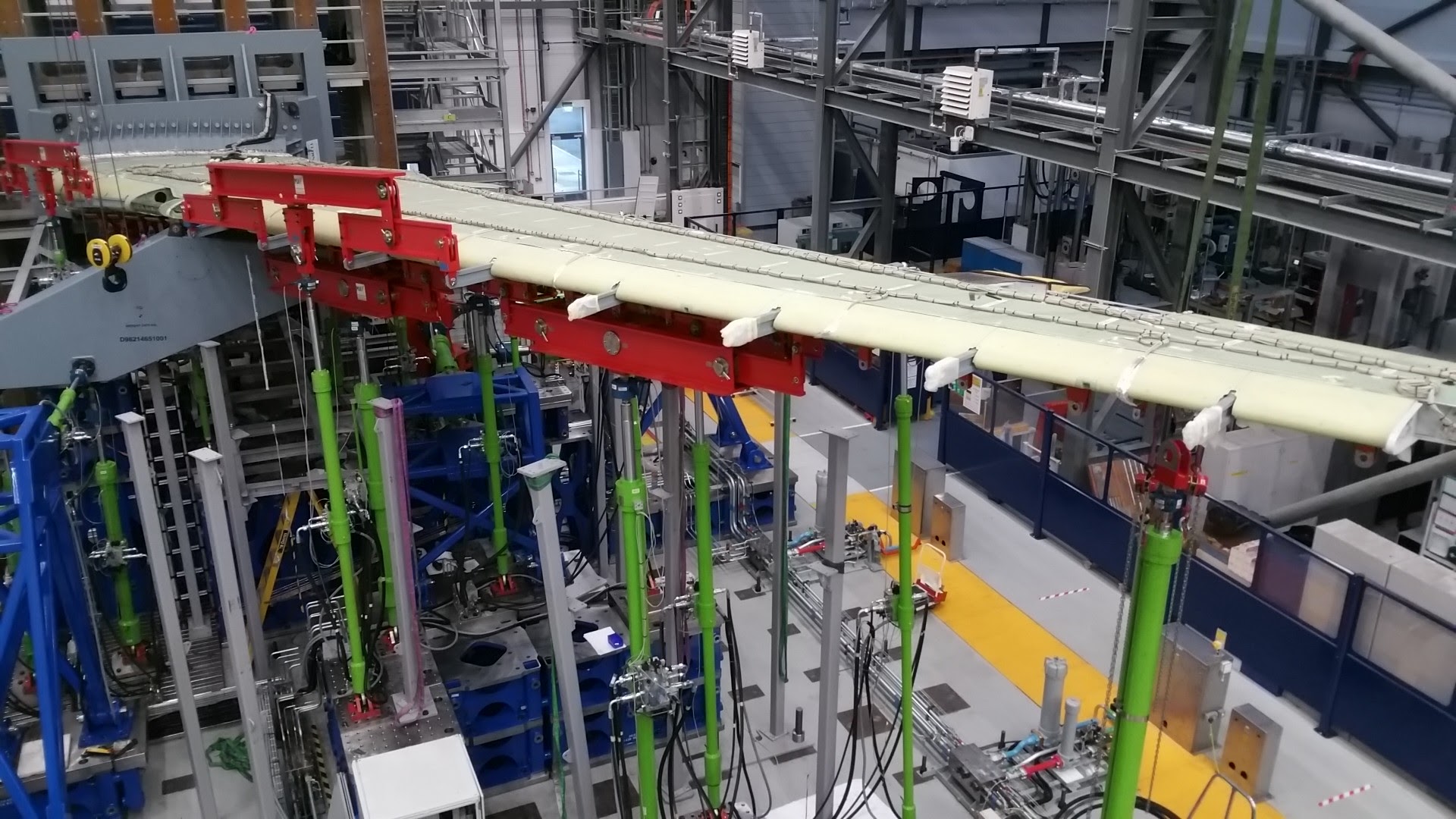
Photograph of wing test in AWICThirty-three months ago (see ‘Finding DIMES‘ on February 6th, 2019) we set off at a gallop ‘to develop and demonstrate an automated measurement system that integrates a range of measurement approaches to enable damage and cracks to be detected and monitored as they originate at multi-material interfaces in an aircraft assembly’. The quotation is taken directly from the aim of the DIMES project which was originally planned and funded as a two-year research programme. Our research, in particular the demonstration element, has been slowed down by the pandemic and we resorted to two no-cost extensions, initially for three months and then for six months to achieve the project aim.   Two weeks ago, we held our final review meeting, and this week we will present our latest results in the third of a series of annual workshops hosted by Airbus, the project’s topic manager.   The DIMES system combines visual and infrared cameras with resistance strain gauges and fibre Bragg gratings to detect 1 mm cracks in metals and damage indications in composites that are only 6 mm in diameter.  We had a concept design by April 2019 (see ‘Joining the dots‘ on July 10th, 2019) and a detailed design by August 2019.  Airbus supplied us with a section of A320 wing, and we built a test-bench at Empa in Zurich in which we installed our prototype measurement system in the last quarter of 2019 (see ‘When seeing nothing is a success‘ on December 11th, 2019).  Then, the pandemic intervened and we did not finish testing until May 2021 by which time, we had also evaluated it for monitoring damage in composite A350 fuselage panels (see ‘Noisy progressive failure of a composite panel‘ on June 30th, 2021).  In parallel, we have installed our ‘DIMES system’ in ground tests on an aircraft wing at Airbus in Filton (see image) and, using a remote installation, in a cockpit at Airbus in Toulouse (see ‘Most valued player performs remote installation‘ on December 2nd, 2020), as well as an aircraft at NRC Aerospace in Ottawa (see ‘An upside to lockdown‘ on April 14th 2021).   Our innovative technology allows condition-led monitoring based on automated damage detection and enables ground tests on aircraft structures to be run 24/7 saving about 3 months on each year-long test.

The University of Liverpool is the coordinator of the DIMES project and the other partners are Empa, Dantec Dynamics GmbH and Strain Solutions Ltd.

The DIMES project has received funding from the Clean Sky 2 Joint Undertaking under the European Union’s Horizon 2020 research and innovation programme under grant agreement No. 820951.

The opinions expressed in this blog post reflect only the author’s view and the Clean Sky 2 Joint Undertaking is not responsible for any use that may be made of the information it contains.

Digital twins that thrive in the real-world

Decorative image

Windows of the Soul II [3D video art installation: http://www.haigallery.com/sonia-falcone/%5D

Digital twins are becoming ubiquitous in many areas of engineering [see ‘Can you trust your digital twin?‘ on November 23rd, 2016].  Although at the same time, the terminology is becoming blurred as digital shadows and digital models are treated as if they are synonymous with digital twins.  A digital model is a digitised replica of physical entity which lacks any automatic data exchange between the entity and its replica.  A digital shadow is the digital representation of a physical object with a one-way flow of information from the object to its representation.  But a digital twin is a functional representation with a live feedback loop to its counterpart in the real-world.  The feedback loop is based on a continuous update to the digital twin about the condition and performance of the physical entity based on data from sensors and on analysis from the digital twin about the performance of the physical entity.  This enables a digital twin to provide a service to many stakeholders.  For example, the users of a digital twin of an aircraft engine could include the manufacturer, the operator, the maintenance providers and the insurers.  These capabilities imply digital twins are themselves becoming products which exist in a digital context that might connect many digital products thus forming an integrated digital environment.  I wrote about integrated digital environments when they were a concept and the primary challenges were technical in nature [see ‘Enabling or disruptive technology for nuclear engineering?‘ on January 28th, 2015].  Many of these technical challenges have been resolved and the next set of challenges are economic and commercial ones associated with launching digital twins into global markets that lack adequate understanding, legislation, security, regulation or governance for digital products.  In collaboration with my colleagues at the Virtual Engineering Centre, we have recently published a white paper, entitled ‘Transforming digital twins into digital products that thrive in the real world‘ that reviews these issues and identifies the need to establish digital contexts that embrace the social, economic and technical requirements for the appropriate use of digital twins [see ‘Digital twins could put at risk what it means to be human‘ on November 18th, 2020].