Finding DIMES

A couple of weeks ago I wrote about the ‘INSTRUCTIVE final reckoning’ (see post on January 9th).  INSTRUCTIVE was an EU project, which ended on December 31st, 2018  in which we demonstrated that infra-red cameras could be used to monitor the initiation and propagation of cracks in aircraft structures (see Middleton et al, 2019).  Now, we have seamlessly moved on to a new EU project, called DIMES (Development of Integrated MEasurement Systems), which started on January 1st, 2019.  To quote our EU documentation, the overall aim of DIMES is ‘to develop and demonstrate an automated measurement system that integrates a range of measurement approaches to enable damage and cracks to be detected and monitored as they originate at multi-material interfaces in an aircraft assembly’.  In simpler terms, we are going to take the results from the INSTRUCTIVE project, integrate them with other existing technologies for monitoring the structural health of an aircraft, and produce a system that can be installed in an aircraft fuselage and will provide early warning on the formation of cracks.  We have two years to achieve this target and demonstrate the system in a ground-based test on a real fuselage at an Airbus facility.  This was a scary prospect until we had our kick-off meeting and a follow-up brainstorming session a couple of weeks ago.  Now, it’s a little less scary.  If I have scared you with the prospect of cracks in aircraft, then do not be alarmed; we have been flying aircraft with cracks in them for years.  It is impossible to build an aircraft without cracks appearing, possibly during manufacturing and certainly in service – perfection (i.e. cracklessness) is unattainable and instead the stresses are maintained low enough to ensure undetected cracks will not grow (see ‘Alan Arnold Griffith’ on April 26th, 2017) and that detected ones are repaired before they propagate significantly (see ‘Aircraft inspection’ on October 10th, 2018).

I should explain that the ‘we’ above is the University of Liverpool and Strain Solutions Limited, who were the partners in INSTRUCTIVE, plus EMPA, the Swiss National Materials Laboratory, and Dantec Dynamics GmbH, a producer of scientific instruments in Ulm, Germany.  I am already working with these latter two organisations in the EU project MOTIVATE; so, we are a close-knit team who know and trust each other  – that’s one of the keys to successful collaborations tackling ambitious challenges with game-changing outcomes.

So how might the outcomes of DIMES be game-changing?  Well, at the moment, aircraft are designed using computer models that are comprehensively validated using measurement data from a large number of expensive experiments.  The MOTIVATE project is about reducing the number of experiments and increasing the quality and quantity of information gained from each experiment, i.e. ‘Getting Smarter’ (see post on June 21st 2017).  However, if the measurement system developed in DIMES allowed us to monitor in-flight strain fields in critical locations on-board an aircraft, then we would have high quality data to support future design work, which would allow further reductions in the campaign of experiments required to support new designs; and we would have continuous comprehensive monitoring of the structural integrity of every aircraft in the fleet, which would allow more efficient planning of maintenance as well as increased safety margins, or reductions in structural weight while maintaining safety margins.  This would be a significant step towards digital twins of aircraft (see ‘Fourth industrial revolution’ on July 4th, 2018 and ‘Can you trust your digital twin?’ on November 23rd, 2016).

The INSTRUCTIVE, MOTIVATE and DIMES projects have received funding from the Clean Sky 2 Joint Undertaking under the European Union’s Horizon 2020 research and innovation programme under grant agreements No. 685777, No. 754660 and No. 820951 respectively.

The opinions expressed in this blog post reflect only the author’s view and the Clean Sky 2 Joint Undertaking is not responsible for any use that may be made of the information it contains.

Sources:

Middleton CA, Gaio A, Greene RJ & Patterson EA, Towards automated tracking of initiation and propagation of cracks in Aluminium alloy coupons using thermoelastic stress analysis, J. Non-destructive Testing, 38:18, 2019


Time at the heart of our problems

This week I started teaching thermodynamics to first year undergraduate students for the first time in twelve months.  I have had a break for a year because my course, which is only delivered once per year, was moved from first to second semester.  Although I have continued to teach postgraduate courses, it’s been like a sabbatical enforced by timetable changes.  Sadly, it’s over and I am back in the large lecture theatre in front of a couple of hundred of students – that makes it sound as if I don’t enjoy it which is not true but it does increase the intensity of the job because all of the other aspects of the role continue unabated.  So, for me time appears to accelerate as I attempt to jam more activities into a week.

Time lies at the heart of much of thermodynamics although we tend not to deal with it explicitly; however, it is implicit in our use of changes in the state of a system to understand it.  Quote Anaximander, the pre-Socratic philosopher & pupil of Thales of Miletus: ‘We understand the world by studying change, not by studying things’.  Time also lies at the centre of the tangle of problems found at the intersection of the theories of gravity, quantum mechanics and thermodynamics.  As Carlo Rovelli has remarked we are still in the dark about this tangle of problems; so, I will touch on it in my thermodynamics course but just to show students the limits of our knowledge and perhaps inspire one or two of them to think about tackling them in postgraduate studies.

Meanwhile, I plan tackle my challenges with time by slowing it down once a week with a walk in the Clwydian Hills where the landscape appears unchanging so that time stands still allowing me to relax.

Sources:

Rovelli C, Seven brief lessons on physics, London, Penguin Books. 2016.

Wohllerben P, The hidden life of trees, London, William Collins, 2017.

Nuclear winter school

I spent the first full-week of January 2019 at a Winter School for a pair of Centres for Doctoral Training focussed on Nuclear Energy (see NGN CDT & ICO CDT).  Together the two centres involve eight UK universities and most of the key players in the UK industry.  So, the Winter School offers an opportunity for researchers in nuclear science and engineering, from academia and industry, to gather together for a week and share their knowledge and experience with more than 80 PhD students.  Each student gives a report on the progress of their research to the whole gathering as either a short oral presentation or a poster.  It’s an exhausting but stimulating week for everyone due to both the packed programmme and the range of subjects covered from fundamental science through to large-scale engineering and socio-economic issues.

Here are a few things that caught my eye:

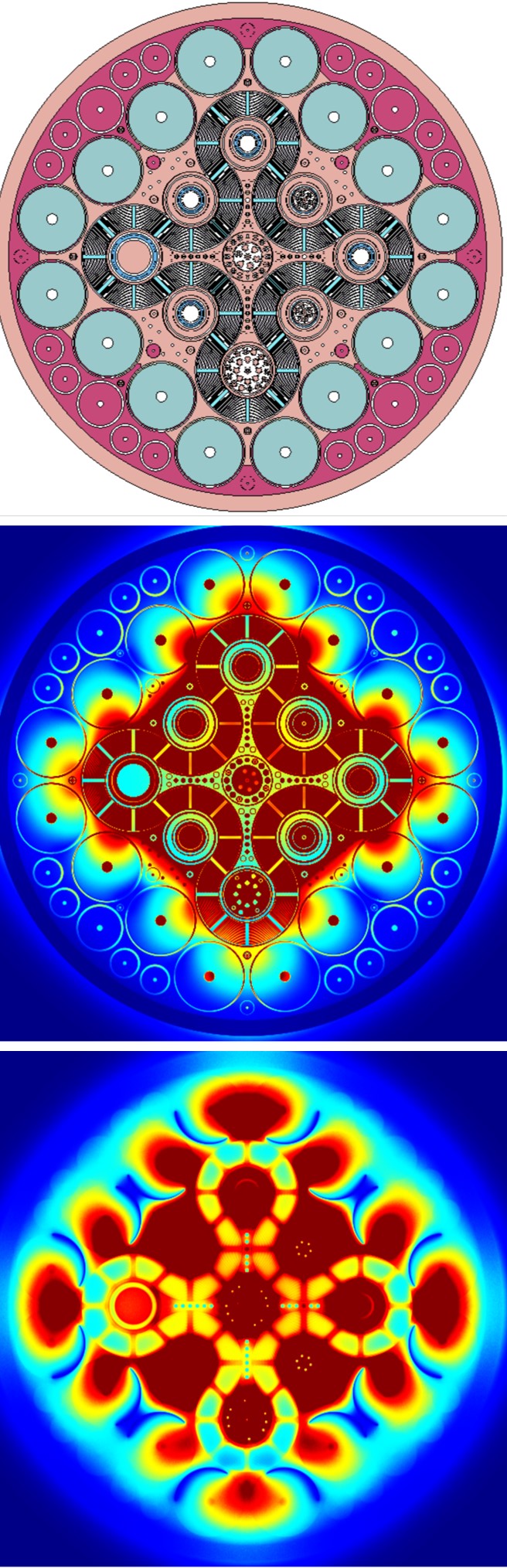
First, the images in the thumbnail above which Paul Cosgrove from the University of Cambridge used to introduce his talk on modelling thermal and neutron fluxes.  They could be from an art gallery but actually they are from the VTT Technical Research Centre of Finland and show the geometry of an advanced test reactor [ATR] (top); the rate of collisions in the ATR (middle); and the neutron density distribution (bottom).

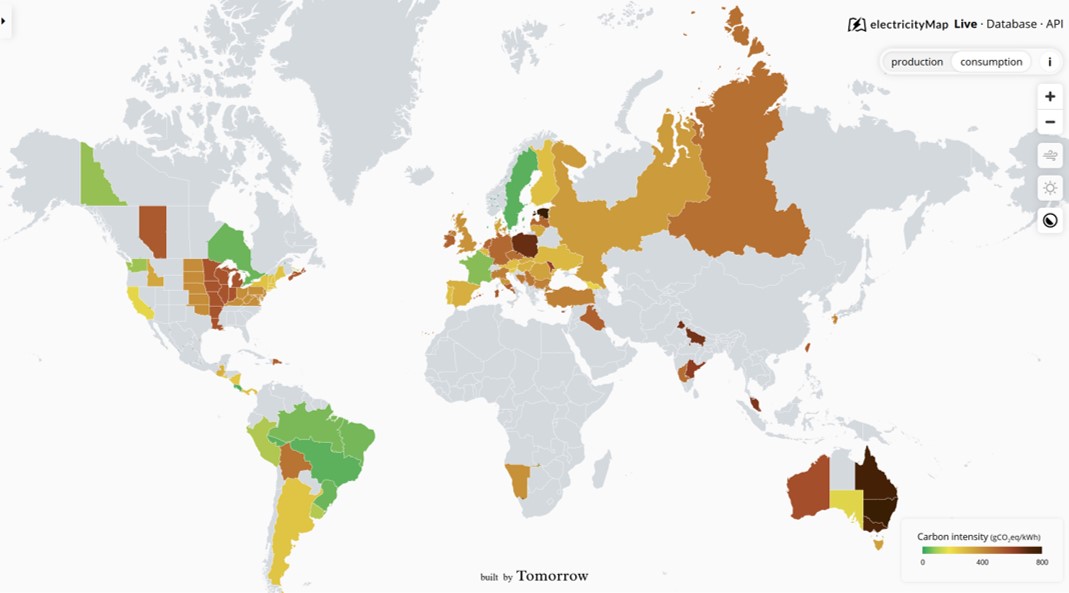
Second, a great app for your phone called electricityMap that shows you a live map of global carbon emissions and when you click on a country it reveals the sources of electricity by type, i.e. nuclear, gas, wind etc, as well as imports and exports of electricity.  Dame Sue Ion told us about it during her key-note lecture.  I think all politicians and journalists need it installed on their phones to check their facts before they start talking about energy policy.

Third, the scale of the concrete infrastructure required in current designs of nuclear power stations compared to the reactor vessel where the energy is generated.  The pictures show the construction site for the Vogtle nuclear power station in Georgia, USA (left) and the reactor pressure vessel being lowered into position (right).  The scale of nuclear power stations was one of the reasons highlighted by Steve Smith from Algometrics for why investors are not showing much interest in them (see ‘Small is beautiful and affordable in nuclear power-stations‘ on January 14th, 2015).  Amongst the other reasons are: too expensive (about £25 billion), too long to build (often decades), too back-end loaded (i.e. no revenue until complete), too complicated (legally, economically & socially), too uncertain politically, too toxic due to poor track record of returns to investors, too opaque in terms of management of industry.  That’s quite a few challenges for the next generation of nuclear scientists and engineers to tackle.  We are making a start by creating design tools that will enable mass-production of nuclear power stations (see ‘Enabling or disruptive technology for nuclear engineering?‘ on January 28th, 2015) following the processes used to produce other massive engineering structures, such as the Airbus A380 (see Integrated Digital Nuclear Design Programme); but the nuclear industry has to move fast to catch up with other sectors of the energy business, such as gas-fired powerstations or wind turbines.  If it were to succeed then the energy market would be massively transformed.


Intelligent aliens?

A couple of weeks ago I wrote about cuttlefish [see ‘Wearing your heart on your sleeve‘ on January 16th, 2019]  based on a wonderful book, that I was given for Christmas, called ‘Other Minds: The Octopus and the Evolution of Intelligent Life‘ by Peter Godfrey-Smith.  Cuttlefish and octopuses are cephalopods that Peter Godfrey-Smith describes as ‘an island of mental complexity in the sea of invertebrate animals’.  The most recent common ancestor of cephalopods and humans is so distant and was so simple that cephalopods represent an independent experiment in the evolution of large brains and complex behaviour.  An octopus has about 500 million neurons, which is not as many as humans, we have about 100 billion; but still a large number and connectivity is probably more important than absolute size [see ‘Digital hive mind‘ on November 30th, 2016].  Whereas we have a central nervous system, an octopus has a distributed system with neurons located in its arms which appears to give each arm a high-level of autonomy.  In addition to tactile sensory information from its suckers, each arm receives visual information from its skin which is sensitive to light.  The extent to which information and control is shared between the neurons in the brain and the network of neurons in its body is unknown.  It is difficult for us to imagine our fingers as being able to respond independently to visual as well as tactile stimuli, even more so to think of them as independent problem-solvers.  Peter Godfrey-Smith suggests that cephalopods are the closest that we are likely to come to meeting intelligent aliens – their thought processes and capabilities appear so different to ours that our scientific studies and experiments are unlikely to fully reveal their intelligence or level of consciousness.  A first step would be to stop eating them!

Peter Godfrey-Smith, Other Minds: The Octopus and the Evolution of Intelligent Life, London: William Collins, 2018.