Category Archives: Soapbox

What a waste

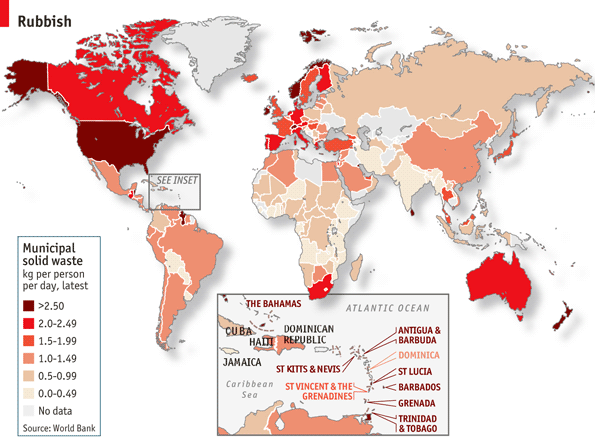
20120609_wom915Einstein’s famous equation, E=mc², does not influence everyday interactions of energy, E and mass, m.  The speed of light, c is 299 792 458 m/s which is very big number and implies a huge amount of energy is required to create a small amount of mass.  This means that energy and mass are independently conserved.  For energy, this is the first law of thermodynamics while the law of conservation of mass is usually attributed to Antoine Lavoisier.  On a planetary scale, the conservation of mass implies that we can assume that the quantity of matter is constant.  Can we apply the second law of thermodynamics to matter as well as energy?  One interpretaton of the second law is that Gibbs energy, or the energy available to do useful work, must decrease in all real processes.   This also applies when matter moves through our economic system.  For instance, we must do work to convert mineral ores into useful products which gradually degrade through use and natural processes, such as corrosion, until they become scrap and we must expend more resources to recycle them and make them useful again.  The sun provides us with a steady supply of useful energy, so that in energy terms planet Earth can be considered an open system with energy flows in and out.  Conversely in mass terms, planet Earth is effectively a closed system with negligible mass flow in or out, so that we do not have a steady supply of new matter from which to manufacture goods.  However, most of us behave with open-world mindset and throw away matter (goods) that are no longer useful to us when we should be repairing and recycling [see my post entitled ‘Old is beautiful‘ on May 1st 2013].  Maybe we can’t reach the zero-waste status aimed at by people like Bea Johnson, but most of us could do better than the 2.2 kg of solid waste produced each day by each of us in OECD countries. That’s 2.1 tonnes per year for an average OECD household (2.63 people)!

Sources:

The New Sustainable Frontier – principles of sustainable development, GSA Office of Governmentwide Policy, September 2009.

Daniel Hoornweq & Perinaz Bhada-Tata, What a Waste: A Global Review of Solid Waste Management, World Bank No.15, 2012.

http://www.economist.com/blogs/graphicdetail/2012/06/daily-chart-3

Models as fables

moel arthurIn his book, ‘Economic Rules – Why economics works, when it fails and how to tell the difference‘, Dani Rodrik describes models as fables – short stories that revolve around a few principal characters who live in an unnamed generic place and whose behaviour and interaction produce an outcome that serves as a lesson of sorts.  This seems to me to be a healthy perspective compared to the almost slavish belief in computational models that is common today in many quarters.  However, in engineering and increasingly in precision medicine, we use computational models as reliable and detailed predictors of the performance of specific systems.  Quantifying this reliability in a way that is useful to non-expert decision-makers is a current area of my research.  This work originated in aerospace engineering where it is possible, though expensive, to acquire comprehensive and information-rich data from experiments and then to validate models by comparing their predictions to measurements.  We have progressed to nuclear power engineering in which the extreme conditions and time-scales lead to sparse or incomplete data that make it more challenging to assess the reliability of computational models.  Now, we are just starting to consider models in computational biology where the inherent variability of biological data and our inability to control the real world present even bigger challenges to establishing model reliability.

Sources:

Dani Rodrik, Economic Rules: Why economics works, when it fails and how to tell the difference, Oxford University Press, 2015

Patterson, E.A., Taylor, R.J. & Bankhead, M., A framework for an integrated nuclear digital environment, Progress in Nuclear Energy, 87:97-103, 2016

Hack, E., Lampeas, G. & Patterson, E.A., An evaluation of a protocol for the validation of computational solid mechanics models, J. Strain Analysis, 51(1):5-13, 2016.

Patterson, E.A., Challenges in experimental strain analysis: interfaces and temperature extremes, J. Strain Analysis, 50(5): 282-3, 2015

Patterson, E.A., On the credibility of engineering models and meta-models, J. Strain Analysis, 50(4):218-220, 2015

A liberal engineering education

115-1547_IMGFredrik Sjoberg points out how the lives of Darwin and Linnaeus have become models for generations of natural scientists.  Youthful travels followed by years of patient, narrowly focussed research and finally the revolutionary ideas and great books.  Very many scientists have followed the first two steps but missed out on the last one, leaving them trapped in ‘the tunnel vision of specialised research’.  As our society and its accompanying technology has become more complex, more and more tunnels or silos of specialised knowledge and research have been created.  This has led specialists to focus on solving issues that they understand best and communicating little or not at all with others in related fields.  At the same time, our society and technologies are becoming more interconnected, making it more appropriate to cross the cultural divides between specialisms.

One of the pleasures of teaching my current MOOC is the diversity of learners in terms of gender, geography and educational background who are willing to cross the cultural divides.  We have people following the MOOC in places as diverse as Iceland, Mexico, Nigeria and Syria.  We have coffee bean growers, retired humanities academics, physical chemists and social historians.  In most of the western world, engineering is taught to male-dominated classes and this has remained a stubborn constant despite strenous efforts to bring about change.  So it is a pleasure to interact with such a diverse cohort of people seeking to liberate their minds from habit and convention.

The original meaning of the term ‘liberal studies’ was studies that liberated students’ minds from habit and convention.  Recently, Vinod Khosla has suggested that we should focus on teaching our students ‘liberal sciences’.     This seems to connect with the ’emotive traits’ that David Brooks has proposed will be required for success in the future, when machines can do most of what humans do now (see my post entitled ‘Smart Machines‘ on February 26th, 2014).  These emotive traits are a voracious lust of understanding, an enthusiasm for work, the ability to grasp the gist and an empathetic sensitivity for what will attract attention.   We don’t teach much of any of these in traditional engineering degrees which is perhaps why we can’t recruit a more diverse student population.  We need to incorporate them into our degree programmes, reduce much of the esoteric brain-twisting analysis and encourage our students to grapple with concepts and their broader implications.  This would become a liberal engineering education.

Sources:

Fredrik Sjoberg, The Fly Trap, Penguin Books, 2015

Asish Ghosh, Dynamic Systems for Everyone: Understanding How Our World Works, Springer, 2015

Vinod Khosla, Is majoring in liberal arts a mistake for students? Medium, February 10th, 2016

David Brooks, What machines can’t do, New York Times, February 3rd, 2014


No beginning or end

milkywayNASAIn the quantum theory of gravity, time becomes the fourth dimension to add to the three dimensions of space (x, y, z or length, width and height), and Stephen Hawking has suggested that we consider it analogous to a sphere. Developing this analogy, we imagine time to be like a flea running around on the surface of a ping-pong ball. A continuous journey, without a beginning or an end. The ‘big bang’, frequently discussed as the beginning of everything, and the ‘big crunch’, proposed by physicists as how things will end, would be the north and south poles of the sphere. The Universe would simply exist. The radius of circles of constant distance from the poles (what we might call lines of latitude) would represent the size of the Universe. Quantum theory also requires the existence of many possible time histories of which we inhabit one. Different lines of longitude can represent these histories.

If you are not already lost (the analogy does not include a useful compass) then physicists would give you a final spin by dropping in the concept of imaginary time! Maybe it is time for the flea to jump off the ping-pong ball, but before it does, we can appreciate that it might move in one direction and then retrace its steps (or its hops if you wish to be pedantic). The flea can travel backwards because in this concept of the Universe, time has the same properties as the other dimensions of length, height and width and so it has backwards as well as forwards directions.”

This is an extract from a book called ‘The Entropy Vector: Connecting Science and Business‘ that I wrote sometime ago with Bob Handscombe.  I have reproduced it here in response to questions from a number of learners in my current MOOC.  The questions were initially about whether the first law of thermodynamics has implications for the universe as a closed system (i.e. one that can exchange energy but not matter with its surroundings) or as an isolated system (i.e. one that can exchange neither energy not matter with its surroundings).  These questions revolve around our understanding of the universe, which I have taken to be everything in the time and space domain, and the first law implies that the energy content of the universe is constant.  The expansion of the universe implies that the average energy density of the universe is getting lower, though it is not uniformly otherwise we would have reached the ‘cosmic heat death’ that I have discussed before.  However, this discussion in the MOOC led to questions about what happened to the first law of thermodynamics prior to the Big Bang, which I deflected as being beyond the scope of a MOOC on Energy! Thermodynamics in Everyday Life.  However, I think it deserves an answer, which is why reproduced the extract above.