Tag Archives: nuclear energy

Scattering electrons reveal dislocations in material structure

Figure 9 from Yang et al, 2012. Map of plastic strain around the crack tip (0, 0) based on the full width of half the maximum of the discrete Fourier transforms of BSE images, together with thermoelastic stress analysis data (white line) and estimates of the plastic zone size based on approaches of Dugdale's (green line) and Irwin's (blue line; dimensions in millimetres).

Figure 9 from Yang et al, 2012. Map of plastic strain around the crack tip (0, 0) based on the full width of half the maximum of the discrete Fourier transforms of BSE images, together with thermoelastic stress analysis data (white line) and estimates of the plastic zone size based on approaches of Dugdale’s (green line) and Irwin’s (blue line; dimensions in millimetres).

It is almost impossible to manufacture metal components that are flawless.  Every flaw or imperfection in a metallic component is a potential site for the initiation of a crack that could lead to the failure of the component [see ‘Alan Arnold Griffith’ on April 26th, 2017].  Hence, engineers are very interested in understanding the mechanisms of crack initiation and propagation so that these processes can be prevented or, at least, inhibited.  It is relatively easy to achieve these outcomes by not applying loads that would supply the energy to drive failure processes; however, the very purpose of a metal component is often to carry load and hence a compromise must be reached.  The deep understanding of crack initiation and propagation, required for an effective and safe compromise, needs detailed measurements of evolution of the crack and of its advancing front or tip [depending whether you are thinking in three- or two-dimensions].  When a metal is subjected to repeated cycles of loading, then a crack can grow incrementally with each load cycle; and in these conditions a small volume of material, just ahead of the crack and into which the crack is about to grow, has an important role in determining the rate of crack growth.  The sharp geometry of the crack tip causes localisation of the applied load in the material ahead of the crack thus raising the stress sufficiently high to cause permanent deformation in the material on the macroscale.  The region of permanent deformation is known as the crack tip plastic zone.  The permanent deformation induces disruptions in the regular packing of the metal atoms or crystal lattice, which are known as dislocations and continued cyclic loading causes the dislocations to move and congregate around the crack tip.  Ultimately, dislocations combine to form voids in the material and then voids coalesce to form the next extension of the crack.  In reality, it is an oversimplification to refer to a crack tip because there is a continuous transition from a definite crack to definitely no crack via a network of loosely connected voids, unconnected voids, aggregated dislocations almost forming a void, to a progressively more dispersed crowd of dislocations and finally virgin or undamaged material.  If you know where to look on a polished metal surface then you could probably see a crack about 1 mm in length and, with aid of an optical microscope, you could probably see the larger voids forming in the material ahead of the crack especially when a load is applied to open the crack.  However, dislocations are very small, of the order tens of nanometres in steel, and hence not visible in an optical microscope because they are smaller than the wavelength of light.  When dislocations congregate in the plastic zone ahead of the crack, they disturb the surface of the metal and causing a change its texture which can be detected in the pattern produced by electrons bouncing off the surface.  At Michigan State University about ten years ago, using backscattered electron (BSE) images produced in a scanning electron microscope (SEM), we demonstrated that the change in texture could be measured and quantified by evaluating the frequency content of the images using a discrete Fourier transform (DFT).  We collected 225 square images arranged in a chessboard pattern covering a 2.8 mm by 2.8 mm square around a 5 mm long crack in a titanium specimen which allowed us to map the plastic zone associated with the crack tip (figure 9 from Yang et al, 2012).  The length of the side of each image was 115 microns and 345 pixels so that we had 3 pixels per micron which was sufficient to resolve the texture changes in the metal surface due to dislocation density.  The images are from our paper published in the Proceedings of the Royal Society and the one below (figure 4 from Yang et al, 2012) shows four BSE images along the top at increasing distances from the crack tip moving from left to right.  The middle row shows the corresponding results from the discrete Fourier transform that illustrate the decreasing frequency content of the images moving from left to right, i.e. with distance from the crack.  The graphs in the bottom row show the profile through the centre of the DFTs.  The grain structure in the metal can be seen in the BSE images and looks like crazy paving on a garden path or patio.  Each grain has a particular and continuous crystal lattice orientation which causes the electrons to scatter differently from it compared to its neighbour.  We have used the technique to verify measurements of the extent of the crack tip plastic zone made using thermoelastic stress analysis (TSA) and then used TSA to study ‘Crack tip plasticity in reactor steels’ [see post on March 13th, 2019].
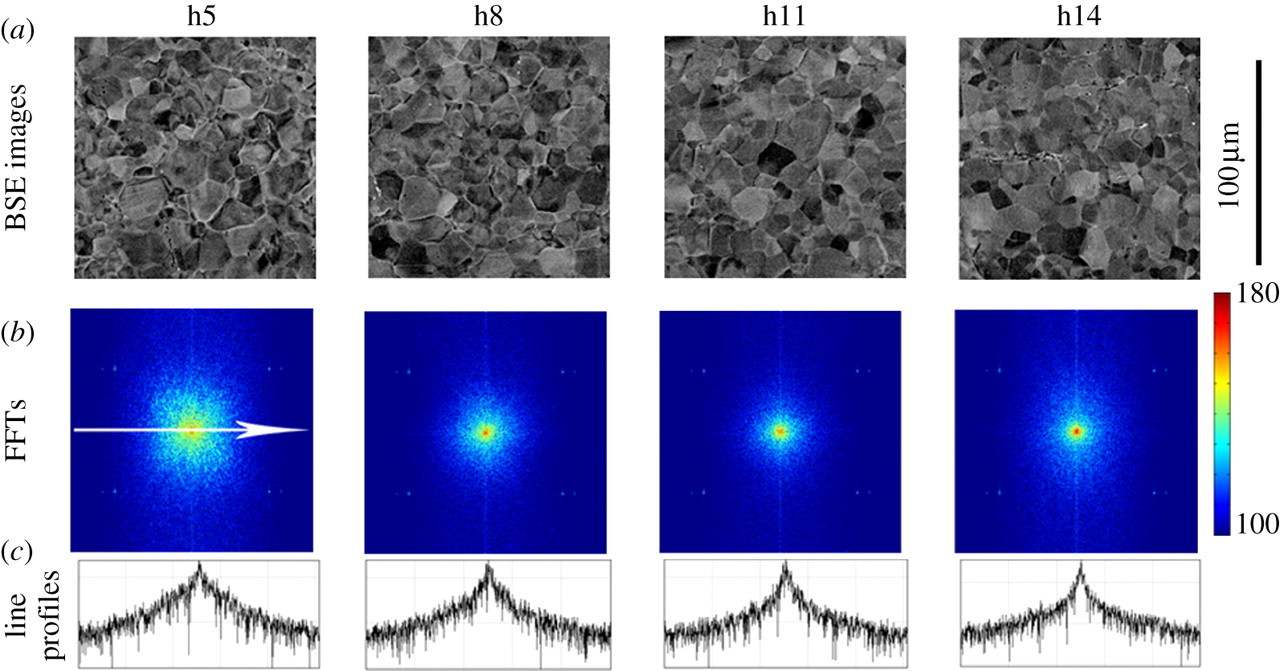
Figure 4 from Yang et al, 2012. (a) Backscattered electron images at increasing distance from crack from left to right; (b) their corresponding discrete Fourier transforms (DFTs) and (c) a horizontal line profile across the centre of each DFT.

Figure 4 from Yang et al, 2012. (a) Backscattered electron images at increasing distance from crack from left to right; (b) their corresponding discrete Fourier transforms (DFTs) and (c) a horizontal line profile across the centre of each DFT.

Reference: Yang, Y., Crimp, M., Tomlinson, R.A., Patterson, E.A., 2012, Quantitative measurement of plastic strain field at a fatigue crack tip, Proc. R. Soc. A., 468(2144):2399-2415.

Tacit hurdle to digital twins

Tacit knowledge is traditionally defined as knowledge that is not explicit or that is difficult to express or transfer from someone else.  This description of what it is not makes the definition itself tacit knowledge which is not very helpful.  Management guides resolve this by giving examples, such as aesthetic sense, or innovation and leadership skills which are elusive skills that are hard to explain [see ‘Innovation out of chaos‘ on June 29th 2016 and  ‘Clueless on leadership style‘ on June 14th, 2017].  In engineering, there are a series of skills that are hard to explain or teach, including creative problem-solving [see ‘Learning problem-solving skills‘  on October 24th, 2018], artful design [see ‘Skilled in ingenuity‘ on August 19th, 2015] and elegant modelling [see ‘Credibility is in the eye of the beholder‘ on April 20th, 2016].  In a university course we attempt to lay the foundations for this tacit engineering knowledge; however, much of it is gained in work through experience and becomes regarded by organisations as part of their intellectual assets – the core of their competitiveness and source of their sustainable technology advantage.  In our work on integrated nuclear digital environments, from which digital twins can be spawned, we would like to capture both explicit and tacit knowledge about complex systems throughout their life cycle which will extend beyond the working lives of their designers, builders and operators.  One of the potential advantages of digital twins is as a knowledge management system by duplicating the life of the physical system and thus allowing its safer and cheaper operation in the long-term as well as its eventual decommissioning.   However, besides the very nature of tacit knowledge that makes its capture difficult, we are finding that its perceived value as an intellectual asset renders stakeholders reluctant to discuss it with us; never mind consider how it might be preserved as part of a digital twin.  Research has shown that tacit knowledge sharing is influenced by environmental factors including national culture, leadership characteristics and social networks [Cai et al, 2020].  I suspect that all of these factors were present in the heyday of the UK civil nuclear power industry when it worked together to construct advanced and complex systems; however, it has not built a power station since 1995 and, at the moment, new power stations are cancelled more often than built, which has almost certainly depressed all of these factors.  So, perhaps we should not be surprised by the difficulties encountered in establishing an integrated nuclear digital environment despite its importance for the future of the industry.

Reference: Cai, Y., Song, Y., Xiao, X. and Shi, W., 2020. The Effect of Social Capital on Tacit Knowledge-Sharing Intention: The Mediating Role of Employee Vigor. SAGE Open, 10(3), p.2158244020945722.

Graphite for Very High Temperature Reactors (VHTR)

One of the implications of the second law of thermodynamics is that the thermal efficiency of power stations increases with their operating temperature.  Thus, there is a drive to increase the operating temperature in the next generation of nuclear power stations, known as Generation IV reactors.  In one type of Generation IV reactors, known as the Very High Temperature Reactor (VHTR), graphite is designed to be both the moderator for neutrons and a structural element of the reactor.  Although the probability of damage in an accident is extremely low, it is important to consider the consequences of damage causing the core of the reactor to be exposed to air.  In these circumstances, with the core temperature at about 1600°C, the graphite would be exposed to severe oxidation by the air that could change its material properties and ability to function as a moderator and structural element.  Therefore, in recent research, my research group has been working with colleagues at the UK National Nuclear Laboratory (NNL) and at the National Tsing Hua University (NTHU) in Taiwan to conduct experiments on nuclear graphite over a range of temperatures.  Our recently published article shows that all grades of nuclear graphite show increased rates of oxidation for temperatures above 1200°C.  We found that large filler particles using a pitch-based graphite rather than a petroleum-based graphite gave higher oxidation resistance at these elevated temperatures.  This data is likely to be important in the design and operations of the next generation of nuclear power stations.

The work described above was supported by the NTHU-University of Liverpool Dual PhD Programme [see ‘Citizens of the world‘ on November 27th, 2019] and NNL.  This is the fifth, and for the moment last, in a series of posts on recent work published by my research group.  The others are: ‘Salt increases nanoparticle diffusion‘ on April 22nd, 2020; ‘Spatio-temporal damage maps for composite materials‘ on May 6th, 2020; ‘Thinking out of the box leads to digital image correlation through space‘ on June 24th, 2020; and, ‘Potential dynamic buckling in hypersonic vehicle skin‘ on July 1st, 2020.

The image is figure 5: SEM micrographs of the surface of petroleum-based IG-110 graphite samples oxidized at various temperatures from Lo IH, Tzelepi A, Patterson EA, Yeh TK. A study of the relationship between microstructure and oxidation effects in nuclear graphite at very high temperatures.  J. Nuclear Materials. 501:361-70, 2018.

Source:

Lo I-H, Yeh T-K, Patterson EA & Tzelepi A, Comparison of oxidation behaviour of nuclear graphite grades at very high temperatures, J. Nuclear Materials, 532:152054, 2020.

Thinking out of the box leads to digital image correlation through space

This is the third in a short series of posts on recent engineering research published by my research group.  Actually, two have already been published: ‘Salt increases nanoparticle diffusion‘ on April 22nd, 2020; and ‘Spatio-temporal damage maps for composite materials‘ on May 6th, 2020 and then I got distracted.  This third one arose from the same project as the time-damage maps which was sponsored by the United States Air Force.  The time-damage maps allow us to explore the evolution of failure in complex materials; however, we already know that damage tends to initiate from imperfections or flaws in the microstructure in the material.  New continuous fibre reinforced composite (CFRC) materials based on ceramics are very sensitive to defects or anomalies in their microstructure, such as misalignment of fibres.  However, they are capable of withstanding temperatures in excess of 1500 degrees Centigrade, which offers the opportunity to use them in jet engines or nuclear power plants to help generate energy more efficiently.  Therefore, it is worthwhile investigating effective methods of inspecting their microstructure which we can do either destructively by repetitively polishing away the surface of a sample and viewing it in a microscope, or non-destructively using x-ray tomography.  In both cases, the result is hundreds of ‘images’ containing millions of data values from which it is challenging to extract useful information.  In our work, we have used a little lateral thinking, to show how digital image correlation, usually used to track deformation of structures using multiple images collected over time [see ‘256 shades of grey‘ on January 22nd, 2014] , can be used to track fibres through the multiple images of the layers of the microstructure.  The result is the sort of ‘stick’ diagram in the image showing the orientation of fibres through the sample.  We have demonstrated that our new algorithm was more reliable and 30 times faster than its nearest rival.

The image shows, at the top, a typical stack of images from the microscope of a ceramic matrix composite; and, at the bottom, a plot of 3d profiles of the fibres tracked using the DIC-based method with the fibres orientated nominally at ±45° from the sectioning (x-y) plane shown in red and green colours.

Source:

Amjad K, Christian WJR, Dvurecenska K, Chapman MG, Uchic MD, Przybyla CP & Patterson EA, Computationally efficient method of tracking fibres in composite materials using digital image correlation, Composites Part A, 129:105683, 2020.