Category Archives: MyResearch

Reliable predictions of non-Newtonian flows of sludge

Regular readers of this blog will be aware that I have been working for many years on validation processes for computational models of structures employed in a wide range of sectors, including aerospace engineering [see ‘The blind leading the blind’ on May 27th, 2020] and nuclear energy [see ‘Million to one’ on November 21st, 2018].  Validation is determining the extent to which predictions from a model are representative of behaviour in the real-world [see ‘Model validation’ on September 18th, 2012].  More recently, I have been working on model credibility, which is the willingness of people, besides the modeller, to use the predictions from models in decision-making [see, for example, ‘Credible predictions for regulatory decision-making’ on December 9th, 2020].  I have started to consider the complex world of predictive modelling of fluid flow and I am hoping to start a collaboration with a new colleague on the flow of sludges.  Sludges are more common than you might think but we are interested in modelling the flow of waste, both wastewater (sewage) and nuclear wastes.  We have a PhD studentship available sponsored jointly by the GREEN CDT and the National Nuclear Laboratory.  The project is interdisciplinary in two dimensions because it will combine experiments and simulations as well as uniting ideas from solid mechanics and fluid mechanics.  The integration of concepts and technologies across these boundaries brings a level of adventure to the project which will be countered by building on well-established research in solid mechanics on quantitative comparisons of measurements and predictions and by employing current numerical and experimental work on wastewater sludges.  If you are interested or know someone who might want to join our research then you can find out more here.

Image: Sewage sludge disposal in Germany: Andrea Roskosch / UBA

Structural damage assessment using infrared detectors in fusion environments

Schematic representation of plasma flux in a fusion reactorAbout six months ago, I described the success of my research group in detecting the early stages of the development of damage in structural components using small, cheap devices based on infrared measurements [see ‘Seeing small changes is a big achievement‘ on October 26th, 2022] after it had been reported in the Proceedings of the Royal Society.  The research was motivated by the needs of the aerospace industry and largely supported via the European Union’s Horizon 2020 research and innovation programme.  We are planning to extend the research to allow our technology to be used for diagnostics in future fusion power plants.  Plasma facing components in these powerplants will experience significant structural and functional degradation in service due to the extreme condition in the reactor.  Our aim is to develop systems based on our infrared monitoring technology that can identify and track material degradation without the need for plant shutdown thereby enabling unplanned maintenance to be undertaken at the earliest sign of component failure.  We are collaborating with the UKAEA and are looking to recruit a PhD student to work on the project supported by the GREEN CDT and Eurofusion.  If you are interested or know someone who might be interested then please follow this link for more information.

Reference:

Amjad, K., Lambert, C.A., Middleton, C.A., Greene, R.J., Patterson, E.A., 2022, A thermal emissions-based real-time monitoring system for in situ detection of cracks, Proc. R. Soc. A., 478: 20210796.

Label-free real-time tracking of individual bacterium

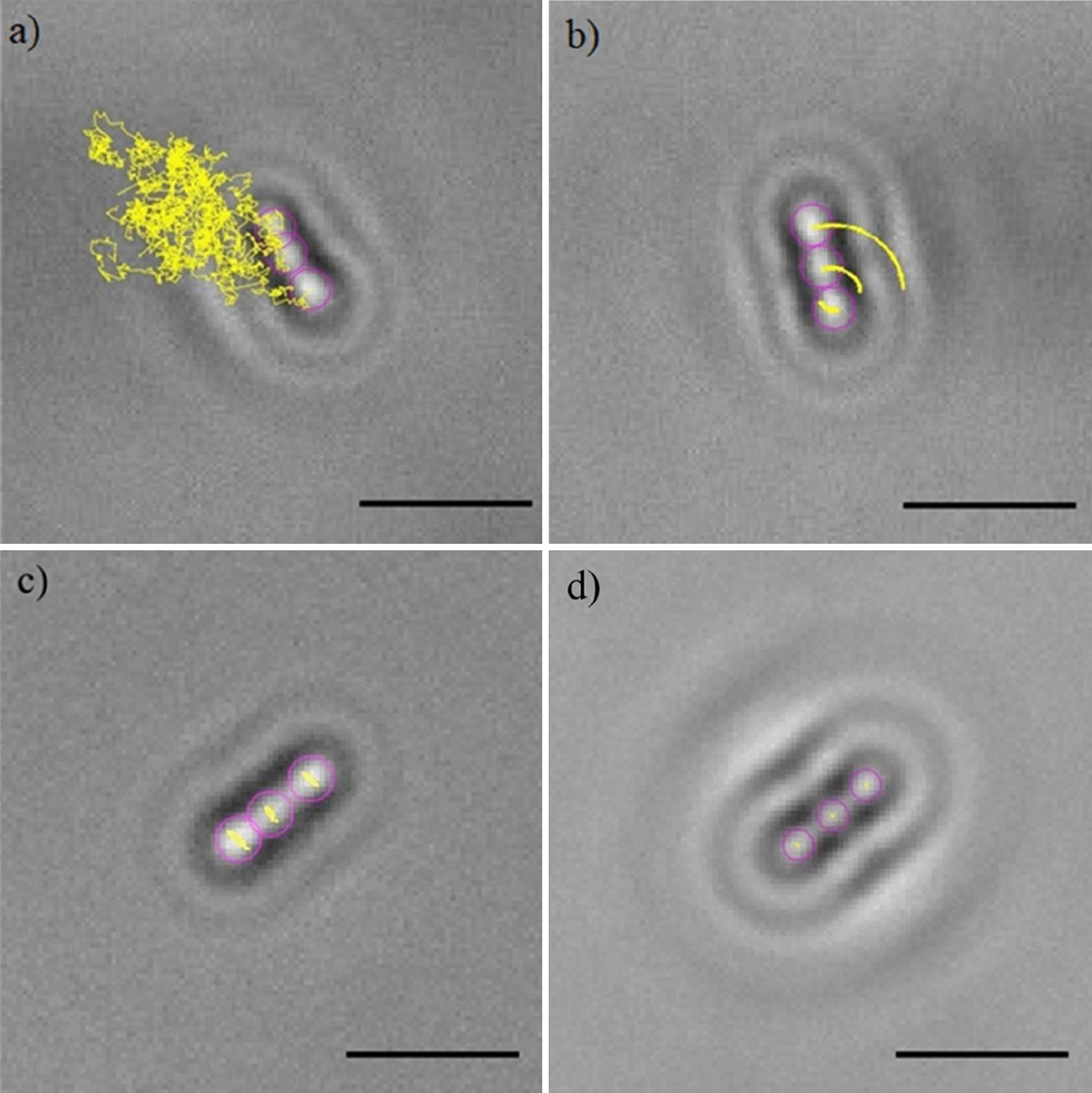
Images from the optical microscope showing the tracks of bacteria interacting with a surfaceAntimicrobial resistant (AMR) infections are already the third leading cause of death in the USA and are predicted to kill 50 million people per year by 2050.  It is the next pandemic starting already.  We have been using our capability to track nanoparticles in an optical microscope [see ‘Slow moving nanoparticles‘ on December 13th, 2017 and ‘Nano biomechanical engineering of agent delivery to cells‘ on December 15th, 2021] to track individual bacterium as they interact with surfaces to form biofilms.  Bacterial biofilms are complex colonies of bacteria that are highly resistant to antimicrobial agents and can cause life-threatening infections.  We have used our label-free, real-time tracking capabilities to explore the dynamics and adhesion of bacteria to surfaces and found that viable bacteria adhered to the surface but continue to move with rotary or sliding motions depending on the mechanics of their attachment to the surface.  Bacteria that were killed by contact with the surface did not move once they were attached to the surface.  The image shows examples of these motions from our paper published last month.  Our ability to detect these differences in the dynamics of bacteria will allow us to detect the onset of the formation of biofilms and to quantify the efficacy of antimicrobial surfaces and coatings.

Image: Figure 4 – Tracks (yellow lines) of the sections (purple circles) of four E. coli bacteria experiencing: (a) random diffusion above the surface; (b) rotary attachment; (c) lateral attachment; (d) static attachment. The dynamics of the four bacteria was monitored for approximately 20 s. The length of the scale bars is 5 μm. From Scientific Reports, 12:18146, 2022.

Source:

Giorgi F, Curran JM & Patterson EA, Real-time monitoring of the dynamics and interactions of bacteria and the early-stage formation of biofilms, Scientific Reports, 12:18146, 2022.

Seeing small changes is a big achievement

Figure 8 from Amjad et al 2022Some years ago I wrote with great excitement about publishing a paper in Royal Society Open Science [see ‘Press release!‘ on November 15th, 2017].  This has become a routine event; however, the excitement returned earlier this month when we had a paper published in the Proceedings of Royal Society of London on ‘A thermal emissions-based real-time monitoring system for in situ detection of cracks’.  The Proceedings were first published in February 1831 and this is only the second time in my career that my group has published a paper in them.  The last time was ten years ago and was also about cracks: ‘Quantitative measurement of plastic strain field at a fatigue crack tip’.  I have already described this earlier work in a post [see ‘Scattering electrons reveal dislocations in material structure’ on November 11th, 2020].  This was the first time that the size and shape of the plastic zone around a crack had been measured directly rather than inferred from other measurements.  It required an expensive scanning electron microscope and a well-equipped laboratory.  In contrast, the work in the paper published this month uses components that can be purchased for the price of a smart phone and assembled into a device not much larger than a smart phone.  The device detects the changes in the temperature distribution over the surface of the metal caused by the propagation of a crack due to repeated loading of the metal.  It is based on the principles of thermoelastic stress analysis [see ‘Counting photons to measure stress‘ on November 18th, 2015], which is a well-established measurement technique that usually requires expensive infra-red cameras.  Our key innovation is to not aim for absolute measurement values, which allows us to ignore calibration requirements, and instead to look for changes in the temperature distribution on the metal surface by extracting feature vectors from the images [see ‘Recognising strain‘ on October 28th 2015].  Our approach lowers the cost of the equipment required by several orders of magnitude, achieves comparable or better resolution of crack growth (around 1 mm) and will function at lower loading frequencies than techniques based on classical thermoelastic stress analysis.  Besides crack analysis, the common theme of the two papers is the innovative use of image processing to identify change, based on the fracture mechanics of crack propagation.

The research reported in this month’s paper was largely performed as part of the DIMES project about which I have written many posts.

The University of Liverpool was the coordinator of the DIMES project and the other partners were Empa, Dantec Dynamics GmbH and Strain Solutions Ltd.  Airbus was the topic manager on behalf of the Clean Sky 2 Joint Undertaking.

Logos of Clean Sky 2 and EUThe DIMES project received funding from the Clean Sky 2 Joint Undertaking under the European Union’s Horizon 2020 research and innovation programme under grant agreement No. 820951.

The opinions expressed in this blog post reflect only the author’s view and the Clean Sky 2 Joint Undertaking is not responsible for any use that may be made of the information it contains.

References:

Amjad, K., Lambert, C.A., Middleton, C.A., Greene, R.J., Patterson, E.A., 2022, A thermal emissions-based real-time monitoring system for in situ detection of cracks, Proc. R. Soc. A., doi: 10.1098/rspa.2021.0796.

Yang, Y., Crimp, M., Tomlinson, R.A., Patterson, E.A., 2012, Quantitative measurement of plastic strain field at a fatigue crack tip, Proc. R. Soc. A., 468(2144):2399-2415.

Image: Figure 8 from Amjad et al, 2022, Proc. R. Soc. A., doi: 10.1098/rspa.2021.0796.