Tag Archives: simulation

Negative capability and optimal ambiguity

Decorative photograph of sculpture on Liverpool waterfront at nightHow is your negative capability?  The very term ‘negative capability’ conveys confusion and ambiguity.  It means our ability to accept uncertainty, a lack of knowledge or control.  It was coined by John Keats to describe the skill of appreciating something without fully understanding it.  It implies suspending judgment about something in order to learn more about it.  This is difficult because we have to move out of a low entropy mindset and consider how it fits in a range of possible mindsets or neuronal assemblies, which raises our psychological entropy and with it our anxiety and mental stress [see ’Psychological entropy increased by effectual leaders‘ on February 10th, 2021].  If we are able to tolerate an optimal level of ambiguity and uncertainty then we might be able to develop an appreciation of a complex system and even an ability to anticipate its behaviour without a full knowledge or understanding of it.  Our sub-conscious brain has excellent negative capabilities; for example, most of us can catch a ball without understanding, or even knowing, anything about the mechanics of its flight towards us, or we accept a ride home from a friend with no knowledge of their driving skills and no control over the vehicle.  Although, if our conscious brain knows that they crashed their car last week then it might override the sub-conscious and cause us to think again before declining the offer of a ride home.  Perhaps this is because our conscious brain tends to have less negative capability and likes to be in control.  Engineers like to talk about their intuition which is probably synonymous with their negative capability because it is their ability to appreciate and anticipate the behaviour of an engineering system without a full knowledge and understanding of it.  This intuition is usually based on experience and perhaps resides in the subconscious mind because if you ask an engineer to explain a decision or prediction based on their intuition then they will probably struggle to provide a complete and rational explanation.  They are comfortable with an optimal level of ambiguity although of course you might not be so comfortable.

Sources:

Richard Gunderman, ‘John Keats’ concept of ‘negative capability’ – or sitting in uncertainty –  is needed now more than ever’.  The Conversation, February 21st, 2021.

David Jeffery, Letter: Keats was uneasy about the pursuit of perfection.  FT Weekend, April 2nd, 2021.

Caputo JD. Truth: philosophy in transit. London: Penguin, 2013.

Digital twins that thrive in the real-world

Decorative image

Windows of the Soul II [3D video art installation: http://www.haigallery.com/sonia-falcone/%5D

Digital twins are becoming ubiquitous in many areas of engineering [see ‘Can you trust your digital twin?‘ on November 23rd, 2016].  Although at the same time, the terminology is becoming blurred as digital shadows and digital models are treated as if they are synonymous with digital twins.  A digital model is a digitised replica of physical entity which lacks any automatic data exchange between the entity and its replica.  A digital shadow is the digital representation of a physical object with a one-way flow of information from the object to its representation.  But a digital twin is a functional representation with a live feedback loop to its counterpart in the real-world.  The feedback loop is based on a continuous update to the digital twin about the condition and performance of the physical entity based on data from sensors and on analysis from the digital twin about the performance of the physical entity.  This enables a digital twin to provide a service to many stakeholders.  For example, the users of a digital twin of an aircraft engine could include the manufacturer, the operator, the maintenance providers and the insurers.  These capabilities imply digital twins are themselves becoming products which exist in a digital context that might connect many digital products thus forming an integrated digital environment.  I wrote about integrated digital environments when they were a concept and the primary challenges were technical in nature [see ‘Enabling or disruptive technology for nuclear engineering?‘ on January 28th, 2015].  Many of these technical challenges have been resolved and the next set of challenges are economic and commercial ones associated with launching digital twins into global markets that lack adequate understanding, legislation, security, regulation or governance for digital products.  In collaboration with my colleagues at the Virtual Engineering Centre, we have recently published a white paper, entitled ‘Transforming digital twins into digital products that thrive in the real world‘ that reviews these issues and identifies the need to establish digital contexts that embrace the social, economic and technical requirements for the appropriate use of digital twins [see ‘Digital twins could put at risk what it means to be human‘ on November 18th, 2020].

Certainty is unattainable and near-certainty unaffordable

The economists John Kay and Mervyn King assert in their book ‘Radical Uncertainty – decision-making beyond numbers‘ that ‘economic forecasting is necessarily harder than weather forecasting’ because the world of economics is non-stationary whereas the weather is governed by unchanging laws of nature. Kay and King observe that both central banks and meteorological offices have ‘to convey inescapable uncertainty to people who crave unavailable certainty’. In other words, the necessary assumptions and idealisations combined with the inaccuracies of the input data of both economic and meteorological models produce inevitable uncertainty in the predictions. However, people seeking to make decisions based on the predictions want certainty because it is very difficult to make choices when faced with uncertainty – it raises our psychological entropy [see ‘Psychological entropy increased by ineffective leaders‘ on February 10th, 2021].  Engineers face similar difficulties providing systems with inescapable uncertainties to people desiring unavailable certainty in terms of the reliability.  The second law of thermodynamics ensures that perfection is unattainable [see ‘Impossible perfection‘ on June 5th, 2013] and there will always be flaws of some description present in a system [see ‘Scattering electrons reveal dislocations in material structure‘ on November 11th, 2020].  Of course, we can expend more resources to eliminate flaws and increase the reliability of a system but the second law will always limit our success. Consequently, to finish where I started with a quote from Kay and King, ‘certainty is unattainable and the price of near-certainty unaffordable’ in both economics and engineering.

From strain measurements to assessing El Niño events

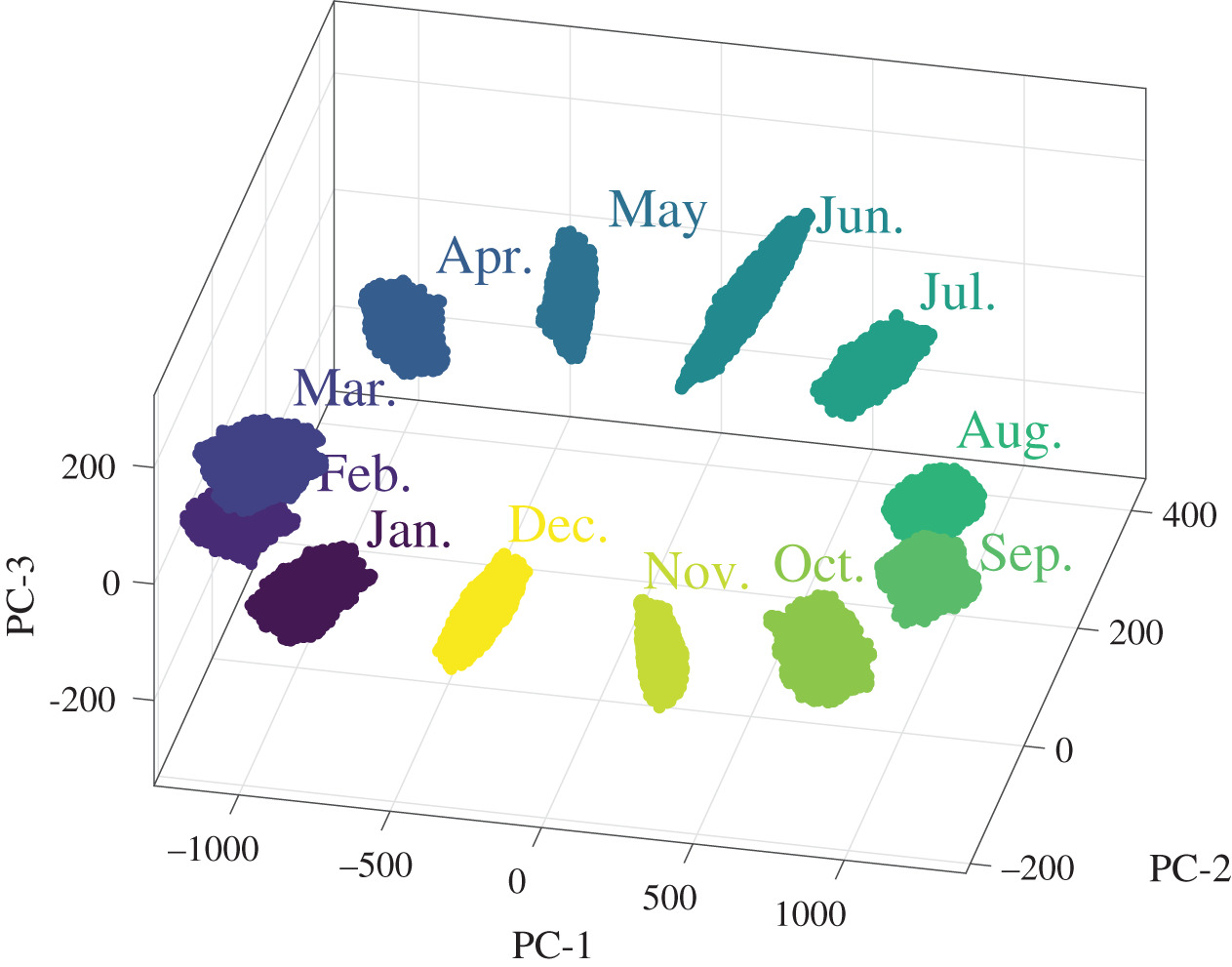
Figure 11 from RSOS 201086One of the exciting aspects of leading a university research group is that you can never be quite sure where the research is going next.  We published a nice example of this unpredictability last week in Royal Society Open Science in a paper called ‘Transformation of measurement uncertainties into low-dimensional feature space‘ [1].  While the title is an accurate description of the contents, it does not give much away and certainly does not reveal that we proposed a new method for assessing the occurrence of El Niño events.  For some time we have been working with massive datasets of measurements from arrays of sensors and representing them by fitting polynomials in a process known as image decomposition [see ‘Recognising strain‘ on October 28th, 2015]. The relatively small number of coefficients from these polynomials can be collated into a feature vector which facilitates comparison with other datasets [see for example, ‘Out of the valley of death into a hype cycle‘ on February 24th, 2021].  Our recent paper provides a solution to the issue of representing the measurement uncertainty in the same space as the feature vector which is roughly what we set out to do.  We demonstrated our new method for representing the measurement uncertainty by calibrating and validating a computational model of a simple beam in bending using data from an earlier study in a EU-funded project called VANESSA [2] — so no surprises there.  However, then my co-author and PhD student, Antonis Alexiadis went looking for other interesting datasets with which to demonstrate the new method.  He found a set of spatially-varying uncertainties associated with a metamodel of soil moisture in a river basin in China [3] and global oceanographic temperature fields collected monthly over 11 years from 2002 to 2012 [4].  We used the latter set of data to develop a new technique for assessing the occurrence of El-Niño events in the Pacific Ocean.  Our technique is based on global ocean dynamics rather than on the small region in the Pacific Ocean which is usually used and has the added advantages of providing a confidence level on the assessment as well as enabling straightforward comparisons of predictions and measurements.  The comparison of predictions and measurements is a recurring theme in our current research but I did not expect it to lead into ocean dynamics.

Image is Figure 11 from [1] showing convex hulls fitted to the cloud of points representing the uncertainty intervals for the ocean temperature measurements for each month in 2002 using only the three most significant principal components . The lack of overlap between hulls can be interpreted as implying a significant difference in the temperature between months.

References:

[1] Alexiadis, A. and Ferson, S. and  Patterson, E.A., , 2021. Transformation of measurement uncertainties into low-dimensional feature vector space. Royal Society Open Science, 8(3): 201086.

[2] Lampeas G, Pasialis V, Lin X, Patterson EA. 2015.  On the validation of solid mechanics models using optical measurements and data decomposition. Simulation Modelling Practice and Theory 52, 92-107.

[3] Kang J, Jin R, Li X, Zhang Y. 2017, Block Kriging with measurement errors: a case study of the spatial prediction of soil moisture in the middle reaches of Heihe River Basin. IEEE Geoscience and Remote Sensing Letters, 14, 87-91.

[4] Gaillard F, Reynaud T, Thierry V, Kolodziejczyk N, von Schuckmann K. 2016. In situ-based reanalysis of the global ocean temperature and salinity with ISAS: variability of the heat content and steric height. J. Climate. 29, 1305-1323.