Tag Archives: science

If you don’t succeed, try and try again…

Photograph of S-shaped plateYou would not think it was difficult to build a thin flat metallic plate using a digital description of the plate and a Laser Powder Bed Fusion (L-PBF) machine which can build complex components, such as hip prostheses.  But it is.  As we have discovered since we started our research project on the thermoacoustic response of additively manufactured parts (see ‘Slow start to an exciting new project on thermoacoustic response of AM metals‘ on September 9th, 2020).  L-PBF involves using a laser beam to melt selected regions of a thin layer of metal powder spread over a flat bed.  The selected regions represent a cross-section of the desired three-dimensional component and repeating the process for each successive cross-section results in the additive building of the component as each layer solidifies.  And there in those last four words lies the problem because ‘as each layer solidifies’ the temperature distribution between the layers causes different levels of thermal expansion that results in strains being locked into our thin plates.  Our plates are too thin to build with their plane surfaces horizontal or perpendicular to the laser beam so instead we build them with their plane surface parallel to the laser beam, or vertical like a street sign.  In our early attempts, the residual stresses induced by the locked-in strains caused the plate to buckle into an S-shape before it was complete (see image).  We solved this problem by building buttresses at the edges of the plate.  However, when we remove the buttresses and detach the plate from the build platform, it buckles into a dome-shape.  Actually, you can press the centre of the plate and make it snap back and forth noisily.  While we are making progress in understanding the mechanisms at work, we have some way to go before we can confidently produce flat plates using additive manufacturing that we can use in comparisons with our earlier work on the performance of conventionally, or subtractively, manufactured plates subject to the thermoacoustic loading experienced by the skin of a hypersonic vehicle [see ‘Potential dynamic buckling in hypersonic vehicle skin‘ on July 1st 2020) or the containment walls in a fusion reactor.  Sometimes research is painfully slow but no one ever talks about it.  Maybe because we quickly forget the painful parts once we have a successful outcome to brag about. But it is often precisely the painful repetitions of “try and try again” that allow us to reach the bragging stage of a successful outcome.

The research is funded jointly by the National Science Foundation (NSF) in the USA and the Engineering and Physical Sciences Research Council (EPSRC) in the UK (see Grants on the Web).

References

Silva AS, Sebastian CM, Lambros J and Patterson EA, 2019. High temperature modal analysis of a non-uniformly heated rectangular plate: Experiments and simulations. J. Sound & Vibration, 443, pp.397-410.

Magana-Carranza R, Sutcliffe CJ, Patterson EA, 2021, The effect of processing parameters and material properties on residual forces induced in Laser Powder Bed Fusion (L-PBF). Additive Manufacturing. 46:102192

Somethings will always be unknown

Decorative image of a fruit fly nervous system Albert Cardona HHMI Janelia Research Campus Welcome Image Awards 2015The philosophy of science has oscillated between believing that everything is knowable and that somethings will always be unknowable. In 1872, the German physiologist, Emil du Bois-Reymond declared ‘we do not know and will not know’ implying that there would always be limits to our scientific knowledge. Thirty years later, David Hilbert, a German mathematician stated that nothing is unknowable in the natural sciences. He believed that by considering some things to be unknowable we limited our ability to know. However, Kurt Godel, a Viennese mathematician who moved to Princeton in 1940, demonstrated in his incompleteness theorems that for any finite mathematical system there will always be statements which are true but unprovable and that a finite mathematical system cannot demonstrate its own consistency. I think that this implies some things will remain unknowable or at least uncertain. Godel believed that his theorems implied that the power of the human mind is infinitely more powerful than any finite machine and Roger Penrose has deployed these incompleteness theorems to argue that consciousness transcends the formal logic of computers, which perhaps implies that artificial intelligence will never replace human intelligence [see ‘Four requirements for consciousness‘ on January 22nd, 2020].  At a more mundane level, Godel’s theorems imply that engineers will always have to deal with the unknowable when using mathematical models to predict the behaviour of complex systems and, of course, to avoid meta-ignorance, we have to assume that there are always unknown unknowns [see ‘Deep uncertainty and meta-ignorance‘ on July 21st, 2021].

Source: Book review by Nick Stephen, ‘Journey to the Edge of Reason by Stephen Budiansky – ruthless logic‘ FT Weekend, 1st June 2021.

Deep uncertainty and meta-ignorance

Decorative imageThe term ‘unknown unknowns’ was made famous by Donald Rumsfeld almost 20 years ago when, as US Secretary of State for Defense, he used it in describing the lack of evidence about terrorist groups being supplied with weapons of mass destruction by the Iraqi government. However, the term was probably coined by almost 50 years earlier by Joseph Luft and Harrington Ingham when they developed the Johari window as a heuristic tool to help people to better understand their relationships.  In engineering, and other fields in which predictive models are important tools, it is used to describe situations about which there is deep uncertainty.  Deep uncertainty refers situations where experts do not know or cannot agree about what models to use, how to describe the uncertainties present, or how to interpret the outcomes from predictive models.  Rumsfeld talked about known knowns, known unknowns, and unknown unknowns; and an alternative simpler but perhaps less catchy classification is ‘The knowns, the unknown, and the unknowable‘ which was used by Diebold, Doherty and Herring as part of the title of their book on financial risk management.  David Spiegelhalter suggests ‘risk, uncertainty and ignorance’ before providing a more sophisticated classification: aleatory uncertainty, epistemic uncertainty and ontological uncertainty.  Aleatory uncertainty is the inevitable unpredictability of the future that can be fully described using probability.  Epistemic uncertainty is a lack of knowledge about the structure and parameters of models used to predict the future.  While ontological uncertainty is a complete lack of knowledge and understanding about the entire modelling process, i.e. deep uncertainty.  When it is not recognised that ontological uncertainty is present then we have meta-ignorance which means failing to even consider the possibility of being wrong.  For a number of years, part of my research effort has been focussed on predictive models that are unprincipled and untestable; in other words, they are not built on widely-accepted principles or scientific laws and it is not feasible to conduct physical tests to acquire data to demonstrate their validity [see editorial ‘On the credibility of engineering models and meta-models‘, JSA 50(4):2015].  Some people would say untestability implies a model is not scientific based on Popper’s statement about scientific method requiring a theory to be refutable.  However, in reality unprincipled and untestable models are encountered in a range of fields, including space engineering, fusion energy and toxicology.  We have developed a set of credibility factors that are designed as a heuristic tool to allow the relevance of such models and their predictions to be evaluated systematically [see ‘Credible predictions for regulatory decision-making‘ on December 9th, 2020].  One outcome is to allow experts to agree on their disagreements and ignorance, i.e., to define the extent of our ontological uncertainty, which is an important step towards making rational decisions about the future when there is deep uncertainty.

References

Diebold FX, Doherty NA, Herring RJ, eds. The Known, the Unknown, and the Unknowable in Financial Risk Management: Measurement and Theory Advancing Practice. Princeton, NJ: Princeton University Press, 2010.

Spiegelhalter D,  Risk and uncertainty communication. Annual Review of Statistics and Its Application, 4, pp.31-60, 2017.

Patterson EA, Whelan MP. On the validation of variable fidelity multi-physics simulations. J. Sound and Vibration. 448:247-58, 2019.

Patterson EA, Whelan MP, Worth AP. The role of validation in establishing the scientific credibility of predictive toxicology approaches intended for regulatory application. Computational Toxicology. 100144, 2020.

From strain measurements to assessing El Niño events

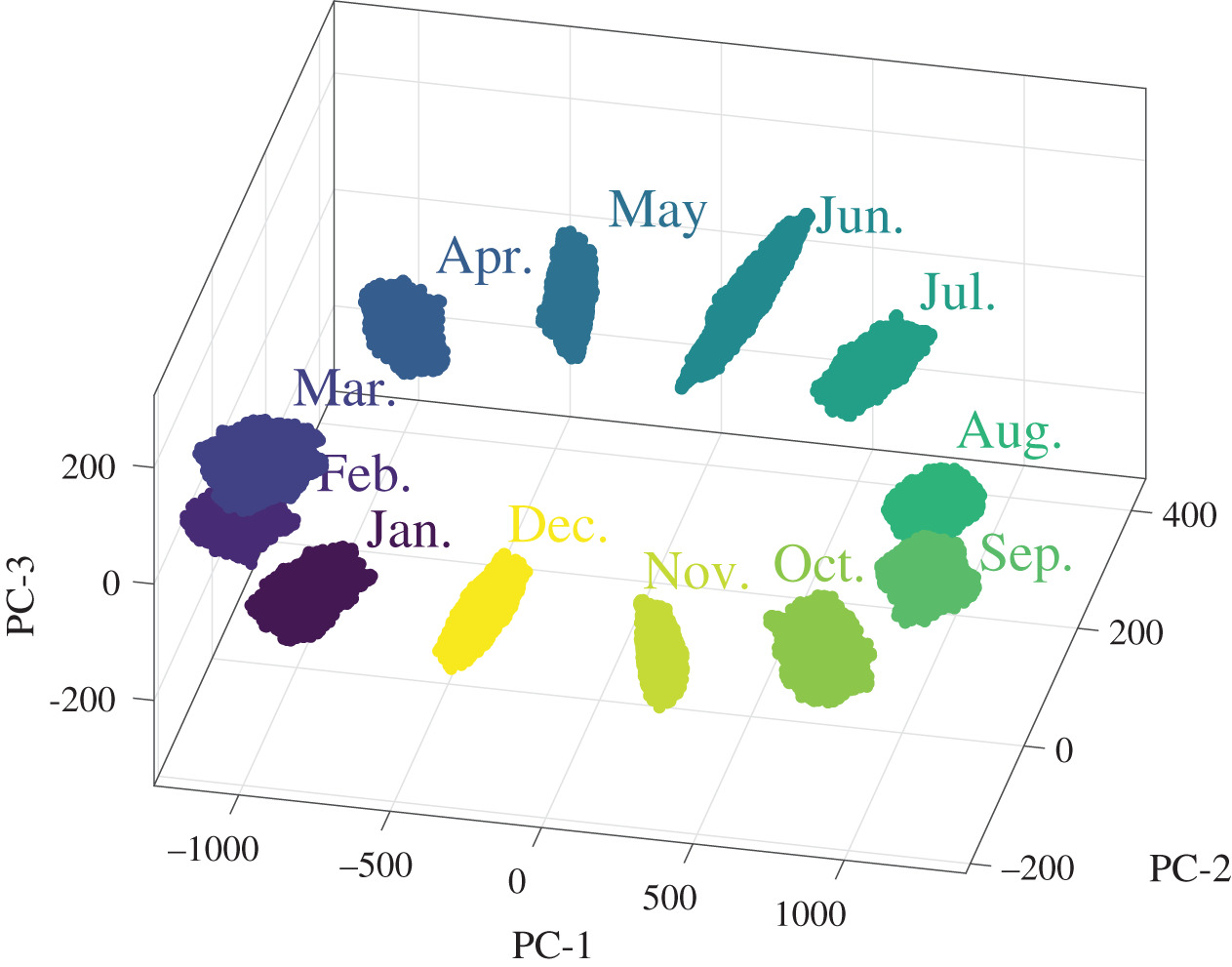
Figure 11 from RSOS 201086One of the exciting aspects of leading a university research group is that you can never be quite sure where the research is going next.  We published a nice example of this unpredictability last week in Royal Society Open Science in a paper called ‘Transformation of measurement uncertainties into low-dimensional feature space‘ [1].  While the title is an accurate description of the contents, it does not give much away and certainly does not reveal that we proposed a new method for assessing the occurrence of El Niño events.  For some time we have been working with massive datasets of measurements from arrays of sensors and representing them by fitting polynomials in a process known as image decomposition [see ‘Recognising strain‘ on October 28th, 2015]. The relatively small number of coefficients from these polynomials can be collated into a feature vector which facilitates comparison with other datasets [see for example, ‘Out of the valley of death into a hype cycle‘ on February 24th, 2021].  Our recent paper provides a solution to the issue of representing the measurement uncertainty in the same space as the feature vector which is roughly what we set out to do.  We demonstrated our new method for representing the measurement uncertainty by calibrating and validating a computational model of a simple beam in bending using data from an earlier study in a EU-funded project called VANESSA [2] — so no surprises there.  However, then my co-author and PhD student, Antonis Alexiadis went looking for other interesting datasets with which to demonstrate the new method.  He found a set of spatially-varying uncertainties associated with a metamodel of soil moisture in a river basin in China [3] and global oceanographic temperature fields collected monthly over 11 years from 2002 to 2012 [4].  We used the latter set of data to develop a new technique for assessing the occurrence of El-Niño events in the Pacific Ocean.  Our technique is based on global ocean dynamics rather than on the small region in the Pacific Ocean which is usually used and has the added advantages of providing a confidence level on the assessment as well as enabling straightforward comparisons of predictions and measurements.  The comparison of predictions and measurements is a recurring theme in our current research but I did not expect it to lead into ocean dynamics.

Image is Figure 11 from [1] showing convex hulls fitted to the cloud of points representing the uncertainty intervals for the ocean temperature measurements for each month in 2002 using only the three most significant principal components . The lack of overlap between hulls can be interpreted as implying a significant difference in the temperature between months.

References:

[1] Alexiadis, A. and Ferson, S. and  Patterson, E.A., , 2021. Transformation of measurement uncertainties into low-dimensional feature vector space. Royal Society Open Science, 8(3): 201086.

[2] Lampeas G, Pasialis V, Lin X, Patterson EA. 2015.  On the validation of solid mechanics models using optical measurements and data decomposition. Simulation Modelling Practice and Theory 52, 92-107.

[3] Kang J, Jin R, Li X, Zhang Y. 2017, Block Kriging with measurement errors: a case study of the spatial prediction of soil moisture in the middle reaches of Heihe River Basin. IEEE Geoscience and Remote Sensing Letters, 14, 87-91.

[4] Gaillard F, Reynaud T, Thierry V, Kolodziejczyk N, von Schuckmann K. 2016. In situ-based reanalysis of the global ocean temperature and salinity with ISAS: variability of the heat content and steric height. J. Climate. 29, 1305-1323.