Tag Archives: PhD vacancy

Assessing nanoparticle populations in historic nuclear waste

Together with colleagues at the JRC Ispra, my research group has shown that the motion of small nanoparticles at low concentrations is independent of their size, density and material [1], [see ‘Slow moving nanoparticles‘ on December 13th, 2017].  This means that commercially-available instruments for evaluating the size and number of nanoparticles in a solution will give erroneous results under certain conditions.  In a proposed PhD project, we are planning to extend our work to develop an instrument with capability to automatically identify and size nanoparticles, in the range from 1 to 150 nanometres, using the three-dimensional optical signature, or caustic, which particles generate in an optical microscope, that can be several orders of magnitude larger than the particle [2],  [see ‘Toxic nanoparticles?‘ on November 13th, 2013].  The motivation for the work is the need to characterise particles present in solution in legacy ponds at Sellafield.  Legacy ponds at the Sellafield site have been used to store historic radioactive waste for decades and progress is being made in reducing the risks associated with these facilities [3].  Over time, there has been a deterioration in the condition of the ponds and their contents that has resulted in particles being present in solution in the ponds.  It is important to characterise these particles in order to facilitate reductions in the risks associated with the ponds.  We plan to use our existing facilities at the University of Liverpool to develop a novel instrument using simple solutions probably with gold nanoparticles and then to progress to non-radioactive simulants of the pond solutions.  The long-term goal will be to transition the technology to the Sellafield site perhaps with an intermediate step involving a demonstration of  the technology on pond solutions using the facilities of the National Nuclear Laboratory.

The PhD project is fully-funded for UK and EU citizens as part of a Centre for Doctoral Training and will involve a year of specialist training followed by three years of research.  For more information following this link.

References:

[1] Coglitore, D., Edwardson, S.P., Macko, P., Patterson, E.A., & Whelan, M.P., Transition from fractional to classical Stokes-Einstein behaviour in simple fluids, Royal Society Open Science, 4:170507, 2017.

[2] Patterson, E.A., Whelan, P., 2008, ‘Optical signatures of small nanoparticles in a conventional microscopeSmall, 4(10):1703-1706.

[3] Comptroller and Auditor General, The Nuclear Decommissioning Authority: progress with reducing risk at Sellafield, National Audit Office, HC 1126, Session 2017-19, 20 June 2018.

Spatial-temporal models of protein structures

For a number of years I have been working on methods for validating computational models of structures [see ‘Model validation‘ on September 18th 2012] using the full potential of measurements made with modern techniques such as digital image correlation [see ‘256 shades of grey‘ on January 22nd 2014] and thermoelastic stress analysis [see ‘Counting photons to measure stress‘ on November 18th 2015].  Usually the focus of our interest is at the macroscale, for example the research on aircraft structures in the MOTIVATE project; however, in a new PhD project with colleagues at the National Tsing Hua University in Taiwan, we are planning to explore using our validation procedures and metrics [1] in structural biology.

The size and timescale of protein-structure thermal fluctuations are essential to the regulation of cellular functions. Measurement techniques such as x-ray crystallography and transmission electron cryomicroscopy (Cryo-EM) provide data on electron density distribution from which protein structures can be deduced using molecular dynamics models. Our aim is to develop our validation metrics to help identify, with a defined level of confidence, the most appropriate structural ensemble for a given set of electron densities. To make the problem more interesting and challenging the structure observed by x-ray crystallography is an average or equilibrium state because a folded protein is constantly in motion undergoing harmonic oscillations, each with different frequencies and amplitude [2].

The PhD project is part of the dual PhD programme of the University of Liverpool and National Tsing Hua University.  Funding is available in form of a fee waiver and contribution to living expenses for four years of study involving significant periods (perferably two years) at each university.  For more information follow this link.

References:

[1] Dvurecenska, K., Graham, S., Patelli, E. & Patterson, E.A., A probabilistic metric for the validation of computational models, Royal Society Open Society, 5:180687, 2018.

[2] Justin Chan, Hong-Rui Lin, Kazuhiro Takemura, Kai-Chun Chang, Yuan-Yu Chang, Yasumasa Joti, Akio Kitao, Lee-Wei Yang. An efficient timer and sizer of protein motions reveals the time-scales of functional dynamics in the ribosome (2018) https://www.biorxiv.org/content/early/2018/08/03/384511.

Image: A diffraction pattern and protein structure from http://xray.bmc.uu.se/xtal/

Digitally-enabled regulatory environment for fusion powerplants

Digital twins are a combination of computational models and real-world data describing the form, function and condition of a system [see ‘Can you trust your digital twin?‘ on November 23rd 2016]. They are beginning to transform design processes for complex systems in a number of industries.  We have been working on a proof-of-concept study for a digital reactor in fission energy based on the Integrated Nuclear Digital Environment (INDE) [1].  The research has been conducted by the Virtual Engineering Centre (VEC) at the University of Liverpool together with partners from industry and national laboratories with funding from the UK Government for nuclear innovation.  In parallel, I having been working with a colleague at the University of Manchester and partners at the Culham Centre for Fusion Energy on the form of a digital environment for fusion energy taking account of the higher order of complexity, the scale of resources, the integration of novel technologies, and the likely diversity and distribution of organisations involved in designing, building and operating a fusion powerplant.  We have had positive interactions with the regulatory authorities during the digital fission reactor project and the culture of enabling-regulation [2] offers an opportunity for a new paradigm in the regulation of fusion powerplants.  Hence, we propose in a new PhD project to investigate the potential provided by the integration of digital twins with the regulatory environment to enable innovation in the design of fusion powerplants.

The PhD project is fully-funded for UK and EU citizens as part of a Centre for Doctoral Training and will involve a year of specialist training followed by three years of research.  For more information following this link.

References:

[1] Patterson EA, Taylor RJ & Bankhead M, A framework for an integrated nuclear digital environment, Progress in Nuclear Energy, 87:97-103, 2016.

[2] http://www.onr.org.uk/documents/2018/guide-to-enabling-regulation-in-practice.pdf

Image: https://www.pexels.com/photo/diagram-drawing-electromagnetic-energy-326394/

Crack tip plasticity in reactor steels

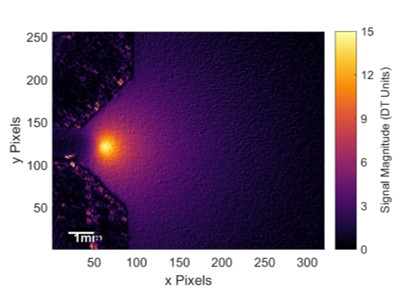
Amplitude of temperature in steel due to a cyclic load with a crack growing from left to right along the horizontal centre line with the stress concentration at its tip exhibiting the peak values. The wedge shapes in the left corners are part of the system.

At this time of year the flow into my inbox is augmented daily by prospective PhD students sending me long emails describing how their skills, qualifications and interests perfectly match the needs of my research group, or sometimes someone else’s group if they have not been careful in setting up their mass mailing.  At the moment, I have four PhD projects for which I am looking for outstanding students; so, because it will help prospective students and might interest my other readers but also because I am short of ideas for the blog, I plan to describe one project per week for the next month.

The first project is about the effect of hydrogen on crack tip plasticity in reactor steels.  Fatigue cracks grow in steels by coalescing imperfections in the microstructure of the material until small voids are formed in areas of high stress.  When these voids connect together a crack is formed.  Repeated loading and unloading of the material provides the energy to move the imperfections, known as dislocations, and geometric features in structures are stress concentrators which focus this energy causing cracks to be formed in their vicinity.  The movement of dislocations causes permanent, or plastic deformation of the material.  The sharp geometry of a crack tip becomes a stress concentrator creating a plastic zone in which dislocations pile up and voids form allowing the crack to extend [see post on ‘Alan Arnold Griffith‘ on April 26th, 2017].  It is possible to detect the thermal energy released during plastic deformation using a technique known as thermoelastic stress analysis [see ‘Counting photons to measure stress‘ on November 18th 2015] as well as to measure the stress field associated with the propagating crack [1].  One of my current PhD students has been using this technique to investigate the effect of irradiation damage on the growth of cracks in stainless steel used in nuclear reactors.  We use an ion accelerator at the Dalton Cumbrian Facility to introduce radiation damage into specimens the size of a postage stamp and afterwards apply cyclic loads and watch the fatigue crack grow using our sensitive infra-red cameras.  We have found that the irradiation reduced the rate of crack growth and we will be publishing a paper on it shortly [and a PhD thesis].  In the new project, our industrial sponsors want us to explore the effect of hydrogen on crack growth in irradiated steel, because the presence of hydrogen is known to accelerate fatigue crack growth [2] which is believe to happen as a result of hydrogen atoms disrupting the formation of dislocations at the microscale and localising plasticity at crack tip on the mesoscale.  However, these ideas have not been demonstrated in experiments, so we plan to do this using thermoelastic stress analysis and to investigate the combined influence of hydrogen and irradiation by developing a process for pre-charging the steel specimens with hydrogen using an electrolytic cell and irradiating them using the ion accelerator.  Both hydrogen and radiation are present in a nuclear reactor and hence the results will be relevant to predicting the safe working life of nuclear reactors.

The PhD project is fully-funded for UK and EU citizens as part of a Centre for Doctoral Training and will involve a year of specialist training followed by three years of research.  For more information following this link.

References:

  1. Yang, Y., Crimp, M., Tomlinson, R.A., Patterson, E.A., 2012, Quantitative measurement of plastic strain field at a fatigue crack tip, Proc. R. Soc. A., 468(2144):2399-2415.
  2. Matsunaga, H., Takakuwa, O., Yamabe, J., & Matsuoka, S., 2017, Hydrogen-enhanced fatigue crack growth in steels and its frequency dependence. Phil. Trans. R. Soc. A, 375(2098), 20160412