Tag Archives: networks

Webs of expertise and knowledge

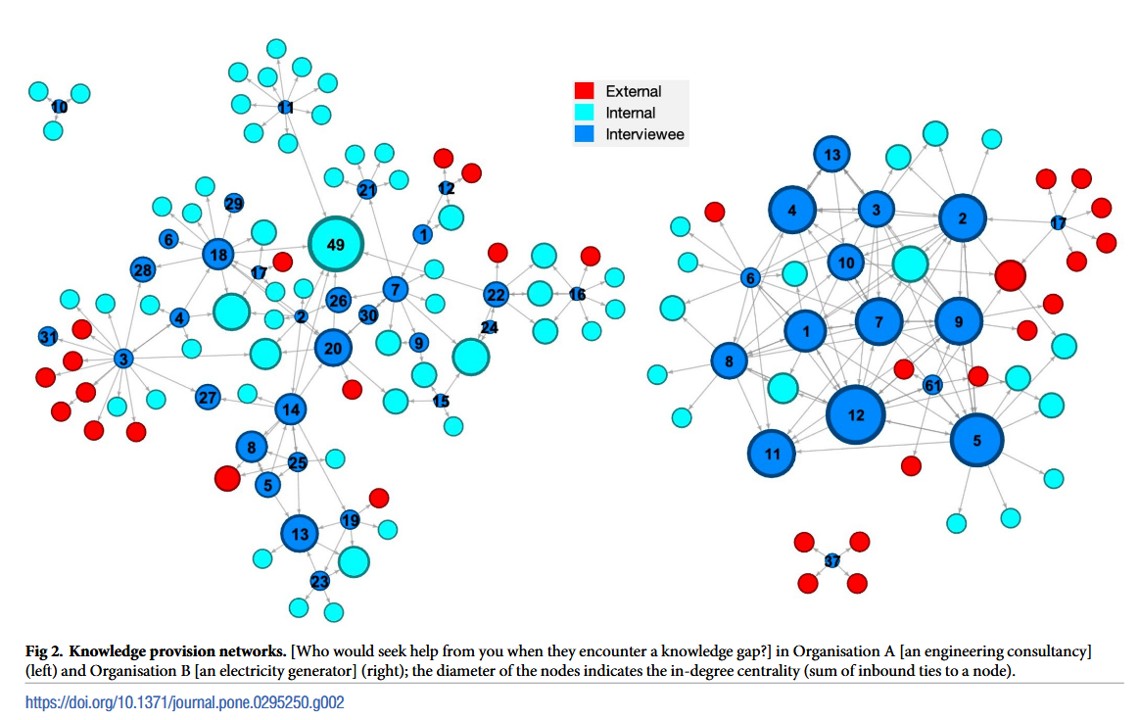
I am writing this post while I am in the middle of leading a breakout activity for more than a hundred PhD students from our Centres for Doctoral Training in nuclear science and engineering, GREEN and SATURN.  We have asked them to construct a knowledge network for a start-up company commissioned to build either a fusion energy power station or a power station based on small modular reactors (SMRs).  A knowledge network is a web of expertise and information whose value comes from the connections and interactions within and outside an organization.  Our aim is to encourage students to think beyond science and engineering and consider the interactions required to deliver safe, economic nuclear power.

We have brought the students together in York from six universities located in the North of England (Lancaster, Leeds, Liverpool, Manchester & Sheffield) and Scotland (Strathclyde).  This is an annual event usually held in the first working week of the New Year (see ‘Nuclear Winter School’ on January 23rd 2019).

The breakout activity has three one-hour time-slots on three consecutive days.  In today’s time-slot, we have divided the students into twenty groups of seven and given them paper, pencils, and a circle stencil plus an eraser with which to draw knowledge networks.  We are hoping for creativity, lively discussions, and some fun.  In yesterday’s one-hour slot, they had briefings from the Chief Manufacturing Engineer for a company building SMRs and the Deputy Chief Engineer of a company developing a fusion power station, as well as from a Digital Knowledge Management Consultant whose PhD led to a paper on knowledge networks, which we shared with the students last month (see ‘Evolutionary model of knowledge management’ on March 6th, 2024).  Tomorrow, one person from each group will have two minutes to present their knowledge network, via a portable visualiser, to an audience of several hundred.  What can go wrong?  Twenty two-minute presentations in one hour with one minute for questions and changeover.

GREEN (Growing skills for Reliable Economic Energy from Nuclear) is co-funded by a consortia of industrial organisations and the UK EPSRC (grant no. EP/S022295/1).

SATURN (Skills And Training Underpinning a Renaissance in Nuclear) succeeded GREEN and is also co-funded by a consortia of industrial organisations and the UK EPSRC (grant no. EP/Y034856/1).

Image shows thumbnail of figure from shared paper with knowledge networks for an engineering consultancy company and an electricity generator, follow this link for full size image.

Are we individuals?

It has been estimated that there are 150 species of bacteria in our gut with a megagenome correspondingly larger than the human genome; and that 90% of the cells in our bodies are bacterial [1].  This challenges a simple understanding of individual identity because on one level we are a collection of organisms, mainly bacteria, rather than a single entity.  The complexity is almost incomprehensible with 30 trillion cells in the human body each with about a billion protein molecules [2].  Each cell is apparently autonomous, making decisions about its role in the system based on information acquired through communicating and signalling with its neighbours, the rest of the system and the environment.  Its autonomy would appear to imbue it with a sense of individual identity which is shaped by its relationships within the network of cells [3].  This also holds for human beings within society although you could argue the network is simpler because the global population is only about 8 billion; however the quantity of information being communicated is probably greater than between cells, so perhaps that makes the network more complex.  Networks are horizontal hierarchies with no one or thing in overall control and they can adapt to cope with changes in the environment.  By contrast, vertical hierarchies depend on top-down obedience and tend to eliminate dissent, yet without dissent there is little or no innovation or adaptation.  Hence, vertical hierarchies can appear to be robust but are actually brittle [4].  In a network we can build connections and share knowledge leading to the development of a collective intelligence that enables us to solve otherwise intractable problems.  Our ability to acquire knowledge not just from own our experiences but also from the experience of others, and hence to progressively grow collective intelligence, is one of the secrets of our success as a species [5].  It also underpins the competitive advantage of many successful organisations; however, it needs a horizontal, stable structure with high levels of trust and mutual dependence, in which our sense of individual identity is shaped by our relationships.

References:

  1. Gilbert SF, Sapp J, Tauber AI, A symbiotic view of life: we have never been individuals, Quarterly Review of Biology, 87(4):325-341, 2012.
  2. Ball P, How Life Works, Picador, 2023.
  3. Wheatley M, Leadership and the New Science: Discovering Order in a Chaotic World, 2nd Edition, Berrett-Koehler Publishers Inc, San Francisco, 1999.
  4. McWilliams D, Money – A Story of Humanity, Simon & Schuster, London, 2024.
  5. Henrich J, The secret of our success: how culture is driving human evolution, domesticating our species, and making us smarter, Princeton, NJ: Princeton University Press, 2015.

In Einstein’s footprints?

Grand Hall of the Guild of Carpenters, Zurich

During the past week, I have been working with members of my research group on a series of papers for a conference in the USA that a small group of us will be attending in the summer.  Dissemination is an important step in the research process; there is no point in doing the research if we lock the results away in a desk drawer and forget about them.  Nowadays, the funding organisations that support our research expect to see a plan of dissemination as part of our proposals for research; and hence, we have an obligation to present our results to the scientific community as well as to communicate them more widely, for instance through this blog.

That’s all fine; but nevertheless, I don’t find most conferences a worthwhile experience.  Often, there are too many uncoordinated sessions running in parallel that contain presentations describing tiny steps forward in knowledge and understanding which fail to compel your attention [see ‘Compelling presentations‘ on March 21st, 2018].  Of course, they can provide an opportunity to network, especially for those researchers in the early stages of their careers; but, in my experience, they are rarely the location for serious intellectual discussion or debate.  This is more likely to happen in small workshops focussed on a ‘hot-topic’ and with a carefully selected eclectic mix of speakers interspersed with chaired discussion sessions.

I have been involved in organising a number of such workshops in Glasgow, London, Munich and Shanghai over the last decade.  The next one will be in Zurich in November 2019 in Guild Hall of Carpenters (Zunfthaus zur Zimmerleuten) where Einstein lectured in November 1910 to the Zurich Physical Society ‘On Boltzmann’s principle and some of its direct consequences‘.  Our subject will be different: ‘Validation of Computational Mechanics Models’; but we hope that the debate on credible models, multi-physics simulations and surviving with experimental data will be as lively as in 1910.  If you would like to contribute then download the pdf from this link; and if you just like to attend the one-day workshop then we will be announcing registration soon and there is no charge!

We have published the outcomes from some of our previous workshops:

Advances in Validation of Computational Mechanics Models (from the 2014 workshop in Munich), Journal of Strain Analysis, vol. 51, no.1, 2016

Strain Measurement in Extreme Environments (from the 2012 workshop in Glasgow), Journal of Strain Analysis, vol. 49, no. 4, 2014.

Validation of Computational Solid Mechanics Models (from the 2011 workshop in Shanghai), Journal of Strain Analysis, vol. 48, no.1, 2013.

The workshop is supported by the MOTIVATE project and further details are available at http://www.engineeringvalidation.org/4th-workshop

The MOTIVATE project has received funding from the Clean Sky 2 Joint Undertaking under the European Union’s Horizon 2020 research and innovation programme under grant agreement No. 754660.

Happenstance, not engineering?

okemos-art-2extract

A few weeks ago I wrote that ‘engineering is all about ingenuity‘ [post on September 14th, 2016] and pointed out that while some engineers are involved in designing, manufacturing and maintaining engines, most of us are not.  So, besides being ingenious, what do the rest of us do?  Well, most of us contribute in some way to the conception, building and sustaining of networks.  Communication networks, food supply networks, power networks, transport networks, networks of coastal defences, networks of oil rigs, refineries and service stations, or networks of mines, smelting works and factories that make everything from bicycles to xylophones.  The list is endless in our highly networked society.  A network is a group of interconnected things or people.  And, engineers are responsible for all of the nodes in our networks of things and for just about all the connections in our networks of both things and people.

Engineers have been constructing networks by building nodes and connecting them for thousands of years, for instance the ancient Mesopotamians were building aqueducts to connect their towns with distance water supplies more than four millenia ago.

Engineered networks are so ubiquitous that no one notices them until something goes wrong, which means engineers tend to get blamed more than praised.  But apparently that is the fault of the ultimate network: the human brain.  Recent research has shown that blame and praise are assigned by different mechanisms in the brain and that blame can be assigned by every location in the brain responsible for emotion whereas praise comes only from a single location responsible for logical thought.  So, we blame more frequently than we praise and we tend to assume that bad things are deliberate while good things are happenstance.  So reliable networks are happenstance rather than good engineering in the eyes of most people!

Sources:

Ngo L, Kelly M, Coutlee CG, Carter RM , Sinnott-Armstrong W & Huettel SA, Two distinct moral mechanisms for ascribing and denying intentionality, Scientific Reports, 5:17390, 2015.

Bruek H, Human brains are wired to blame rather than to praise, Fortune, December 4th 2015.