Category Archives: structures

Spontaneously MOTIVATEd

Some posts arise spontaneously, stimulated by something that I have read or done, while others are part of commitment to communicate on a topic related to my research or teaching, such as the CALE series.  The motivation for a post seems unrelated to its popularity.  This post is part of that commitment to communicate.

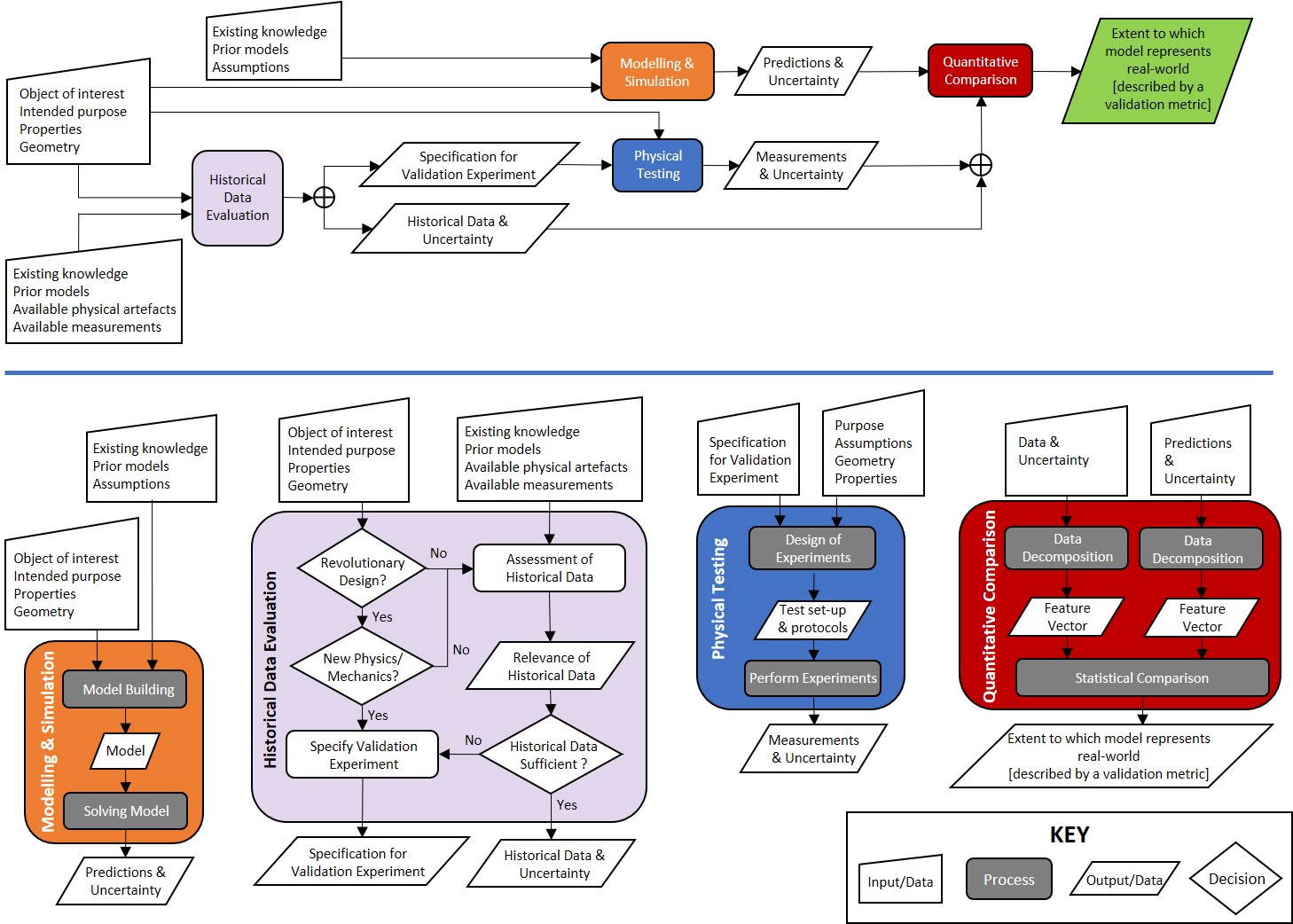
After 12 months, our EU-supported research project, MOTIVATE [see ‘Getting Smarter‘ on June 21st, 2017] is one-third complete in terms of time; and, as in all research it appears to have made a slow start with much effort expended on conceptualizing, planning, reviewing prior research and discussions.  However, we are on-schedule and have delivered on one of our four research tasks with the result that we have a new validation metric and a new flowchart for the validation process.  The validation metric was revealed at the Photomechanics 2018 conference in Toulouse earlier this year [see ‘Massive Engineering‘ on April 4th, 2018].  The new flowchart [see the graphic] is the result of a brainstorming [see ‘Brave New World‘ on January 10th, 2018] and much subsequent discussion; and will be presented at a conference in Brussels next month [ICEM 2018] at which we will invite feedback [proceedings paper].  The big change from the classical flowchart [see for example ASME V&V guide] is the inclusion of historical data with the possibility of not requiring experiments to provide data for validation purposes. This is probably a paradigm shift for the engineering community, or at least the V&V [Validation & Verification] community.  So, we are expecting some robust feedback – feel free to comment on this blog!

References:

Hack E, Burguete RL, Dvurecenska K, Lampeas G, Patterson EA, Siebert T & Szigeti E, Steps toward industrial validation experiments, In Proceedings Int. Conf. Experimental Mechanics, Brussels, July 2018 [pdf here].

Dvurcenska K, Patelli E & Patterson EA, What’s the probability that a simulation agrees with your experiment? In Proceedings Photomechanics 2018, Toulouse, March 2018.


Third time lucky

At the end of last year my research group had articles published by the Royal Society’s journal  Open Science in two successive months [see ‘Press Release!‘ on November 15th, 2017 and ‘Slow moving nanoparticles‘ on December 13th, 2017].  I was excited about both publications because I had only had one article published before by the Royal Society and because the Royal Society issues a press release whenever it publishes a new piece of science.  However, neither press release generated any interest from anyone; probably because science does not sell newspapers (or attract viewers) unless it is bad news or potentially life-changing.  And our work on residual stress around manufactured holes in aircraft or on the motion of nanoparticles does not match either of these criteria.

Last month, we did it again with an article on ‘An experimental study on the manufacture and characterization of in-plane fibre-waviness defects in composites‘.  Third time lucky, because this time our University press office were interested enough to write a piece for the news page of the University website, entitled ‘Engineers develop new method to recreate fibre waviness defects in lab‘.  Fibre waviness is an issue in the manufacture of structural components of aircraft using carbon fibre reinforced composites because kinks or waves in the fibres can cause structural weaknesses.  As part of his PhD, supported by Airbus and the UK Engineering and Physical Sciences Research Council (EPSRC), Will Christian developed an innovative technique to generate defects in our lab so that we can gain a better understanding of them. Read the article or the press release to find out more!

Image shows fracture through a waviness-defect in the top-ply of a carbon-fibre laminate observed in a microscope following sectioning after failure.

Reference:

Christian WJR, DiazDelaO FA, Atherton K & Patterson EA, An experimental study on the manufacture and characterisation of in-plane fibre-waviness defects in composites, R. Soc. open sci. 5:180082, 2018.

A short scramble in the Hindu Kush

I have been resolving an extreme case of Tsundoku [see ‘Tsundoki‘ on May 24th, 2017] over the last few weeks by reading ‘A short walk in the Hindu Kush‘ by Eric Newby which I bought nearly forty years ago but never read, despite taking it on holiday a couple of years ago.  Although it was first published in 1958, it is still in print and on its 50th edition; so, it has become something of classic piece of travel writing.  It is funny, understated and very English, or least early to mid 20th century English.

It felt quite nostalgic for me because about thirty years ago I took a short walk in Gilgit Baltistan. Gilgit Baltistan is in northern Pakistan on the border with China and to the west of Nuristan in Afghanistan where Eric Newby and Hugh Carless took their not-so short walk.  I went for a scramble up a small peak to get a better view of the mountains in the Hindu Kush after a drive of several days up the Karakorum Highway.  We were driven from Islamabad to about a mile short of the border with China on the Khunjerab pass at 4730 m [compared to Mont Blanc at 4810 m].

I was there because the Pakistani Government supplied a small group of lecturers with a mini-bus and driver to take us up the Karakorum Highway [and back!] in exchange for a course of CPD [Continuing Professional Development] lectures on structural integrity.  This we delivered in Islamabad to an audience of academics and industrialists during the week before the trip up the Karakoram Highway.  So, Eric Newby’s description of whole villages turning out to greet them and of seeing apricots drying in the sun on the flat roofs of the houses brought back memories for me.

INSTRUCTIVE research relevance

The Southwest airplane accident last week has been initially attributed to a fatigue crack in a fan blade in the engine.  One of the reasons that this an extremely rare event is the enormous research effort that has been expended on the design, testing and maintenance of the engines and the airframe.  It’s an ongoing research effort to address the trilemma of aircraft that are safe, sustainable and low cost to build and operate.  In collaboration with Strain Solutions Limited, we are in the last year of a three-year project called INSTRUCTIVE which is funded by the Clean Sky 2 programme of the European Commission [see ‘Instructive report and Brexit‘ on March 29th, 2017].   The focus of the research is the development of techniques for use in the aerospace industry to detect the initiation of cracks in the airframe before the crack is visible to the naked eye [see ‘Instructive update‘ on October 4th, 2017].  Laboratory-based techniques exist with this capability and the objective is to transfer the technology to the industrial scale and environment – initially in structural tests performed as part of the design and certification process and perhaps later as part of inspections of aircraft in service.  So far, we have moved from the small components reported in the update posted in October, to a chunk of aircraft fuselage in our lab and we are preparing to participate in a test being conducted by Airbus later this year.

We are also planning a knowledge exchange workshop on ‘Real-time damage tracking in engineering structures’ on November 21st, 2018 at the University of Liverpool’s London campus.  The one-day workshop is being organised in collaboration with the British Society for Strain Measurement.  More details to follow – it will be free!

Image Credit: Powering the 737: CFM56-7 series | by Frans Zwart at https://www.flickr.com/photos/15545136@N06/9719995154  [CC BY-NC-ND 2.0]