Category Archives: mechanics

Hierarchical modelling in engineering and biology

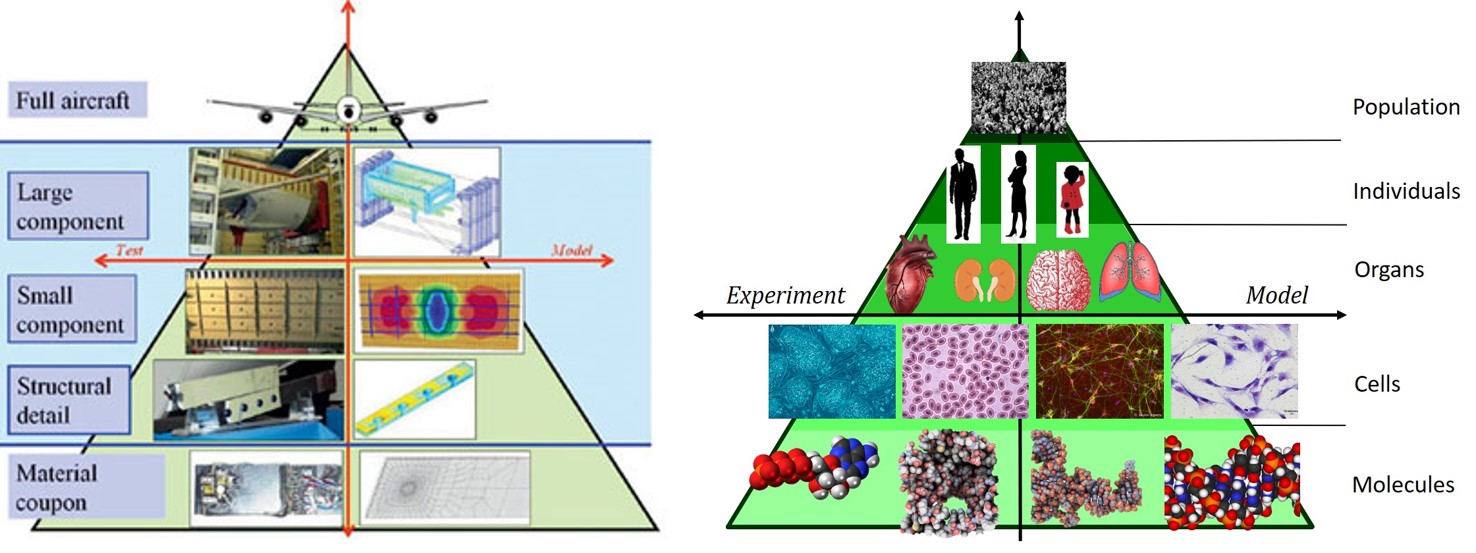
In the 1979 Glenn Harris proposed an analytical hierarchy of models for estimating tactical force effectiveness for the US Army which was represented as a pyramid with four layers with a theatre/campaign simulation at the apex supported by mission level simulations below which was engagement model and engineering models of assets/equipment at the base.  The idea was adopted by the aerospace industry [see the graphic on the left] who place the complete aircraft on the apex supported by systems, sub-systems and components beneath in increasing numbers with the pyramid divided vertically in half to represent physical tests on one side and simulations on the other.  This represents the need to validate predictions from computational models with measurements in the real-world [see post on ‘Model validation‘ on September 18th, 2012]. These diagrams are schematic representations used by engineers to plan and organise the extensive programmes of modelling and physical testing undertaken during the design of new aircraft [see post on ‘Models as fables‘ on March 16th, 2016].  The objective of the MOTIVATE research project is to reduce quantity and increase the quality of the physical tests so that pyramid becomes lop-sided, i.e. the triangle representing the experiments and tests is a much thinner slice than the one representing the modelling and simulations [see post on ‘Brave New World‘ on January 10th, 2018].

At the same time, I am working with colleagues in toxicology on approaches to establishing credibility in predictive models for chemical risk assessment.  I have constructed an equivalent pyramid to represent the system hierarchy which is shown on the right in the graphic.  The challenge is the lack of measurement data in the top left of the pyramid, for both moral and legal reasons, which means that there is very limited real-world data available to confirm the predictions from computational models represented on the right of the pyramid.  In other words, my colleagues in toxicology, and computational biology in general, are where my collaborators in the aerospace industry would like to be while my collaborators in the aerospace want to be where the computational biologists find themselves already.  The challenge is that in both cases a paradigm shift is required from objectivism toward relativism;  since, in the absence of comprehensive real-world measurement data, validation or confirmation of predictions becomes a social process involving judgement about where the predictions lie on a continuum of usefulness.

Sources:

Harris GL, Computer models, laboratory simulators, and test ranges: meeting the challenge of estimating tactical force effectiveness in the 1980’s, US Army Command and General Staff College, May 1979.

Trevisani DA & Sisti AF, Air Force hierarchy of models: a look inside the great pyramid, Proc. SPIE 4026, Enabling Technology for Simulation Science IV, 23 June 2000.

Patterson EA & Whelan MP, A framework to establish credibility of computational models in biology, Progress in Biophysics and Molecular Biology, 129:13-19, 2017.

Designing for damage

Eighteen months ago I wrote about an insight on high-speed photography that Clive Siviour shared during his 2016 JSA Young Investigator Lecture [see my post entitled ‘Popping balloons‘ on June 15th, 2016].  Clive is interested in high-speed photography because he studies the properties of materials when they are subject to very high rates of deformation, in particular polymers used in mobile phones and cycle helmets – the design requirements for these two applications are very different.  The polymer used in the case of your mobile phone needs to protect the electronics inside your phone by absorbing the kinetic energy when you drop the phone on a tiled floor and it needs to be able to do this repeatedly because you are unlikely to replace the case after each accidental drop. A cyclist’s helmet also needs to protect what is inside it but it only needs to do this once because you will replace your helmet after an accident.  So, the kinetic energy resulting from an impact can be dissipated through the propagation of damage in the helmut; but in the phone case, it has to be absorbed temporarily as strain energy and then released, like in a spring.

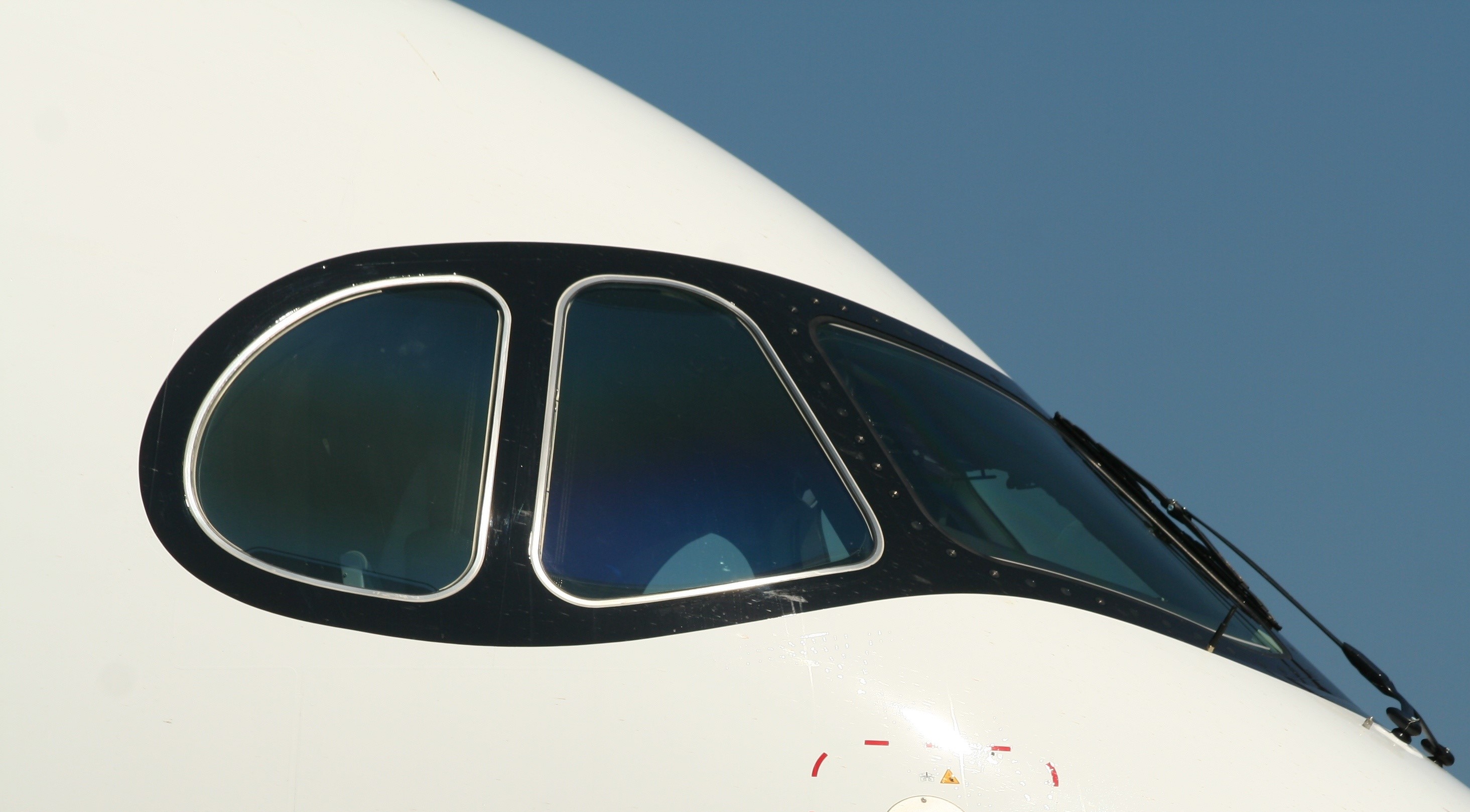
Of course there is at least an order of magnitude difference in the consequences associated with the design of a phone case and a cycle helmet.  We can step up the consequences, at least another order of magnitude, by considering the impact performance of the polycarbonate used in the cockpit windows of airplanes.  These need to able absorb the energy associated with impacts by birds, runway debris and other objects, as well as withstanding the cycles of pressurisation associated with take-off, cruising at altitude and landing.  They can be replaced after an event but only once the plane as landed safely.  Consequently, an in-depth understanding of the material behaviour under these different loading conditions is needed to produce a successful design.  Of course, we also need a detailed knowledge of the loading conditions, which are influenced not just by the conditions and events during flight but also the way in which the window is attached to the rest of the airplane.  A large and diverse team is needed to ensure that all of this knowledge and understanding is effectively integrated in the design of the cockpit window.  The team is likely to include experts in materials, damage mechanics, structural integrity, aerodynamic loading as well as manufacturing and finance, since the window has to be made and fitted into the aircraft at an acceptable cost.  A similar team will be needed to design the mobile phone casing with the addition of product design and marketing expertise because it is a consumer product.  In other words, engineering is team activity and engineers must be able to function as team members and leaders.

I wrote this post shortly after Clive’s lecture but since then it is has languished in my drafts folder – in part because I thought it was too long and boring.  However, my editor encourages me to write about engineering more often and so, I have dusted it off and shortened it (slightly!).

Image: https://commons.wikimedia.org/wiki/File:Airbus_A350_cockpit_windows_(14274972354).jpg

Slow moving nanoparticles

Random track of a nanoparticle superimposed on its image generated in the microscope using a pin-hole and narrowband filter.

A couple of weeks ago I bragged about research from my group being included in a press release from the Royal Society [see post entitled ‘Press Release!‘ on November 15th, 2017].  I hate to be boring but it’s happened again.  Some research that we have been performing with the European Union’s Joint Research Centre in Ispra [see my post entitled ‘Toxic nanoparticles‘ on November 13th, 2013] has been published this morning by the Royal Society Open Science.

Our experimental measurements of the free motion of small nanoparticles in a fluid have shown that they move slower than expected.  At low concentrations, unexpectedly large groups of molecules in the form of nanoparticles up to 150-300nm in diameter behave more like an individual molecule than a particle.  Our experiments support predictions from computer simulations by other researchers, which suggest that at low concentrations the motion of small nanoparticles in a fluid might be dominated by van der Waals forces rather the thermal motion of the surrounding molecules.  At the nanoscale there is still much that we do not understand and so these findings will have potential implications for predicting nanoparticle transport, for instance in drug delivery [e.g., via the nasal passage to the central nervous system], and for understanding enhanced heat transfer in nanofluids, which is important in designing systems such as cooling for electronics, solar collectors and nuclear reactors.

Our article’s title is ‘Transition from fractional to classical Stokes-Einstein behaviour in simple fluids‘ which does not reveal much unless you are familiar with the behaviour of particles and molecules.  So, here’s a quick explanation: Robert Brown gave his name to the motion of particles suspended in a fluid after reporting the random motion or diffusion of pollen particles in water in 1828.  In 1906, Einstein postulated that the motion of a suspended particle is generated by the thermal motion of the surrounding fluid molecules.  While Stokes law relates the drag force on the particle to its size and fluid viscosity.  Hence, the Brownian motion of a particle can be described by the combined Stokes-Einstein relationship.  However, at the molecular scale, the motion of individual molecules in a fluid is dominated by van der Waals forces, which results in the size of the molecule being unimportant and the diffusion of the molecule being inversely proportional to a fractional power of the fluid viscosity; hence the term fractional Stokes-Einstein behaviour.  Nanoparticles that approach the size of large molecules are not visible in an optical microscope and so we have tracked them using a special technique based on imaging their shadow [see my post ‘Seeing the invisible‘ on October 29th, 2014].

Source:

Coglitore D, Edwardson SP, Macko P, Patterson EA, Whelan MP, Transition from fractional to classical Stokes-Einstein behaviour in simple fluids, Royal Society Open Science, 4:170507, 2017. doi:

Press release!

A jumbo jet has about six million parts of which roughly half are fasteners – that’s a lot of holes.

It is very rare for one of my research papers to be included in a press release on its publication.  But that’s what has happened this month as a consequence of a paper being included in the latest series published by the Royal Society.  The contents of the paper are not earth shattering in terms of their consequences for humanity; however, we have resolved a long-standing controversy about why cracks grow from small holes in structures [see post entitled ‘Alan Arnold Griffith‘ on  April 26th, 2017] that are meant to be protected from such events by beneficial residual stresses around the hole.  This is important for aircraft structures since a civilian airliner can have millions of holes that contain rivets and bolts which hold the structure together.

We have used mechanical tests to assess fatigue life, thermoelastic stress analysis to measure stress distributions [see post entitled ‘Counting photons to measure stress‘ on November 18th, 2015], synchrotron x-ray diffraction to evaluate residual stress inside the metal and microscopy to examine failure surfaces [see post entitled ‘Forensic engineering‘ on July 22nd, 2015].  The data from this diverse set of experiments is integrated in the paper to provide a mechanistic explanation of how cracks exploit imperfections in the beneficial residual stress field introduced by the manufacturing process and can be aided in their growth by occasional but modest overloads, which might occur during a difficult landing or take-off.

The success of this research is particularly satisfying because at its heart is a PhD student supported by a dual PhD programme between the University of Liverpool and National Tsing Hua University in Taiwan.  This programme, which supported by the two partner universities, is in its sixth year of operation with a steady state of about two dozen PhD students enrolled, who divide their time between Liverpool, England and Hsinchu, Taiwan.  The synchrotron diffraction measurements were performed, with a colleague from Sheffield Hallam University, at the European Synchrotron Research Facility (ESRF) in Grenoble, France; thus making this a truly international collaboration.

Source:

Amjad K, Asquith D, Patterson EA, Sebastian CM & Wang WC, The interaction of fatigue cracks with a residual stress field using thermoelastic stress analysis and synchrotron x-ray diffraction experiments, R. Soc. Open Sci. 4:171100.