 A month or so ago I gave a lecture entitled ‘Establishing FACTS (Fidelity And Credibility in Tests & Simulations)’ to the local branch of the Institution of Engineering Technology (IET). Of course my title was a play on words because the Oxford English Dictionary defines a ‘fact’ as ‘a thing that is known or proved to be true’ or ‘information used as evidence or as part of report’. One of my current research interests is how we establish predictions from simulations as evidence that can be used reliably in decision-making. This is important because simulations based on computational models have become ubiquitous in engineering for, amongst other things, design optimisation and evaluation of structural integrity. These models need to possess the appropriate level of fidelity and to be credible in the eyes of decision-makers, not just their creators. Model credibility is usually provided through validation processes using a small number of physical tests that must yield a large quantity of reliable and relevant data [see ‘Getting smarter‘ on June 21st, 2017]. Reliable and relevant data means making measurements with low levels of uncertainty under real-world conditions which is usually challenging.
These topics recur through much of my research and have found applications in aerospace engineering, nuclear engineering and biology. My lecture to the IET gave an overview of these ideas using applications from each of these fields, some of which I have described in past posts. So, I have now created a new page on this blog with a catalogue of these past posts on the theme of ‘FACTS‘. Feel free to have a browse!

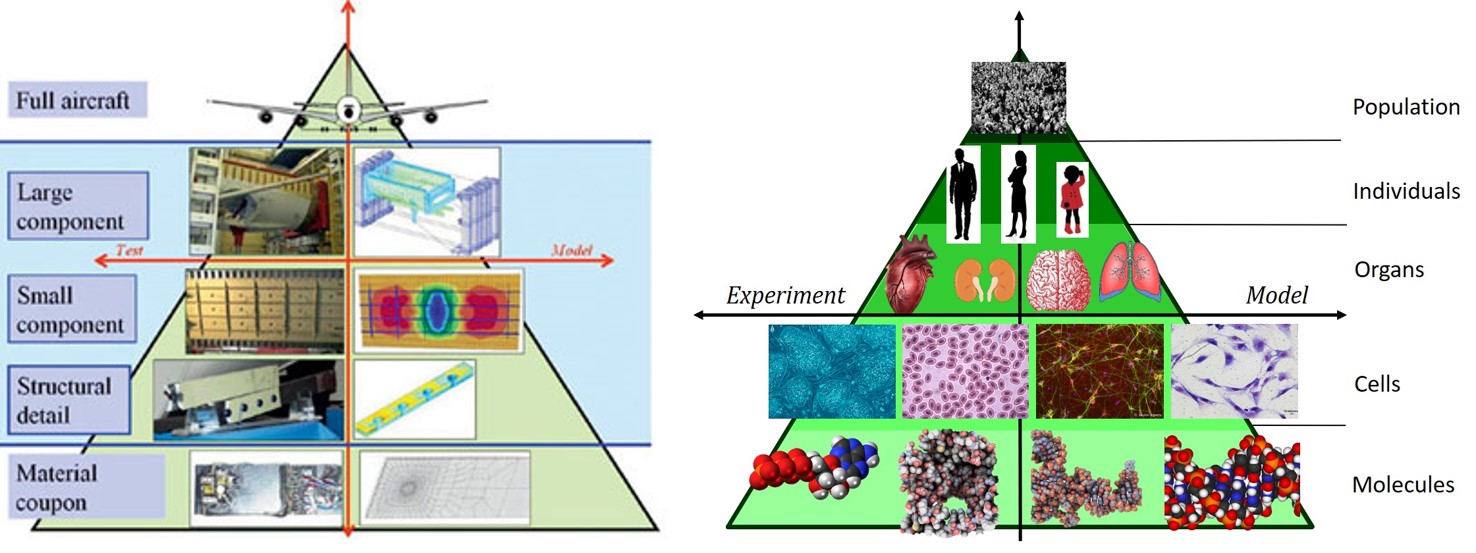

 Term has started, and our students are preparing for end-of-semester examinations; so, I suspect that they would welcome the opportunity to deploy the sleeping-learning that Aldous Huxley envisaged in his ‘Brave New World’ of 2540. In the brave new world of digital engineering, some engineers are attempting to conceive of a world in which experiments have become obsolete because we can rely on computational modelling to simulate engineering systems. This ambitious goal is a driver for the MOTIVATE project [see my post entitled ‘
 Realize Engineering
