Tag Archives: science

Size matters

Most of us have a sub-conscious understanding of the forces that control the interaction of objects in the size scale in which we exist, i.e. from millimetres through to metres.  In this size scale gravitational and inertial forces dominate the interactions of bodies.  However, at the size scale that we cannot see, even when we use an optical microscope, the forces that the dominate the behaviour of objects interacting with one another are different.  There was a hint of this change in behaviour observed in our studies of the diffusion of nanoparticles [see ‘Slow moving nanoparticles‘ on December 13th, 2017], when we found that the movement of nanoparticles less than 100 nanometres in diameter was independent of their size.  Last month we published another article in one of the Nature journals, Scientific Reports, on ‘The influence of inter-particle forces on diffusion at the nanoscale‘, in which we have demonstrated by experiment that Van der Waals forces and electrostatic forces are the dominant forces at the nanoscale.  These forces control the diffusion of nanoparticles as well as surface adhesion, friction and colloid stability.  This finding is significant because the ionic strength of the medium in which the particles are moving will influence the strength of these forces and hence the behaviour of the nanopartices.  Since biological fluids contain ions, this will be important in understanding and predicting the behaviour of nanoparticles in biological applications where they might be used for drug delivery, or have a toxicological impact, depending on their composition.

Van der Waals forces are weak attractive forces between uncharged molecules that are distance dependent.  They are named after a Dutch physicist, Johannes Diderik van der Waals (1837-1923).  Electrostatic forces occur between charged particles or molecules and are usually repulsive with the result that van der Waals and electrostatic forces can balance each other, or not depending on the circumstances.

Sources:

Giorgi F, Coglitore D, Curran JM, Gilliland D, Macko P, Whelan M, Worth A & Patterson EA, The influence of inter-particle forces on diffusion at the nanoscale, Scientific Reports, 9:12689, 2019.

Coglitore D, Edwardson SP, Macko P, Patterson EA, Whelan MP, Transition from fractional to classical Stokes-Einstein behaviour in simple fluids, Royal Society Open Science, 4:170507, 2017. doi: .

Patterson EA & Whelan MP, Tracking nanoparticles in an optical microscope using caustics. Nanotechnology, 19 (10): 105502, 2009.

Image: from Giorgi et al 2019, figure 1 showing a photograph of a caustic (top) generated by a 50 nm gold nanoparticle in water taken with the optical microscope adjusted for Kohler illumination and closing the condenser field aperture to its minimum following method of Patterson and Whelan with its 2d random walk over a period of 3 seconds superimposed and a plot of the same walk (bottom).

Thought leadership in fusion engineering

The harnessing of fusion energy has become something of a holy grail – sought after by many without much apparent progress.  It is the energy process that ‘powers’ the stars and if we could reproduce it on earth in a controlled environment then it would offer almost unlimited energy with very low environmental costs.  However, understanding the science is an enormous challenge and the engineering task to design, build and operate a fusion-fuelled power station is even greater.  The engineering difficulties originate from the combination of two factors: the emergent behaviour present in the complex system and that it has never been done before.  Engineering has achieved lots of firsts but usually through incremental development; however, with fusion energy it would appear that it will only work when all of the required conditions are present.  In other words, incremental development is not viable and we need everything ready before flicking the switch.  Not surprisingly, engineers are cautious about flicking switches when they are not sure what will happen.  Yet, the potential benefits of getting it right are huge; so, we would really like to do it.  Hence, the holy grail status: much sought after and offering infinite abundance.

Last week I joined the search, or at least offered guidance to those searching, by publishing an article in Royal Society Open Science on ‘An integrated digital framework for the design, build and operation of fusion power plants‘.  Working with colleagues at the Culham Centre for Fusion Energy, Richard Taylor and I have taken our earlier work on an integrated nuclear digital environment for the nuclear energy using fission [see ‘Enabling or disruptive technology for nuclear engineering?‘ on january 28th, 2015] and combined it with the hierarchical pyramid of testing and simulation used in the aerospace industry [see ‘Hierarchical modelling in engineering and biology‘ on March 14th, 2018] to create a framework that can be used to guide the exploration of large design domains using computational models within a distributed and collaborative community of engineers and scientists.  We hope it will shorten development times, reduce design and build costs, and improve credibility, operability, reliability and safety.  It is a long list of potential benefits for a relatively simple idea in a relatively short paper (only 12 pages).  Follow the link to find out more – it is an open access paper, so it’s free.

References

Patterson EA, Taylor RJ & Bankhead M, A framework for an integrated nuclear digital environment, Progress in Nuclear Energy, 87:97-103, 2016.

Patterson EA, Purdie S, Taylor RJ & Waldon C, An integrated digital framework for the design, build and operation of fusion power plants, Royal Society Open Science, 6(10):181847, 2019.

Engineering as the very spirit and soul of your existence

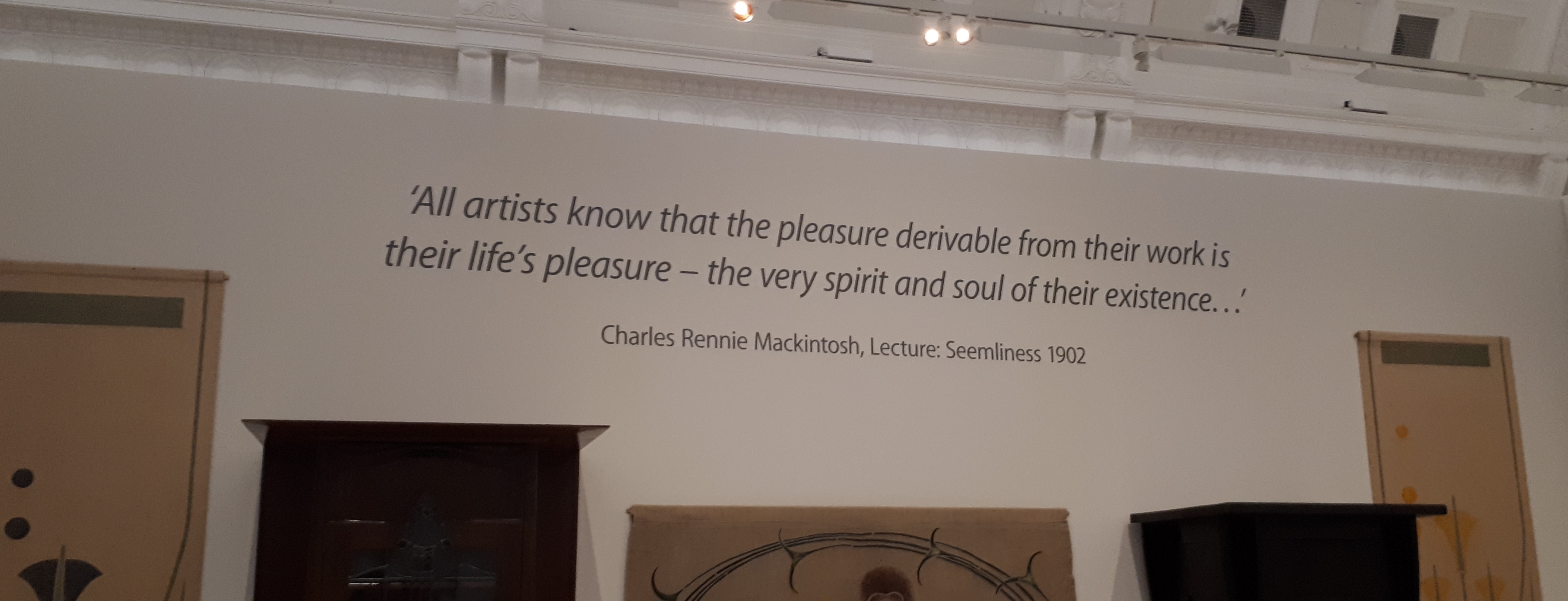
I wrote some weeks ago about art challenging the way we think and artists being spokespeople for society [see ‘Spokesperson for society’ on August 28th, 2019] and also about ‘Taking a sketch instead of snapping a photo’ [on September 3rd, 2019].  My photo of the sketch taken by Rennie Mackintosh was snapped at an exhibition in Walker Art Gallery in Liverpool; and, on the wall of the gallery was a quote from Rennie Mackintosh: ‘All artists know that pleasure derivable from their work is their life’s pleasure – the very spirit and soul of their existence’.  I feel the same way about my work as an engineer and I think that many of my colleagues would agree with me.  In my welcome talk to new engineering undergraduate students last week, I used this quote and tried to convey the extent to which science and engineering is a part of my existence and how I hoped it would become a part of their life.  I am not sure that I convinced very many of them.

Photograph taken on 17th August 2019 by the author at the Rennie Mackintosh Exhibition at the Walker Art Gallery, Liverpool.

Engineering correspondents needed

Society’s perception  of scientists and engineers is not well-balanced; scientists tend to get the headlines when they make new discoveries while engineers are only in the headlines when things go wrong.  Even worse, when I was a student, the successes of the NASA’s space shuttle were usually reported as scientific achievements while its problems were engineering failures; when the whole programme was an enormous feat of engineering!  Perhaps this is because news organisations tend to have science correspondents and editors but no engineering correspondents.  When you search for engineering journalism jobs most of the results relate to roles associated with the technology of journalism; whereas a search for science journalism jobs results in dozens of vacancies for science writers, correspondents and editors.  The lack of engineering correspondents has been evident in the UK during the past week in reporting about the potential bursting of the dam at Toddbrock Reservoir and flooding of the town of Whaley Bridge in Derbyshire UK.  A 188 year old dam has been damaged by the turbulent flow of water over its spillway following unprecedented levels of rainfall (e.g. https://www.bbc.co.uk/news/uk-england-derbyshire-49222956). There is little discussion of the significant achievement of the Victorian engineers who designed and built a dam in the 1831 that has lasted 188 years or that climate change is causing shifts in weather patterns which have altered the design specifications for engineering infrastructure including dams, bridges and sea defences.  We need more journalists to write about engineering and preferable more journalists who have been educated as engineers particularly as society starts to face the potential existential threat caused by climate change and over-population.

For more on the nature of engineering, and its relationship to science, see ‘Making things happen‘ on September 26th, 2018; ‘Engineering is all about ingenuity‘ on September 14th, 2016 and ‘Life takes engineering‘ on April 22nd 2015.

And on the communication skills of engineers: ‘Poetasting engineers‘ on March 4th, 2015 and ‘Einstein and public engagement‘ on August 8th, 2018.