 Last month I spent almost a week in Zurich. It is one of our favourite European cities [see ‘A reflection of existentialism‘ on December 20th, 2017]; however, on this occasion there was no time for sight-seeing because I was there for the mid-term meeting of the MOTIVATE project and to conduct some tests and demonstrations in the laboratories of our host, EMPA, the Swiss Federal Laboratories for Materials Science and Technology. Two of our project partners, Dantec Dynamics GmbH based in Ulm, Germany, and the Athena Research Centre in Patras, Greece, have developed methods for quantifying the uncertainty present in measurements of deformation made in an industrial environment using digital image correlation (DIC) [see ‘256 shades of grey‘ on January 22, 2014]. Digital image correlation is a technique in which we usually apply a random speckle pattern to the object which allows us to track the movement of the object surface over time by searching for the new position of the speckles in the photographs of the object. If we use a pair of cameras in a stereoscopic arrangement, then we can measure in-plane and out-of-plane displacements. Digital image correlation is a well-established measurement technique that has become ubiquitous in mechanics laboratories. In previous EU projects, we have developed technology for quantifying uncertainty in in-plane [SPOTS project] and out-of-plane [ADVISE project] measurements in a laboratory environment. However, when you take the digital image correlation equipment into an industrial environment, for instance an aircraft hangar to make measurements during a full-scale test, then additional sources of uncertainty and error appear. The new technology demonstrated last month allows these additional uncertainties to be quantified. As part of the MOTIVATE project, we will be involved in a full-scale test on a large section of an Airbus aircraft next year and so, we will be able to utilise the new technology for the first time.
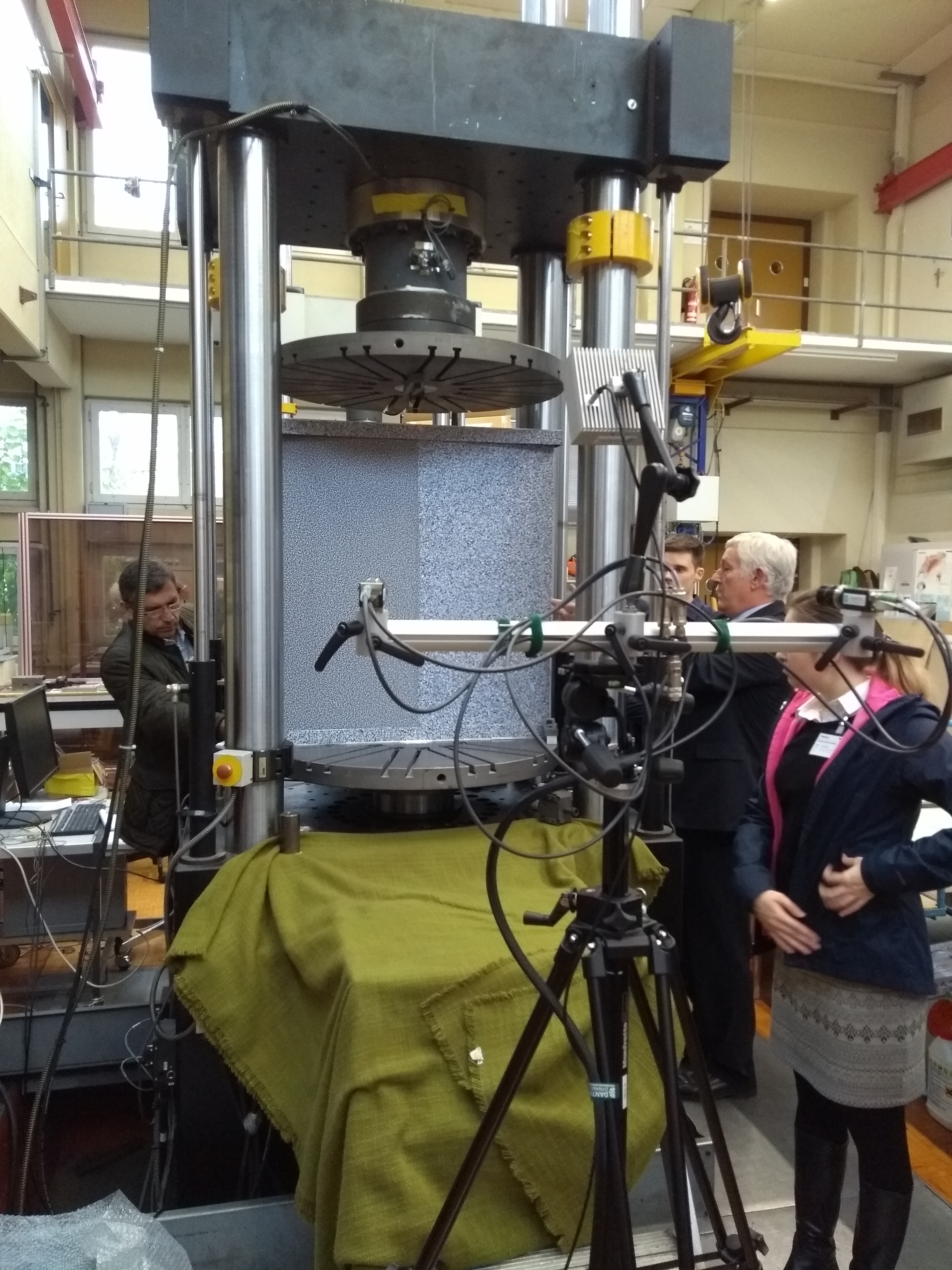
The photograph shows preparations for the demonstrations in EMPA’s laboratories. In the foreground is a stereoscopic digital image correlation system with which we are about to make measurements of deformation of a section of aircraft skin, supplied by Airbus, which has a speckle pattern on its surface and is about to be loaded in compression by the large servo-hydraulic test machine.

References:
From SPOTS project:
From ADVISE project: