Monthly Archives: July 2018

Establishing fidelity and credibility in tests & simulations (FACTS)

A month or so ago I gave a lecture entitled ‘Establishing FACTS (Fidelity And Credibility in Tests & Simulations)’ to the local branch of the Institution of Engineering Technology (IET). Of course my title was a play on words because the Oxford English Dictionary defines a ‘fact’ as ‘a thing that is known or proved to be true’ or ‘information used as evidence or as part of report’.   One of my current research interests is how we establish predictions from simulations as evidence that can be used reliably in decision-making.  This is important because simulations based on computational models have become ubiquitous in engineering for, amongst other things, design optimisation and evaluation of structural integrity.   These models need to possess the appropriate level of fidelity and to be credible in the eyes of decision-makers, not just their creators.  Model credibility is usually provided through validation processes using a small number of physical tests that must yield a large quantity of reliable and relevant data [see ‘Getting smarter‘ on June 21st, 2017].  Reliable and relevant data means making measurements with low levels of uncertainty under real-world conditions which is usually challenging.

These topics recur through much of my research and have found applications in aerospace engineering, nuclear engineering and biology. My lecture to the IET gave an overview of these ideas using applications from each of these fields, some of which I have described in past posts.  So, I have now created a new page on this blog with a catalogue of these past posts on the theme of ‘FACTS‘.  Feel free to have a browse!

Nauseous blogging?

In his novel ‘Nausea’, Jean-Paul Sartre suggests that at around forty, experienced professionals ‘christen their small obstinacies and a few proverbs with the name of experience, they begin to simulate slot machines: put in a coin in the left hand slot and you get tales wrapped in silver paper, put a coin in the slot on the right and you get precious bits of advice that stick to your teeth like caramels’.  When I first read this passage a few weeks ago, it seemed like an apt description of a not-so-young professor writing a weekly blog.

I am on vacation combining the positive effects of reading [see ‘Reading offline‘  on March 19th, 2014] and walking [see ‘Gone walking‘ on April 19th, 2017] with a digital detox [see ‘In digital detox‘ on July 19th, 2017]; but, through the scheduling facilities provided by WordPress, I am still able to dispense my slot machine homily. I will leave you to decide which posts are from the left and right slots.

Source:

Jean-Paul Sartre, Nausea, translated by Lloyd Alexander, New York: New Directions Pub. Co., 2013.

La Nausée was first published in 1938 by Librairie Gallimard, Paris.

Experiences in the lecture theatre

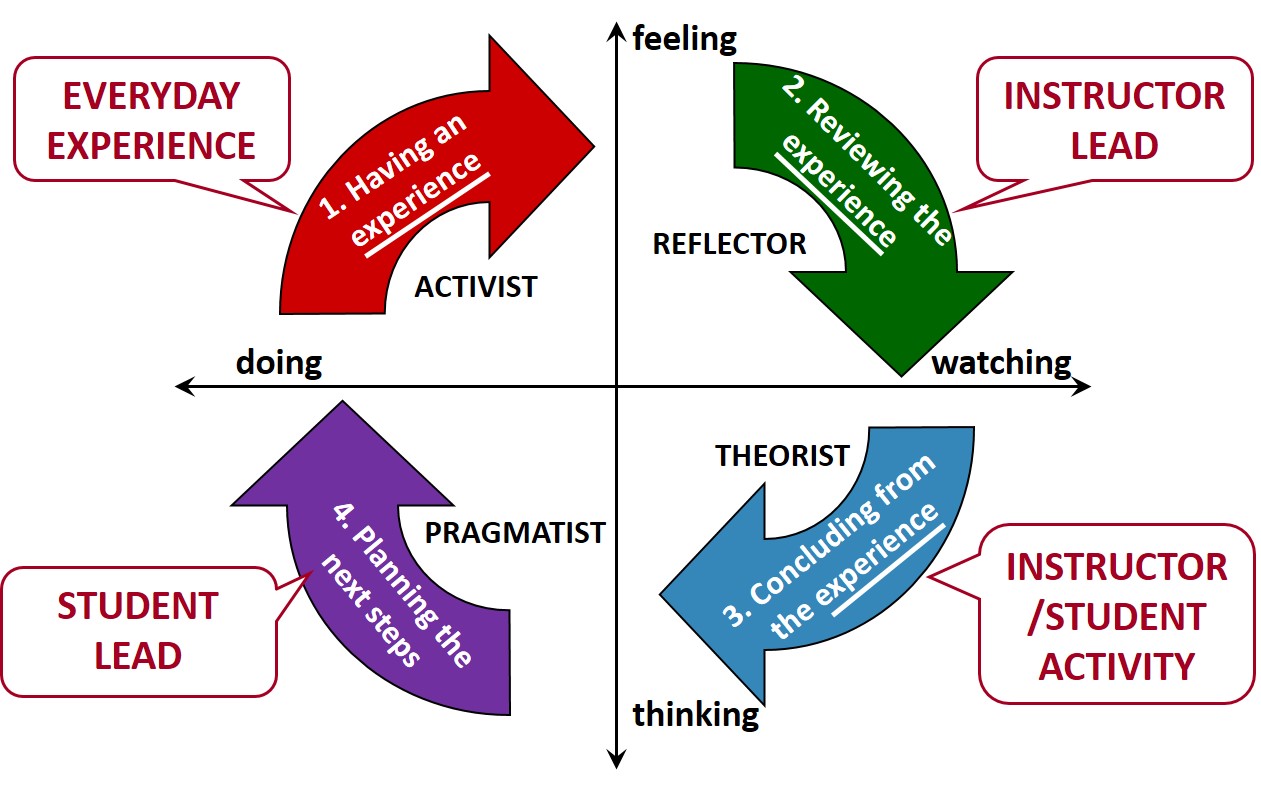
I wrote a couple of weeks ago about cycling students around Honey and Mumford’s learning modes [See ‘So how do people learn?‘ on June 20th 2018] without explaining how this might be achieved in a lecture course.  The first step in the cycle is having an experience, which is difficult for a student in a lecture theatre with dozens of other people.  A demonstration by the lecturer does not achieve it because the student is not doing and feeling.

So, how can the first step be achieved in a traditional engineering lecture course?  Well one answer, for introductory courses, is to exploit the everyday experiences of the students by choosing something that they will have done for themselves, preferably more than once.  It can be useful to perform a demonstration at the start of the lecture to engage the students and remind them about their own experience.  All of the lesson plans provided on this blog start with this kind of activity [https://realizeengineering.blog/everyday-engineering-examples/].

The lecture can proceed to reviewing the experience and building a new context around it, i.e. the engineering principles that are being taught.  It might necessary to review the experience in several different ways and make a series of connections to it.  I recommend that the third step: concluding from the experience, should be a student activity guided by the instructor – perhaps a piece of homework that leads the student to take the fourth step on their own, becoming a Pragmatist by planning their next steps.

Doris Lessing, Nobel Laureate for Literature, in ‘The Four-gated City‘ wrote ‘That is what learning is.  You suddenly understand something you’ve understood all your life, but in a new way.’  Understanding an everyday experience a new [engineering] way is what we are trying to achieve.


CALE #4 [Creating A Learning Environment: a series of posts based on a workshop given periodically by Pat Campbell and Eann Patterson in the USA supported by NSF and the UK supported by HEA]

Fourth industrial revolution

Have you noticed that we are in the throes of a fourth industrial revolution?

The first industrial revolution occurred towards the end of the 18th century with the introduction of steam power and mechanisation.  The second industrial revolution took place at the end of the 19th and beginning of the 20th century and was driven by the invention of electrical devices and mass production.  The third industrial revolution was brought about by computers and automation at the end of the 20th century.  The fourth industrial revolution is happening as result of combining physical and cyber systems.  It is also called Industry 4.0 and is seen as the integration of additive manufacturing, augmented reality, Big Data, cloud computing, cyber security, Internet of Things (IoT), simulation and systems engineering.  Most organisations are struggling with the integration process and, as a consequence, are only exploiting a fraction of the capabilities of the new technology.  Revolutions are, by their nature, disruptive and those organisations that embrace and exploit the innovations will benefit while the existence of the remainder is under threat [see [‘The disrupting benefit of innovation’ on May 23rd, 2018].

Our work on the Integrated Nuclear Digital Environment, on Digital Twins, in the MOTIVATE project and on hierarchical modelling in engineering and biology is all part of the revolution.

Links to these research posts:

Enabling or disruptive technology for nuclear engineering?’ on January 28th, 2015

Can you trust your digital twin?’ on November 23rd, 2016

Getting Smarter’ on June 21st, 2017

‘Hierarchical modelling in engineering and biology’ [March 14th, 2018]


Image: Christoph Roser at AllAboutLean.com from https://commons.wikimedia.org/wiki/File:Industry_4.0.png [CC BY-SA 4.0].