Tag Archives: creativity

Meta-knowledge: knowledge about knowledge

As engineers, we like to draw simple diagrams of the systems that we are attempting to analyse because most of us are pictorial problem-solvers and recording the key elements of a problem in a sketch helps us to identify the important issues and select an appropriate solution procedure [see ‘Meta-representational competence’ on May 13th, 2015].  Of course, these simple representations can be misleading if we omit parameters or features that dominate the behaviour of the system; so, there is considerable skill in idealising a system so that the analysis is tractable, i.e. can be solved.  Students find it especially difficult to acquire these skills [see ‘Learning problem-solving skills‘ on October 24th, 2018] and many appear to avoid drawing a meaningful sketch even when examinations marks are allocated to it [see ‘Depressed by exams‘ on January 31st, 2018].  Of course, in thermodynamics it is complicated by the entropy of the system being reduced when we omit parameters in order to idealise the system; because with fewer parameters to describe the system there are fewer microstates in which the system can exist and, hence according to Boltzmann, the entropy will be lower [see ‘Entropy on the brain‘ on November 29th, 2017].  Perhaps this is the inverse of realising that we understand less as we know more.  In other words, as our knowledge grows it reveals to us that there is more to know and understand than we can ever hope to comprehend [see ‘Expanding universe‘ on February 7th, 2018]. Is that the second law of thermodynamics at work again, creating more disorder to counter the small amount of order achieved in your brain?

Image: Sketch made during an example class

Knowledge explosions

Photo credit: Tom

When the next cohort of undergraduate students were born, Wikipedia had only just been founded [January 2001] and Google had been in existence for just over a decade [since 1998].  In their lifetime, the number of articles on Wikipedia has grown to nearly 6 million in the English language, which is equivalent to 2,500 print volumes of the Encyclopedia Britannica, and counting all language editions there are 48 million articles.  When Leonardo Da Vinci was born in 1452, Johan Gutenberg had just published his first Bible using moveable type.  By the time Leonardo Da Vinci was 20 years old, about 15 million books had been printed which was more than all of the scribes in Europe had produced in the previous 1500 years.  Are these comparable explosions in the availability of knowledge?  The proportion of the global population that is literate has changed dramatically from about 2%, when Leonardo was alive, to over 80% today which probably makes the arrival of the internet, Wikipedia and other online knowledge bases much more significant than the invention of the printing press.

Today what matters is not what you know but what you can do with the knowledge because access to the internet via your smart phone has made memorisation redundant.

Nuclear winter school

I spent the first full-week of January 2019 at a Winter School for a pair of Centres for Doctoral Training focussed on Nuclear Energy (see NGN CDT & ICO CDT).  Together the two centres involve eight UK universities and most of the key players in the UK industry.  So, the Winter School offers an opportunity for researchers in nuclear science and engineering, from academia and industry, to gather together for a week and share their knowledge and experience with more than 80 PhD students.  Each student gives a report on the progress of their research to the whole gathering as either a short oral presentation or a poster.  It’s an exhausting but stimulating week for everyone due to both the packed programmme and the range of subjects covered from fundamental science through to large-scale engineering and socio-economic issues.

Here are a few things that caught my eye:

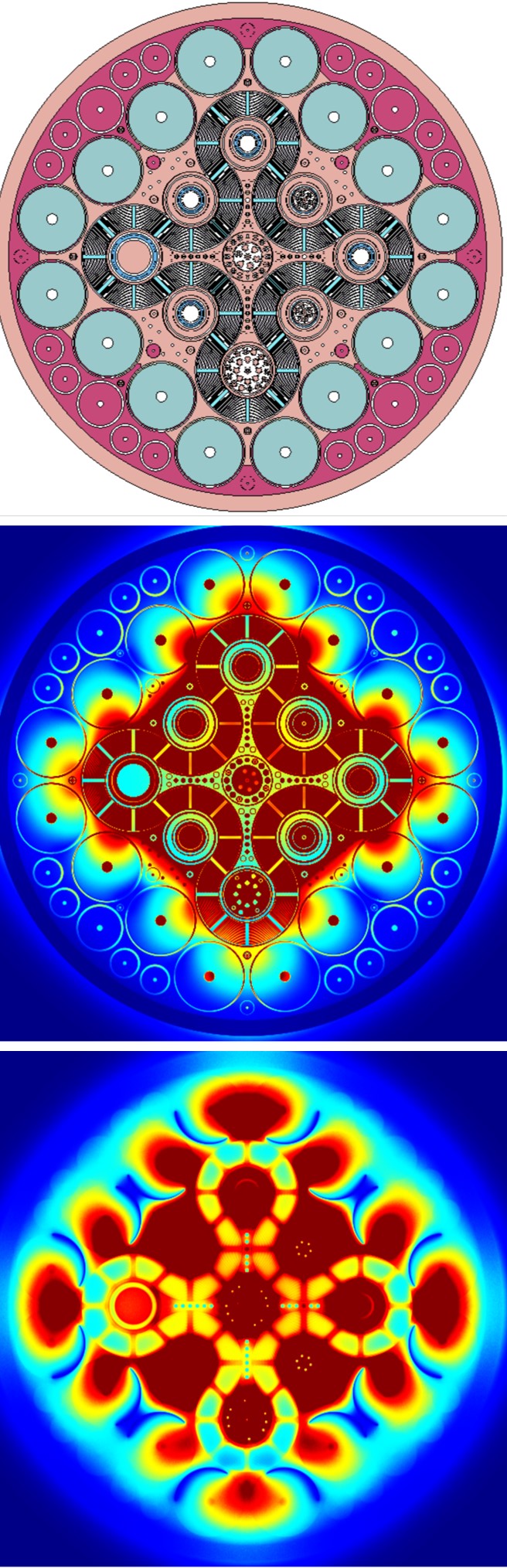
First, the images in the thumbnail above which Paul Cosgrove from the University of Cambridge used to introduce his talk on modelling thermal and neutron fluxes.  They could be from an art gallery but actually they are from the VTT Technical Research Centre of Finland and show the geometry of an advanced test reactor [ATR] (top); the rate of collisions in the ATR (middle); and the neutron density distribution (bottom).

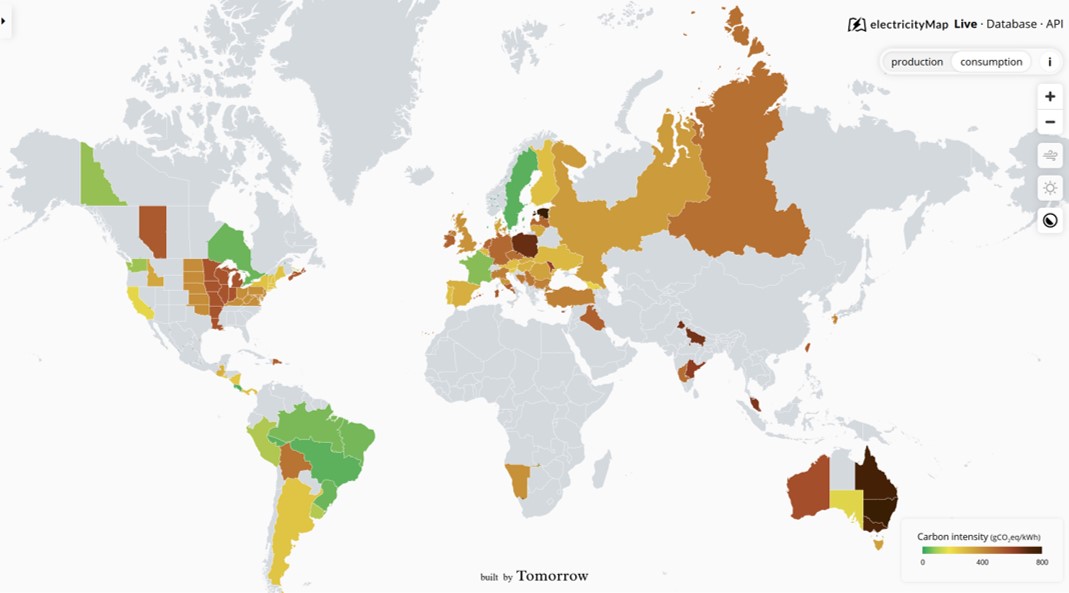
Second, a great app for your phone called electricityMap that shows you a live map of global carbon emissions and when you click on a country it reveals the sources of electricity by type, i.e. nuclear, gas, wind etc, as well as imports and exports of electricity.  Dame Sue Ion told us about it during her key-note lecture.  I think all politicians and journalists need it installed on their phones to check their facts before they start talking about energy policy.

Third, the scale of the concrete infrastructure required in current designs of nuclear power stations compared to the reactor vessel where the energy is generated.  The pictures show the construction site for the Vogtle nuclear power station in Georgia, USA (left) and the reactor pressure vessel being lowered into position (right).  The scale of nuclear power stations was one of the reasons highlighted by Steve Smith from Algometrics for why investors are not showing much interest in them (see ‘Small is beautiful and affordable in nuclear power-stations‘ on January 14th, 2015).  Amongst the other reasons are: too expensive (about £25 billion), too long to build (often decades), too back-end loaded (i.e. no revenue until complete), too complicated (legally, economically & socially), too uncertain politically, too toxic due to poor track record of returns to investors, too opaque in terms of management of industry.  That’s quite a few challenges for the next generation of nuclear scientists and engineers to tackle.  We are making a start by creating design tools that will enable mass-production of nuclear power stations (see ‘Enabling or disruptive technology for nuclear engineering?‘ on January 28th, 2015) following the processes used to produce other massive engineering structures, such as the Airbus A380 (see Integrated Digital Nuclear Design Programme); but the nuclear industry has to move fast to catch up with other sectors of the energy business, such as gas-fired powerstations or wind turbines.  If it were to succeed then the energy market would be massively transformed.


Wading in reflections

I have written before about Daniel Goleman’s analysis of leadership styles [see ‘Clueless on leadership style‘ on June 14th, 2017]; to implement these styles, he identifies, four competencies you require: self-awareness, self-management, social awareness and relationship management.  Once again, I am involved in teaching helping people develop these competencies through our Science & Technology Leadership CPD programme for aspiring leaders in Research & Development [R&D].  As part of the module on Science Leadership and Ethics we have asked our delegates to write a short essay reflecting on the ethics of one or two real events and, either from experience or vicariously, on the leadership associated with them.  Our delegates find this challenging, especially the reflective aspect which is designed to induce them to think about their self, their feelings and their reactions to events.  They are technologists who are used to writing objectively in technical reports and the concept of writing about the inner workings of their mind is alien to them.

Apparently, the author Peter Carey compared writing to ‘wading in the flooded basement of my mind’ and, to stretch the analogy, I suspect that our delegates are worried about getting out of their depth or perhaps they haven’t found the stairs to the basement yet.  We try to help by providing a map in the form of the flowchart in the thumbnail together with the references below.  Nevertheless, this assignment remains an exercise that most undertake by standing at the top of the stairs with a weak flashlight and that few both get their feet wet and tell us what they find in the basement.

References:

A short guide to reflective writing, University of Birmingham, Library Services Academic Skills Centre, https://intranet.birmingham.ac.uk/as/libraryservices/library/skills/asc/documents/public/Short-Guide-Reflective-Writing.pdf

http://www.bbc.co.uk/bitesize/intermediate2/english/folio/personal_reflective_essay/revision/1/

Sources:

Image: https://www.pinterest.co.uk/pin/589901251161855637/

Goleman D, Boyatzis R & McKee A, The new leaders: transforming the art of leadership into the science of results, London: Sphere, 2002.

Dickson A, Books do furnish a lie, FT Weekend, 18/19 August 2018.