 A couple of weeks ago, after reviewing one of my posts, my editor commented that I was repeating myself because I had already written on the same topic in an earlier post. I feel that is inevitable in a weekly blog which has an archive of more than three hundred posts – I am just not sufficiently creative to produce something original every week. Besides, maybe that’s not necessary. Anyhow, today I am returning to a theme that I have written about previously: the Treasury at the Weston Library in Oxford. It is a small museum with a rotating collection of treasures from the Bodleian Library, which until the end of February 2019 is on the topic of ‘Sappho to Suffrage: women who dared‘. As you might expect from the title, the oldest treasure in the exhibition are fragments of a copy from the 2nd century AD of one of Sappho’s poems. Sappho, who lived on the Greek island of Lesbos between 630 and 580 BC, is the first female writer known to Western civilisation. Her work was almost lost – the fragments of papyrus on display were found on an ancient Eygptian rubbish dump. Perhaps this is a good representation of men’s attitude to women’s writing because probably since Sappho, female writers have been neglected by publishers and male readers. As Nilanjana Roy has reported, publishing houses submit more books by male writers for literary prizes and book reviews tend to highlight more books by men than by women. In books written by women the gender of characters in evenly divided, whereas in those written by men, women only occupy between a quarter and third of the character-space and men tend to read books written by men. Perhaps it is unsurprising that many men are lacking in understanding and social awareness of half the population. Encouraged by my wife and daughters, this imbalance in my reading habits is being addressed by reading the books shortlisted for the Women’s Prize for Fiction each year during our summer holidays. I can recommend the 2018 winner ‘Home Fire’ by Kamila Shamsie – it’s very topical, will make you think and pulls you along to its dramatic final page. However, you should also read ‘When I hit you’ by Meena Kandasamy – it was both enlightening and shocking to me, and I was left wondering about the line between fiction and non-fiction. I also really enjoyed last year’s winner: ‘The Power’ by Naomi Alderman.
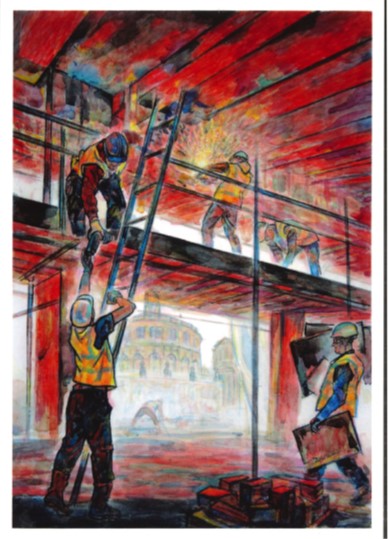
BTW – the thumbnail is a scan of postcard bought in the Weston Library showing a painting by their artist in residence, Dr Weimen He, who captured moments in time during the refurbishment of the library.
Source: Gender and genre: reading the world by Nilanjana Roy in the FT Weekend, Saturday 22 September 2018.
Previous posts featuring the Weston Library Treasury: ‘Pope and Austen‘ on September 9th, 2015, ‘Red Crane‘ on July 26th, 2017 and ‘Ramblings on equality‘ on October 11th, 2017.


 Realize Engineering
