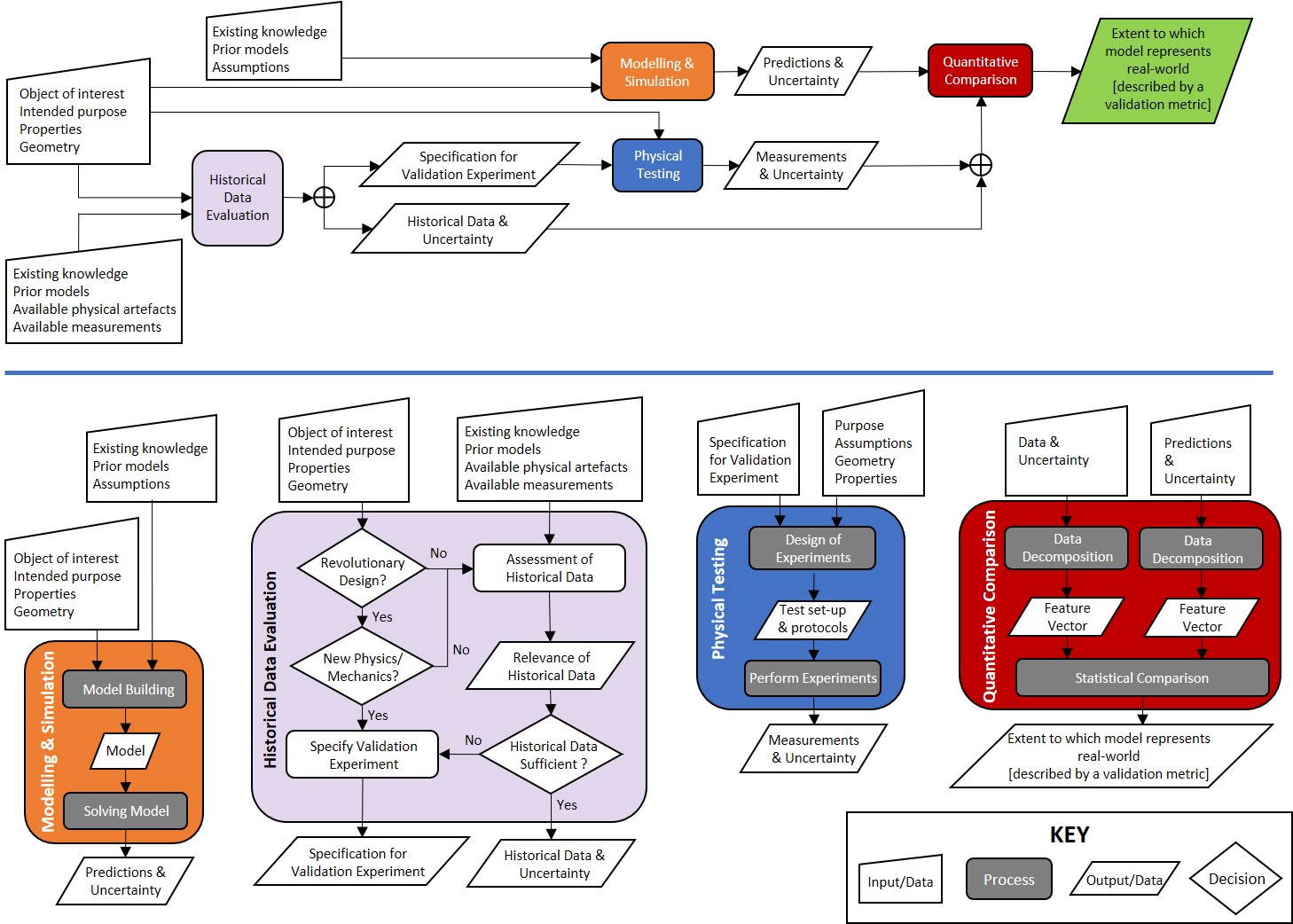
 ‘All models are wrong, but some are useful’ is a quote, usually attributed to George Box, that is often cited in the context of computer models and simulations. Working out which models are useful can be difficult and it is essential to get it right when a model is to be used to design an aircraft, support the safety case for a nuclear power station or inform regulatory risk assessment on a new chemical. One way to identify a useful model to assess its predictions against measurements made in the real-world [see ‘Model validation’ on September 18th, 2012]. Many people have worked on validation metrics that allow predicted and measured signals to be compared; and, some result in a statement of the probability that the predicted and measured signal belong to the same population. This works well if the predictions and measurements are, for example, the temperature measured at a single weather station over a period of time; however, these validation metrics cannot handle fields of data, for instance the map of temperature, measured with an infrared camera, in a power station during start-up. We have been working on resolving this issue and we have recently published a paper on ‘A probabilistic metric for the validation of computational models’. We reduce the dimensionality of a field of data, represented by values in a matrix, to a vector using orthogonal decomposition [see ‘Recognizing strain’ on October 28th, 2015]. The data field could be a map of temperature, the strain field in an aircraft wing or the topology of a landscape – it does not matter. The decomposition is performed separately and identically on the predicted and measured data fields to create to two vectors – one each for the predictions and measurements. We look at the differences in these two vectors and compare them against the uncertainty in the measurements to arrive at a probability that the predictions belong to the same population as the measurements. There are subtleties in the process that I have omitted but essentially, we can take two data fields composed of millions of values and arrive at a single number to describe the usefulness of the model’s predictions.
Our paper was published by the Royal Society with a press release but in the same week as the proposed Brexit agreement and so I would like to think that it was ignored due to the overwhelming interest in the political storm around Brexit rather than its esoteric nature.
Source:




 Realize Engineering