Hierarchical modelling in engineering and biology

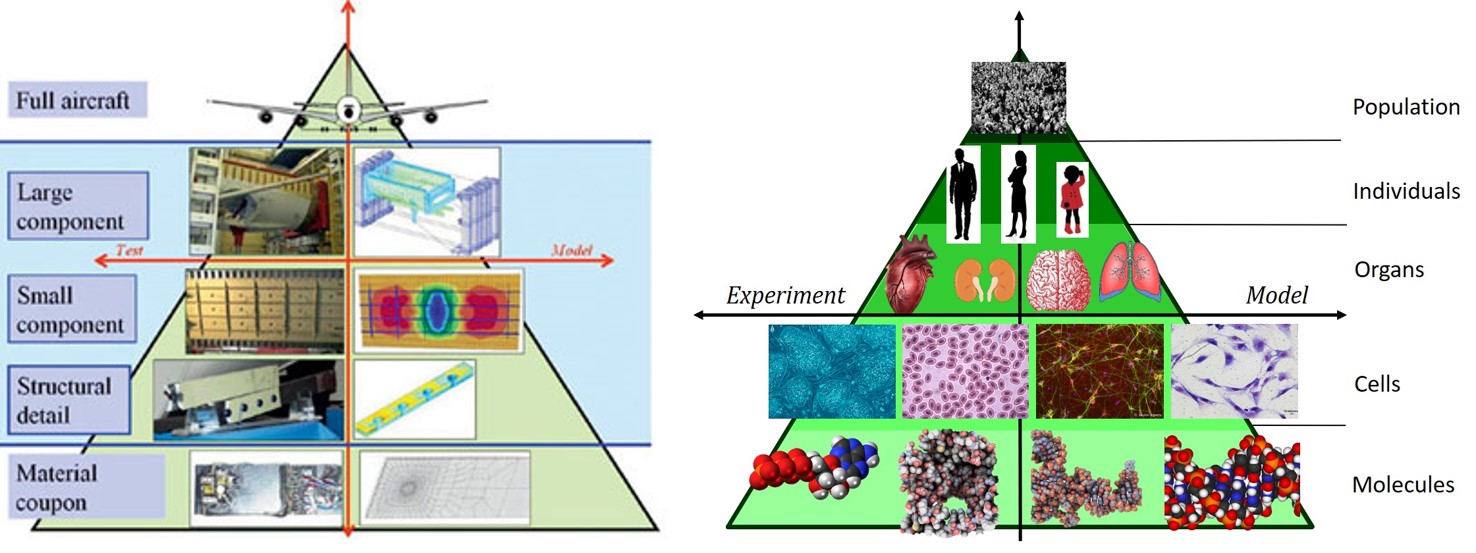
In the 1979 Glenn Harris proposed an analytical hierarchy of models for estimating tactical force effectiveness for the US Army which was represented as a pyramid with four layers with a theatre/campaign simulation at the apex supported by mission level simulations below which was engagement model and engineering models of assets/equipment at the base.  The idea was adopted by the aerospace industry [see the graphic on the left] who place the complete aircraft on the apex supported by systems, sub-systems and components beneath in increasing numbers with the pyramid divided vertically in half to represent physical tests on one side and simulations on the other.  This represents the need to validate predictions from computational models with measurements in the real-world [see post on ‘Model validation‘ on September 18th, 2012]. These diagrams are schematic representations used by engineers to plan and organise the extensive programmes of modelling and physical testing undertaken during the design of new aircraft [see post on ‘Models as fables‘ on March 16th, 2016].  The objective of the MOTIVATE research project is to reduce quantity and increase the quality of the physical tests so that pyramid becomes lop-sided, i.e. the triangle representing the experiments and tests is a much thinner slice than the one representing the modelling and simulations [see post on ‘Brave New World‘ on January 10th, 2018].

At the same time, I am working with colleagues in toxicology on approaches to establishing credibility in predictive models for chemical risk assessment.  I have constructed an equivalent pyramid to represent the system hierarchy which is shown on the right in the graphic.  The challenge is the lack of measurement data in the top left of the pyramid, for both moral and legal reasons, which means that there is very limited real-world data available to confirm the predictions from computational models represented on the right of the pyramid.  In other words, my colleagues in toxicology, and computational biology in general, are where my collaborators in the aerospace industry would like to be while my collaborators in the aerospace want to be where the computational biologists find themselves already.  The challenge is that in both cases a paradigm shift is required from objectivism toward relativism;  since, in the absence of comprehensive real-world measurement data, validation or confirmation of predictions becomes a social process involving judgement about where the predictions lie on a continuum of usefulness.

Sources:

Harris GL, Computer models, laboratory simulators, and test ranges: meeting the challenge of estimating tactical force effectiveness in the 1980’s, US Army Command and General Staff College, May 1979.

Trevisani DA & Sisti AF, Air Force hierarchy of models: a look inside the great pyramid, Proc. SPIE 4026, Enabling Technology for Simulation Science IV, 23 June 2000.

Patterson EA & Whelan MP, A framework to establish credibility of computational models in biology, Progress in Biophysics and Molecular Biology, 129:13-19, 2017.

Tyranny of quantification

There is a growing feeling that our use of metrics is doing more harm than good.  My title today is a mis-quote from Rebecca Solnit; she actually said ‘tyranny of the quantifiable‘ or perhaps it is combination of her quote and the title of a new book by Jerry Muller: ‘The Tyranny of Metrics‘ that was reviewed in the FT Weekend on 27/28 January 2018 by Tim Harford, who recently published a book called Messy that dealt with similar issues, amongst other things.

I wrote ‘growing feeling’ and then almost fell into the trap of attempting to quantify the feeling by providing you with some evidence; but, I stopped short of trying to assign any numbers to the feeling and its growth – that would have been illogical since the definition of a feeling is ‘an emotional state or reaction, an idea or belief, especially a vague or irrational one’.

Harford puts it slightly differently: that ‘many of us have a vague sense that metrics are leading us astray, stripping away context, devaluing subtle human judgment‘.  Advances in sensors and the ubiquity of computing power allows vast amounts of data to be acquired and processed into metrics that can be ranked and used to make and justify decisions.  Data and consequently, empiricism is king.  Rationalism has been cast out into the wilderness.  Like Muller, I am not suggesting that metrics are useless, but that they are only one tool in decision-making and that they need to used by those with relevent expertise and experience in order to avoid unexpected consequences.

To quote Muller: ‘measurement is not an alternative to judgement: measurement demands judgement – judgement about whether to measure, what to measure, how to evaluate the significance of what’s been measured, whether rewards and penalties will be attached to the results, and to whom to make the measurements available‘.

Sources:

Lunch with the FT – Rebecca Solnit by Rana Foroohar in FT Weekend 10/11 February 2018

Desperate measures by Tim Harford in FT Weekend 27/28 February 2018

Muller JZ, The Tyranny of Metrics, Princeton NJ: Princeton University Press, 2018.

Image: http://maxpixel.freegreatpicture.com/Measurement-Stopwatch-Timer-Clock-Symbol-Icon-2624277

Designing for damage

Eighteen months ago I wrote about an insight on high-speed photography that Clive Siviour shared during his 2016 JSA Young Investigator Lecture [see my post entitled ‘Popping balloons‘ on June 15th, 2016].  Clive is interested in high-speed photography because he studies the properties of materials when they are subject to very high rates of deformation, in particular polymers used in mobile phones and cycle helmets – the design requirements for these two applications are very different.  The polymer used in the case of your mobile phone needs to protect the electronics inside your phone by absorbing the kinetic energy when you drop the phone on a tiled floor and it needs to be able to do this repeatedly because you are unlikely to replace the case after each accidental drop. A cyclist’s helmet also needs to protect what is inside it but it only needs to do this once because you will replace your helmet after an accident.  So, the kinetic energy resulting from an impact can be dissipated through the propagation of damage in the helmut; but in the phone case, it has to be absorbed temporarily as strain energy and then released, like in a spring.

Of course there is at least an order of magnitude difference in the consequences associated with the design of a phone case and a cycle helmet.  We can step up the consequences, at least another order of magnitude, by considering the impact performance of the polycarbonate used in the cockpit windows of airplanes.  These need to able absorb the energy associated with impacts by birds, runway debris and other objects, as well as withstanding the cycles of pressurisation associated with take-off, cruising at altitude and landing.  They can be replaced after an event but only once the plane as landed safely.  Consequently, an in-depth understanding of the material behaviour under these different loading conditions is needed to produce a successful design.  Of course, we also need a detailed knowledge of the loading conditions, which are influenced not just by the conditions and events during flight but also the way in which the window is attached to the rest of the airplane.  A large and diverse team is needed to ensure that all of this knowledge and understanding is effectively integrated in the design of the cockpit window.  The team is likely to include experts in materials, damage mechanics, structural integrity, aerodynamic loading as well as manufacturing and finance, since the window has to be made and fitted into the aircraft at an acceptable cost.  A similar team will be needed to design the mobile phone casing with the addition of product design and marketing expertise because it is a consumer product.  In other words, engineering is team activity and engineers must be able to function as team members and leaders.

I wrote this post shortly after Clive’s lecture but since then it is has languished in my drafts folder – in part because I thought it was too long and boring.  However, my editor encourages me to write about engineering more often and so, I have dusted it off and shortened it (slightly!).

Image: https://commons.wikimedia.org/wiki/File:Airbus_A350_cockpit_windows_(14274972354).jpg

Creating an evolving learning environment

A couple of weeks ago, I wrote about marking examinations and my tendency to focus on the students that I had failed to teach rather than those who excelled in their knowledge of problem-solving with the laws of thermodynamics [see my post ‘Depressed by exams‘ on January 31st, 2018].  One correspondent suggested that I shouldn’t beat myself up because ‘to teach is to show, to learn is to acquire‘; and that I had not failed to show but that some of my students had failed to acquire.  However, Adams and Felder have stated that the ‘educational role of faculty is not to impart knowledge; but to design learning environments that support knowledge acquisition‘.  My despondency arises from my apparent inability to create a learning environment that supports and encourages knowledge acquisition for all of my students.  People arrive in my class with a variety of formative experiences and different ways of learning, which makes it challenging to generate a learning environment that is effective for everyone.   It’s an on-going challenge due to the ever-widening cultural gap between students and their professors, which is large enough to have warranted at least one anthropological study (see My Freshman Year by Rebekah Nathan). So, my focus on the weaker exam scripts has a positive outcome because it causes me to think about evolving the learning environment.

Sources:

Adams RS, Felder RM, Reframing professional development: A systems approach to preparing engineering educators to educate tomorrow’s engineers. J. Engineering Education, 97(3):230-240, 2008.

Nathan R, My freshman year: what a professor learned by becoming a student, Cornell University Press, Ithaca, New York, 2005