Category Archives: FACTS

Getting smarter

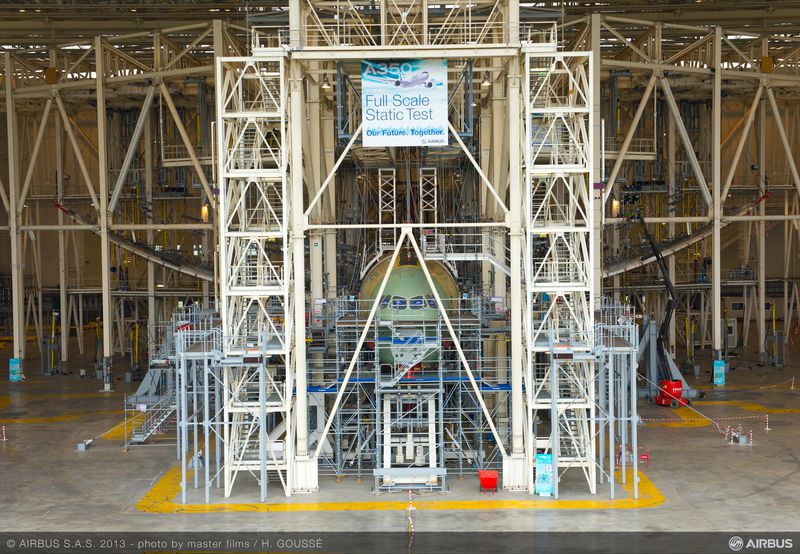
A350 XWB passes Maximum Wing Bending test [from: http://www.airbus.com/galleries/photo-gallery%5D

Garbage in, garbage out (GIGO) is a perennial problem in computational simulations of engineering structures.  If the description of the geometry of the structure, the material behaviour, the loading conditions or the boundary conditions are incorrect (garbage in), then the simulation generates predictions that are wrong (garbage out), or least an unreliable representation of reality.  It is not easy to describe precisely the geometry, material, loading and environment of a complex structure, such as an aircraft or a powerstation; because, the complete description is either unavailable or too complicated.  Hence, modellers make assumptions about the unknown information and, or to simplify the description.  This means the predictions from the simulation have to be tested against reality in order to establish confidence in them – a process known as model validation [see my post entitled ‘Model validation‘ on September 18th, 2012].

It is good practice to design experiments specifically to generate data for model validation but it is expensive, especially when your structure is a huge passenger aircraft.  So naturally, you would like to extract as much information from each experiment as possible and to perform as few experiments as possible, whilst both ensuring predictions are reliable and providing confidence in them.  In other words, you have to be very smart about designing and conducting the experiments as well as performing the validation process.

Together with researchers at Empa in Zurich, the Industrial Systems Institute of the Athena Research Centre in Athens and Dantec Dynamics in Ulm, I am embarking on a new EU Horizon 2020 project to try and make us smarter about experiments and validation.  The project, known as MOTIVATE [Matrix Optimization for Testing by Interaction of Virtual and Test Environments (Grant Nr. 754660)], is funded through the Clean Sky 2 Joint Undertaking with Airbus acting as our topic manager to guide us towards an outcome that will be applicable in industry.  We held our kick-off meeting in Liverpool last week, which is why it is uppermost in my mind at the moment.  We have 36-months to get smarter on an industrial scale and demonstrate it in a full-scale test on an aircraft structure.  So, some sleepness nights ahead…

Bibliography:


ASME V&V 10-2006, Guide for verification & validation in computational solid mechanics, American Society of Mech. Engineers, New York, 2006.

European Committee for Standardisation (CEN), Validation of computational solid mechanics models, CEN Workshop Agreement, CWA 16799:2014 E.

Hack E & Lampeas G (Guest Editors) & Patterson EA (Editor), Special issue on advances in validation of computational mechanics models, J. Strain Analysis, 51 (1), 2016.

http://www.engineeringvalidation.org/

Instructive report and Brexit

Even though this blog is read in more than 100 countries, surely nobody can be unaware of the furore about Brexit – the UK Government’s plan to leave the European Union.  The European Commission has been funding my research for more than twenty years and I am a frequent visitor to their Joint Research Centre in Ispra, Italy.  During the last decade, I have led consortia of industry, national labs and universities that rejoice in names such as SPOTS, VANESSA and, most recently MOTIVATE.  These are acronyms based loosely on the title of the research project.  Currently, there is no sign that these pan-European research programmes will exclude scientists and engineers from the UK, but then the process of leaving the EU has not yet started, so who knows…

At the moment, I am working with a small UK company, Strain Solutions Ltd, on a EU project called INSTRUCTIVE.  I said these were loose acronyms and this one is very loose: Infrared STRUctural monitoring of Cracks using Thermoelastic analysis in production enVironmEnts.  We are working with Airbus in France, Germany, Spain and the UK to transition a technology from the laboratory to the industrial test environment.  Airbus conducts full-scale fatigue tests on airframe structures to ensure that they have the appropriate life-cycle performance and the INSTRUCTIVE project will deliver a new tool for monitoring the development of damage, in the form of cracks, during these tests.  The technology is thermoelastic stress analysis, which is well-established as a laboratory-based technique [1] for structural analysis [2], fracture mechanics [3] and damage mechanics [4], that I described in a post on November 18th, 2015 [see ‘Counting photons to measure stress’].  It’s exciting to be evolving it into an industrial technique but also to be looking at the potential to apply it using cheap infrared cameras instead of the current laboratory instruments that cost tens of thousands of any currency.  It’s a three-year project and we’ve just completed our first year so we should finish before any Brexit consequences!  Anyway, the image gives you a taster and I plan to share more results with you shortly…

BTW – You might get the impression from my recent posts that teaching MOOCs [see ‘Slowing down time to think [about strain energy]’ on March 8th, 2017] and leadership [see ‘Inspirational leadership’ on March 22nd, 2018] were foremost amongst my activities.  I only write about my research occasionally.  This would not be an accurate impression because the majority of my working life is spent supervising and writing about research.  Perhaps, it’s because I spend so much time writing about research in my ‘day job’ that last year I only blogged about it three times on: digital twins [see ‘Can you trust your digital twin?’ on November 23rd, 2016], model credibility [see ‘Credibility is in the Eye of the Beholder’ on April 20th, 2016] and model validation [see Models as fables on March 16th, 2016].  This list gives another false impression – that my research is focussed on digital modelling and simulation.  It is just the trendiest part of my research activity.  So, I thought that I should correct this imbalance with some INSTRUCTIVE posts.

References:

[1] Greene, R.J., Patterson, E.A., Rowlands, R.E., 2008, ‘Thermoelastic stress analysis’, in Handbook of Experimental Mechanics edited by W.N. Sharpe Jr., Springer, New York.

[2] Rowlands, R.E., Patterson, E.A., 2008, ‘Determining principal stresses thermoelastically’, J. Strain Analysis, 43(6):519-527.

[3] Diaz, F.A., Patterson, E.A., Yates, J.R., 2009, ‘Assessment of effective stress intensity factors using thermoelastic stress analysis’, J. Strain Analysis, 44 (7), 621-632.

[4] Fruehmann RK, Dulieu-Barton JM, Quinn S, Thermoelastic stress and damage analysis using transient loading, Experimental Mechanics, 50:1075-1086, 2010.

Can you trust your digital twin?

Author's digital twin?

Author’s digital twin?

There is about a 3% probability that you have a twin. About 32 in 1000 people are one of a pair of twins.  At the moment an even smaller number of us have a digital twin but this is the direction in which computational biomedicine is moving along with other fields.  For instance, soon all aircraft will have digital twins and most new nuclear power plants.  Digital twins are computational representations of individual members of a population, or fleet, in the case of aircraft and power plants.  For an engineering system, its computer-aided design (CAD) is the beginning of its twin, to which information is added from the quality assurance inspections before it leaves the factory and from non-destructive inspections during routine maintenance, as well as data acquired during service operations from health monitoring.  The result is an integrated model and database, which describes the condition and history of the system from conception to the present, that can be used to predict its response to anticipated changes in its environment, its remaining useful life or the impact of proposed modifications to its form and function. It is more challenging to create digital twins of ourselves because we don’t have original design drawings or direct access to the onboard health monitoring system but this is being worked on. However, digital twins are only useful if people believe in the behaviour or performance that they predict and are prepared to make decisions based on the predictions, in other words if the digital twins possess credibility.  Credibility appears to be like beauty because it is in eye of the beholder.  Most modellers believe that their models are both beautiful and credible, after all they are their ‘babies’, but unfortunately modellers are not usually the decision-makers who often have a different frame of reference and set of values.  In my group, one current line of research is to provide metrics and language that will assist in conveying confidence in the reliability of a digital twin to non-expert decision-makers and another is to create methodologies for evaluating the evidence prior to making a decision.  The approach is different depending on the extent to which the underlying models are principled, i.e. based on the laws of science, and can be tested using observations from the real world.  In practice, even with principled, testable models, a digital twin will never be an identical twin and hence there will always be some uncertainty so that decisions remain a matter of judgement based on a sound understanding of the best available evidence – so you are always likely to need advice from a friendly engineer   🙂

Sources:

De Lange, C., 2014, Meet your unborn child – before it’s conceived, New Scientist, 12 April 2014, p.8.

Glaessgen, E.H., & Stargel, D.S., 2012, The digital twin paradigm for future NASA and US Air Force vehicles, Proc 53rd AIAA/ASME/ASCE/AHS/ASC Structures, Structural Dynamics and Materials Conference, AIAA paper 2012-2018, NF1676L-13293.

Patterson E.A., Feligiotti, M. & Hack, E., 2013, On the integration of validation, quality assurance and non-destructive evaluation, J. Strain Analysis, 48(1):48-59.

Patterson, E.A., Taylor, R.J. & Bankhead, M., 2016, A framework for an integrated nuclear digital environment, Progress in Nuclear Energy, 87:97-103.

Patterson EA & Whelan MP, 2016, A framework to establish credibility of computational models in biology, Progress in Biophysics & Molecular Biology, doi: 10.1016/j.pbiomolbio.2016.08.007.

Tuegel, E.J., 2012, The airframe digital twin: some challenges to realization, Proc 53rd AIAA/ASME/ASCE/AHS/ASC Structures, Structural Dynamics and Materials Conference.

Coping with uncertainty

The first death of driver in a car while using Autopilot has been widely reported with much hyperbole though with a few notable exceptions, for instance Nick Bilton in Vanity Fair on July 7th, 2016 who pointed out that you were safer statistically in a Tesla with its Autopilot functioning than driving normally.  This is based on the fact that worldwide there is a fatality for every 60 million miles driven, or every 94 million miles in the US, whereas Joshua Brown’s tragic death was the first in 130 million miles driven by Teslas with Autopilot activated.  This implies that globally you are twice as likely to survive your next car journey in an autonomously driven Tesla than in a manually driven car.

If you decide to go by plane instead then the probability of arriving safely is extremely good because only one in every 3 million flights last year resulted in fatalities or put another way: 3.3 billion passengers were transported with the loss of 641 lives, which is a one in 5 million.  People worry about these probabilities while at the same time buying lottery tickets with a much lower probability of winning the jackpot, which is about 1 in 14 million in the UK.  In all of these cases, the probability is saying something about the frequency of occurance of these events.  We don’t know whether the plane will crash on the next flight we take so we rationalise this uncertainty by defining the frequency of flights that end in a fatal crash.  The French mathematician, Pierre-Simon Laplace (1749-1827) thought about probability as a measure of our ignorance or uncertainty.  As we have come to realise the extent of our uncertainty about many things in science (see my post: ‘Electron Uncertainty‘ on July 27th, 2016) and life (see my post: ‘Unexpected bad news for turkeys‘ on November 25th, 2015), the more important the concept of probability has become.   Caputo has argued that ‘a post-modern style demands a capacity to sustain uncertainty and instability, to live with the unforeseen and unpredictable as positive conditions of the possibility of an open-ended future’.  Most of us can manage this concept when the open-ended future is a lottery jackpot but struggle with the remaining uncertainties of life, particularly when presented with new ones, such as autonomous cars.

Sources:

Bilton, N., How the media screwed up the fatal Tesla accident, Vanity Fair, July 7th, 2016

IATA Safety Report 2014

Caputo JD, Truth: Philosophy in Transit, London: Penguin 2013.

Ball, J., How safe is air travel really? The Guardian, July 24th, 2014

Boagey, R., Who’s behind the wheel? Professional Engineering, 29(8):22-26, August 2016.