Tag Archives: simulations

All arms and legs

Imagine building a humanoid robot with head, arms and legs from different organisations that will not share the technical details of the products, probably because they are worried about their intellectual property being stolen.  The likely result would be a robot that moves in slow uncoordinated jerky steps, unlike those seen at the recent World Humanoid Robot Games in China where a humanoid robot beat Usain Bolt’s 100m record.  We have encountered this problem in attempting to build an industrial metaverse consisting of a connected series of digital twins [see ‘Digital twins that thrive in the real-world’ on June 9th, 2021] that represent different parts of a complex engineering system, e.g., a power station.  The organisations that have developed the digital twins or computer simulations are reluctant to share technical information because they want to protect their intellectual property.  Our solution has been to develop an apex software architecture that seamlessly and securely connects computer models of all of the parts of the system with high-speed two-way exchange of information – the equivalent of the central nervous system in the humanoid robot.  Our architecture reduced the processing times for simulations of a nuclear reactor sixteen-fold compared to current approaches and required one-third of the number of analysts to perform the simulations.  The architecture is readily adaptable too; you can plug n’ play with different computational models – the equivalent to changing a leg on a humanoid robot using a snap-fit connector.  Read our 2022 paper if you would like to know more or get in touch if you would like to use our apex architecture.

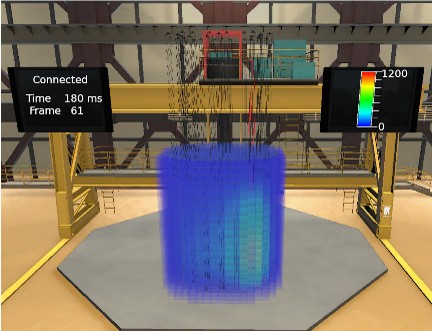
Image: Figure 9b from Bowman et al, 2022, showing simulated power distribution and control rod position overlayed on a model of a PWR reactor.

Reference: Bowman D, Dwyer L, Levers A, Patterson EA, Purdie S, Vikhorev K. A unified approach to digital twin architecture—proof-of-concept activity in the nuclear sector. IEEE Access, 10:44691-709, 2022

Storm in a computer

Decorative painting of a stormy seascapeAs part of my undergraduate course on thermodynamics [see ‘Change in focus’ on October 5th, 2022) and in my MOOC on Thermodynamics in Everyday Life [See ‘Engaging learners on-line‘ on May 25th, 2016], I used to ask students to read Chapter 1 ‘The Storm in the Computer’ from Philosophy and Simulation: The Emergence of Synthetic Reason by Manuel Delanda.  It is a mind-stretching read and I recommended that students read it at least twice in order to appreciate its messages.  To support their learning, I provided them with a précis of the chapter that is reproduced below in a slightly modified form.

At the start of the chapter, the simplest emergent properties, such as the temperature and pressure of a body of water in a container, are discussed [see ‘Emergent properties’ on September 16th, 2015].  These properties are described as emergent because they are not the property of a single component of the system, that is individual water molecules but are features of the system as a whole.  They arise from an objective averaging process for the billions of molecules of water in the container.  The discussion is extended to two bodies of water, one hot and one cold brought into contact within one another.  An average temperature will emerge with a redistribution of molecules to create a less ordered state.  The spontaneous flow of energy, as temperature differences cancel themselves, is identified as an important driver or capability, especially when the hot body is continually refreshed by a fire, for instance.  Engineers harness energy gradients or differences and the resultant energy flow to do useful work, for instance in turbines.

However, Delanda does not deviate to discuss how engineers exploit energy gradients.  Instead he identifies the spontaneous flow of molecules, as they self-organise across an energy gradient, as the driver of circulatory flows in the oceans and atmosphere, known as convection cells.  Five to eight convections cells can merge in the atmosphere to form a thunderstorm.  In thunderstorms, when the rising water vapour becomes rain, the phase transition from vapour to liquid releases latent heat or energy that helps sustain the storm system.  At the same time, gradients in electrical charge between the upper and lower sections of the storm generate lightening.

Delanda highlights that emergent properties can be established by elucidating the mechanisms that produce them at one scale and these emergent properties can become the components of a phenomenon at a much larger scale.  This allows scientists and engineers to construct models that take for granted the existence of emergent properties at one scale to explain behaviour at another, which is called ‘mechanism-independence’.  For example, it is unnecessary to model molecular movement to predict heat transfer.  These ideas allow simulations to replicate behaviour at the system level without the need for high-fidelity representations at all scales.  The art of modelling is the ability to decide what changes do, and what changes do not, make a difference, i.e., what to include and exclude.

Source:

Manuel Delanda Philosophy and Simulation: The Emergence of Synthetic Reason, Continuum, London, 2011.

Image: Painting by Sarah Evans owned by the author.

Can you trust your digital twin?

Author's digital twin?

Author’s digital twin?

There is about a 3% probability that you have a twin. About 32 in 1000 people are one of a pair of twins.  At the moment an even smaller number of us have a digital twin but this is the direction in which computational biomedicine is moving along with other fields.  For instance, soon all aircraft will have digital twins and most new nuclear power plants.  Digital twins are computational representations of individual members of a population, or fleet, in the case of aircraft and power plants.  For an engineering system, its computer-aided design (CAD) is the beginning of its twin, to which information is added from the quality assurance inspections before it leaves the factory and from non-destructive inspections during routine maintenance, as well as data acquired during service operations from health monitoring.  The result is an integrated model and database, which describes the condition and history of the system from conception to the present, that can be used to predict its response to anticipated changes in its environment, its remaining useful life or the impact of proposed modifications to its form and function. It is more challenging to create digital twins of ourselves because we don’t have original design drawings or direct access to the onboard health monitoring system but this is being worked on. However, digital twins are only useful if people believe in the behaviour or performance that they predict and are prepared to make decisions based on the predictions, in other words if the digital twins possess credibility.  Credibility appears to be like beauty because it is in eye of the beholder.  Most modellers believe that their models are both beautiful and credible, after all they are their ‘babies’, but unfortunately modellers are not usually the decision-makers who often have a different frame of reference and set of values.  In my group, one current line of research is to provide metrics and language that will assist in conveying confidence in the reliability of a digital twin to non-expert decision-makers and another is to create methodologies for evaluating the evidence prior to making a decision.  The approach is different depending on the extent to which the underlying models are principled, i.e. based on the laws of science, and can be tested using observations from the real world.  In practice, even with principled, testable models, a digital twin will never be an identical twin and hence there will always be some uncertainty so that decisions remain a matter of judgement based on a sound understanding of the best available evidence – so you are always likely to need advice from a friendly engineer   🙂

Sources:

De Lange, C., 2014, Meet your unborn child – before it’s conceived, New Scientist, 12 April 2014, p.8.

Glaessgen, E.H., & Stargel, D.S., 2012, The digital twin paradigm for future NASA and US Air Force vehicles, Proc 53rd AIAA/ASME/ASCE/AHS/ASC Structures, Structural Dynamics and Materials Conference, AIAA paper 2012-2018, NF1676L-13293.

Patterson E.A., Feligiotti, M. & Hack, E., 2013, On the integration of validation, quality assurance and non-destructive evaluation, J. Strain Analysis, 48(1):48-59.

Patterson, E.A., Taylor, R.J. & Bankhead, M., 2016, A framework for an integrated nuclear digital environment, Progress in Nuclear Energy, 87:97-103.

Patterson EA & Whelan MP, 2016, A framework to establish credibility of computational models in biology, Progress in Biophysics & Molecular Biology, doi: 10.1016/j.pbiomolbio.2016.08.007.

Tuegel, E.J., 2012, The airframe digital twin: some challenges to realization, Proc 53rd AIAA/ASME/ASCE/AHS/ASC Structures, Structural Dynamics and Materials Conference.