Category Archives: structures

Designing for damage

Eighteen months ago I wrote about an insight on high-speed photography that Clive Siviour shared during his 2016 JSA Young Investigator Lecture [see my post entitled ‘Popping balloons‘ on June 15th, 2016].  Clive is interested in high-speed photography because he studies the properties of materials when they are subject to very high rates of deformation, in particular polymers used in mobile phones and cycle helmets – the design requirements for these two applications are very different.  The polymer used in the case of your mobile phone needs to protect the electronics inside your phone by absorbing the kinetic energy when you drop the phone on a tiled floor and it needs to be able to do this repeatedly because you are unlikely to replace the case after each accidental drop. A cyclist’s helmet also needs to protect what is inside it but it only needs to do this once because you will replace your helmet after an accident.  So, the kinetic energy resulting from an impact can be dissipated through the propagation of damage in the helmut; but in the phone case, it has to be absorbed temporarily as strain energy and then released, like in a spring.

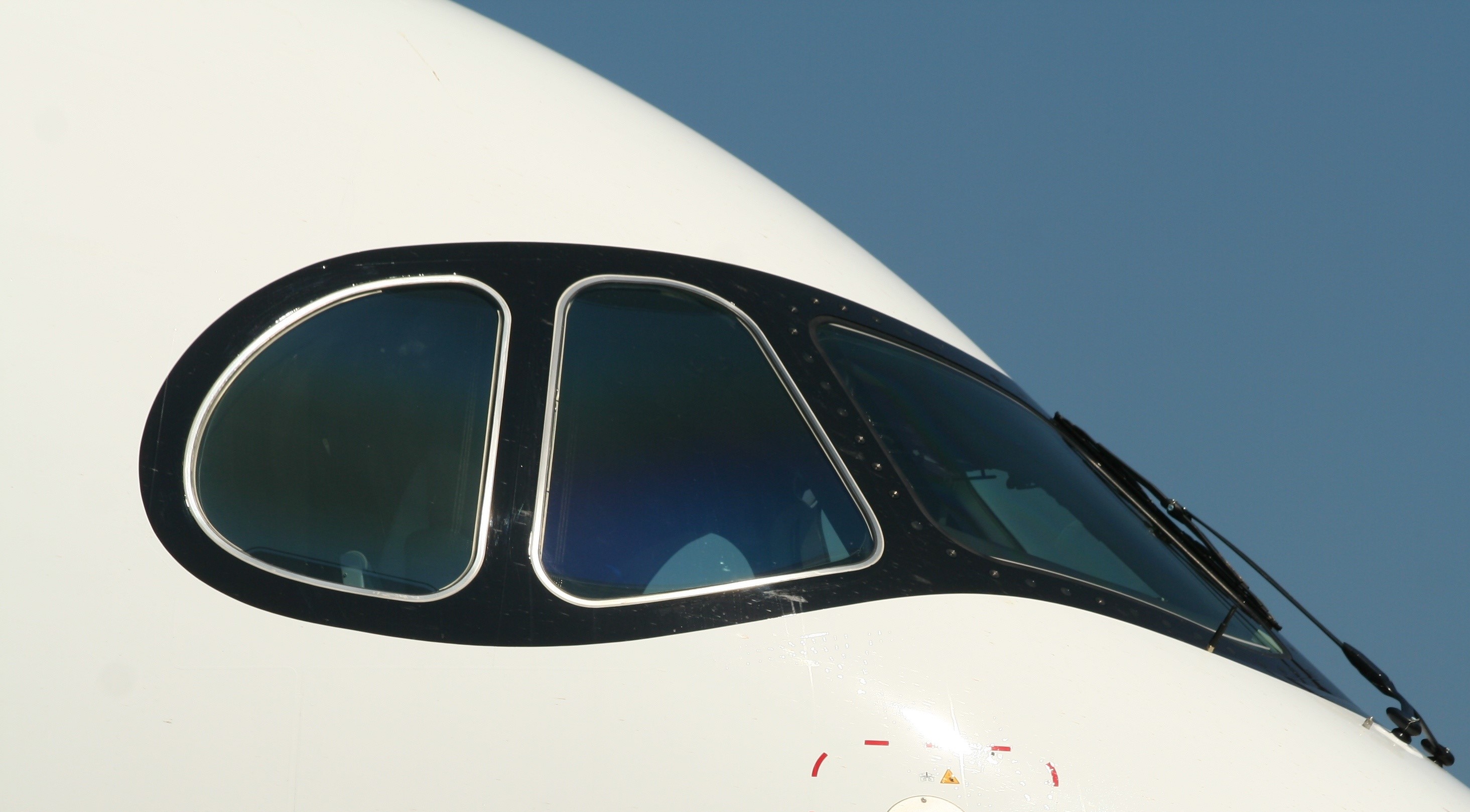
Of course there is at least an order of magnitude difference in the consequences associated with the design of a phone case and a cycle helmet.  We can step up the consequences, at least another order of magnitude, by considering the impact performance of the polycarbonate used in the cockpit windows of airplanes.  These need to able absorb the energy associated with impacts by birds, runway debris and other objects, as well as withstanding the cycles of pressurisation associated with take-off, cruising at altitude and landing.  They can be replaced after an event but only once the plane as landed safely.  Consequently, an in-depth understanding of the material behaviour under these different loading conditions is needed to produce a successful design.  Of course, we also need a detailed knowledge of the loading conditions, which are influenced not just by the conditions and events during flight but also the way in which the window is attached to the rest of the airplane.  A large and diverse team is needed to ensure that all of this knowledge and understanding is effectively integrated in the design of the cockpit window.  The team is likely to include experts in materials, damage mechanics, structural integrity, aerodynamic loading as well as manufacturing and finance, since the window has to be made and fitted into the aircraft at an acceptable cost.  A similar team will be needed to design the mobile phone casing with the addition of product design and marketing expertise because it is a consumer product.  In other words, engineering is team activity and engineers must be able to function as team members and leaders.

I wrote this post shortly after Clive’s lecture but since then it is has languished in my drafts folder – in part because I thought it was too long and boring.  However, my editor encourages me to write about engineering more often and so, I have dusted it off and shortened it (slightly!).

Image: https://commons.wikimedia.org/wiki/File:Airbus_A350_cockpit_windows_(14274972354).jpg

Press release!

A jumbo jet has about six million parts of which roughly half are fasteners – that’s a lot of holes.

It is very rare for one of my research papers to be included in a press release on its publication.  But that’s what has happened this month as a consequence of a paper being included in the latest series published by the Royal Society.  The contents of the paper are not earth shattering in terms of their consequences for humanity; however, we have resolved a long-standing controversy about why cracks grow from small holes in structures [see post entitled ‘Alan Arnold Griffith‘ on  April 26th, 2017] that are meant to be protected from such events by beneficial residual stresses around the hole.  This is important for aircraft structures since a civilian airliner can have millions of holes that contain rivets and bolts which hold the structure together.

We have used mechanical tests to assess fatigue life, thermoelastic stress analysis to measure stress distributions [see post entitled ‘Counting photons to measure stress‘ on November 18th, 2015], synchrotron x-ray diffraction to evaluate residual stress inside the metal and microscopy to examine failure surfaces [see post entitled ‘Forensic engineering‘ on July 22nd, 2015].  The data from this diverse set of experiments is integrated in the paper to provide a mechanistic explanation of how cracks exploit imperfections in the beneficial residual stress field introduced by the manufacturing process and can be aided in their growth by occasional but modest overloads, which might occur during a difficult landing or take-off.

The success of this research is particularly satisfying because at its heart is a PhD student supported by a dual PhD programme between the University of Liverpool and National Tsing Hua University in Taiwan.  This programme, which supported by the two partner universities, is in its sixth year of operation with a steady state of about two dozen PhD students enrolled, who divide their time between Liverpool, England and Hsinchu, Taiwan.  The synchrotron diffraction measurements were performed, with a colleague from Sheffield Hallam University, at the European Synchrotron Research Facility (ESRF) in Grenoble, France; thus making this a truly international collaboration.

Source:

Amjad K, Asquith D, Patterson EA, Sebastian CM & Wang WC, The interaction of fatigue cracks with a residual stress field using thermoelastic stress analysis and synchrotron x-ray diffraction experiments, R. Soc. Open Sci. 4:171100.

Red to blue

Some research has a very long incubation time.  Last month, we published a short paper that describes the initial results of research that started just after I arrived in Liverpool in 2011.  There are various reasons for our slow progress, including our caution about the validity of the original idea and the challenges of working across discipline boundaries.  However, we were induced to rush to publication by the realization that others were catching up with us [see blog post and conference paper].  Our title does not give much away: ‘Characterisation of metal fatigue by optical second harmonic generation‘.

Second harmonic generation or frequency doubling occurs when photons interact with a non-linear material and are combined to produce new photons with twice the energy, and hence, twice the frequency and half the wavelength of the original photons.  Photons are discrete packets of energy that, in our case, are supplied in pulses of 2 picoseconds from a laser operating at a wavelength of 800 nanometres (nm).  The photons strike the surface, are reflected, and then collected in a spectrograph to allow us to evaluate the wavelength of the reflected photons.  We look for ones at 400 nm, i.e. a shift from red to blue.

The key finding of our research is that the second harmonic generation from material in the plastic zone ahead of a propagating fatigue crack is different to virgin material that has experienced no plastic deformation.  This is significant because the shape and size of the crack tip plastic zone determines the rate and direction of crack propagation; so, information about the plastic zone can be used to predict the life of a component.  At first sight, this capability appears similar to thermoelastic stress analysis that I have described in Instructive Update on October 4th, 2017; however, the significant potential advantage of second harmonic generation is that the component does not have to be subject to a cyclic load during the measurement, which implies we could study behaviour during a load cycle as well as conduct forensic investigations.  We have some work to do to realise this potential including developing an instrument for routine measurements in an engineering laboratory, rather than an optics lab.

Last week, I promised weekly links to posts on relevant Thermodynamics topics for students following my undergraduate module; so here are three: ‘Emergent properties‘, ‘Problem-solving in Thermodynamics‘, and ‘Running away from tigers‘.


Instructive Update

Six months ago I wrote about our EU research project, called INSTRUCTIVE, and the likely consequences of Brexit for research [see my post: ‘Instructive report and Brexit‘ on March 29th, 2017].  We seem to be no closer to knowing the repercussions of Brexit on research in the UK and EU – a quarter of EU funding allocated to universities goes to UK universities so the potential impacts will hit both the UK and EU.  Some researchers take every opportunity to highlight these risks and the economic benefits of EU research; for instance the previous EU research programme, Framework Programme 7, is estimated to have created 900,000 jobs in Europe and increased GDP by about 1% in perpetuity.  However, most researchers are quietly getting on with their research and hoping that our political leaders will eventually arrive at a solution that safeguards our prosperity and security.  Our INSTRUCTIVE team is no exception to this approach.  We are about half-way through our project and delivered our first public presentation of our work at the International Conference on Advances in Experimental Mechanics last month.  We described how we are able to identify cracks in metallic structures before they are long enough to be visible to the naked eye, or any other inspection technique commonly used for aircraft structures.  We identify the cracks using an infra-red camera by detecting the energy released during the formation and accumulation of dislocations in the atomic structure that coalesce into voids and eventually into cracks [see my post entitled ‘Alan Arnold Griffith‘ on April 26th, 2017 for more on energy release during crack formation].  We can identify cracks at sub-millimetre lengths and then track them as they propagate through a structure.  At the moment, we are quantifying our ability to detect cracks forming underneath the heads of fasteners [see picture] and other features in real aerospace structures; so that we can move our technology out of the laboratory and into an industrial environment.  We have a big chunk of airplane sitting in the laboratory that we will use for future tests – more on that in later blog posts!

INSTRUCTIVE is an EU Horizon 2020 project funded under the Clean Sky 2 programme [project no. 686777] and involves Strain Solutions Ltd and the University of Liverpool working with Airbus.

Statistics on funding from http://russellgroup.ac.uk/news/horizon-2020-latest-statistics/and https://www.russellgroup.ac.uk/media/5068/24horizon-2020-the-contribution-of-russell-group-universities-june-201.pdf

For other posts on similar research topics, see ‘Counting photons to measure stress‘ on November 18th, 2015 and ‘Forensic engineering‘ on July 22nd, 2015.