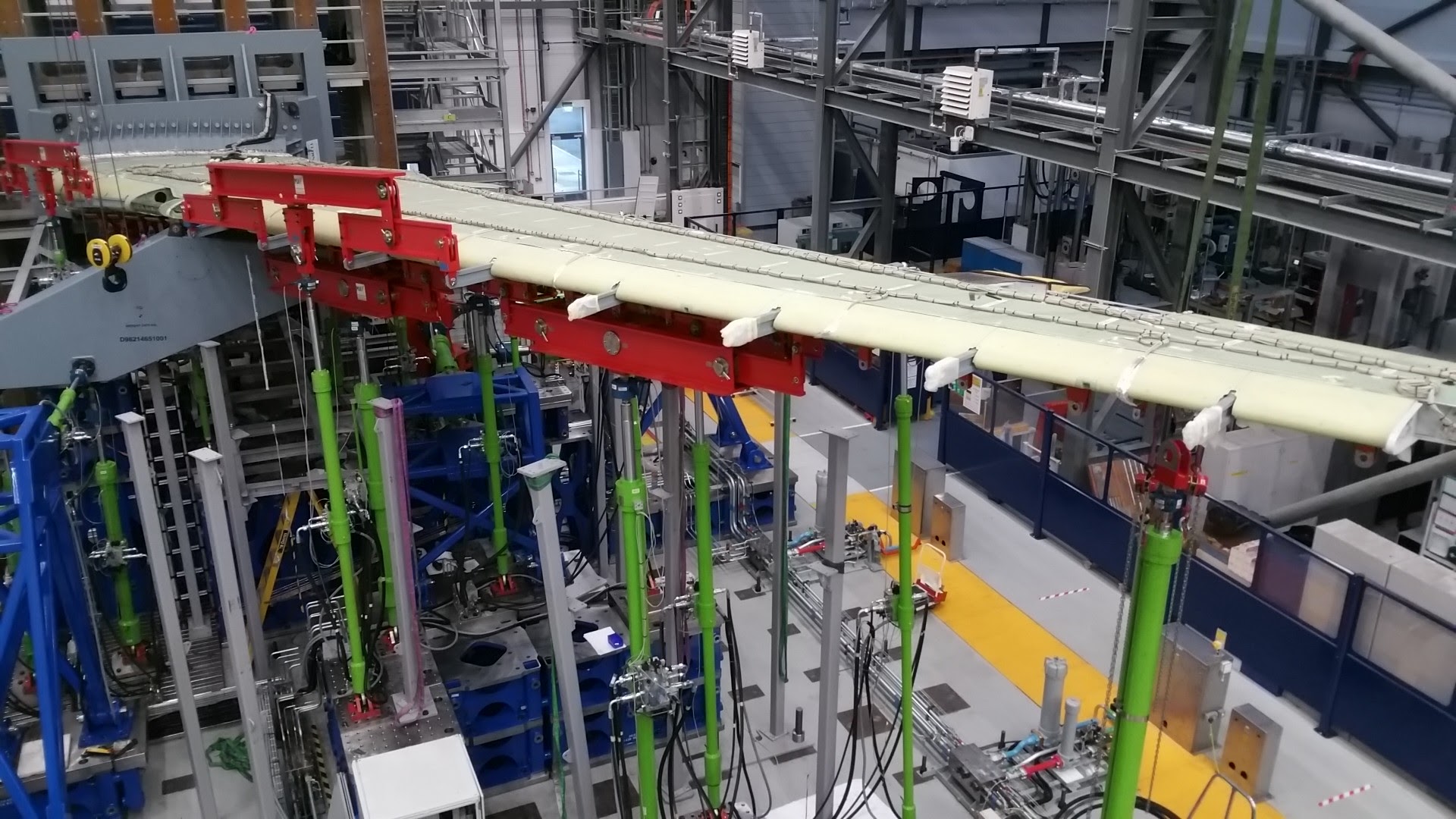
 Thirty-three months ago (see ‘Finding DIMES‘ on February 6th, 2019) we set off at a gallop ‘to develop and demonstrate an automated measurement system that integrates a range of measurement approaches to enable damage and cracks to be detected and monitored as they originate at multi-material interfaces in an aircraft assembly’. The quotation is taken directly from the aim of the DIMES project which was originally planned and funded as a two-year research programme. Our research, in particular the demonstration element, has been slowed down by the pandemic and we resorted to two no-cost extensions, initially for three months and then for six months to achieve the project aim. Two weeks ago, we held our final review meeting, and this week we will present our latest results in the third of a series of annual workshops hosted by Airbus, the project’s topic manager. The DIMES system combines visual and infrared cameras with resistance strain gauges and fibre Bragg gratings to detect 1 mm cracks in metals and damage indications in composites that are only 6 mm in diameter. We had a concept design by April 2019 (see ‘Joining the dots‘ on July 10th, 2019) and a detailed design by August 2019. Airbus supplied us with a section of A320 wing, and we built a test-bench at Empa in Zurich in which we installed our prototype measurement system in the last quarter of 2019 (see ‘When seeing nothing is a success‘ on December 11th, 2019). Then, the pandemic intervened and we did not finish testing until May 2021 by which time, we had also evaluated it for monitoring damage in composite A350 fuselage panels (see ‘Noisy progressive failure of a composite panel‘ on June 30th, 2021). In parallel, we have installed our ‘DIMES system’ in ground tests on an aircraft wing at Airbus in Filton (see image) and, using a remote installation, in a cockpit at Airbus in Toulouse (see ‘Most valued player performs remote installation‘ on December 2nd, 2020), as well as an aircraft at NRC Aerospace in Ottawa (see ‘An upside to lockdown‘ on April 14th 2021). Our innovative technology allows condition-led monitoring based on automated damage detection and enables ground tests on aircraft structures to be run 24/7 saving about 3 months on each year-long test.
The University of Liverpool is the coordinator of the DIMES project and the other partners are Empa, Dantec Dynamics GmbH and Strain Solutions Ltd.
 The DIMES project has received funding from the Clean Sky 2 Joint Undertaking under the European Union’s Horizon 2020 research and innovation programme under grant agreement No. 820951.
The opinions expressed in this blog post reflect only the author’s view and the Clean Sky 2 Joint Undertaking is not responsible for any use that may be made of the information it contains.



 Realize Engineering