Tag Archives: mechanics

Press release!

A jumbo jet has about six million parts of which roughly half are fasteners – that’s a lot of holes.

It is very rare for one of my research papers to be included in a press release on its publication.  But that’s what has happened this month as a consequence of a paper being included in the latest series published by the Royal Society.  The contents of the paper are not earth shattering in terms of their consequences for humanity; however, we have resolved a long-standing controversy about why cracks grow from small holes in structures [see post entitled ‘Alan Arnold Griffith‘ on  April 26th, 2017] that are meant to be protected from such events by beneficial residual stresses around the hole.  This is important for aircraft structures since a civilian airliner can have millions of holes that contain rivets and bolts which hold the structure together.

We have used mechanical tests to assess fatigue life, thermoelastic stress analysis to measure stress distributions [see post entitled ‘Counting photons to measure stress‘ on November 18th, 2015], synchrotron x-ray diffraction to evaluate residual stress inside the metal and microscopy to examine failure surfaces [see post entitled ‘Forensic engineering‘ on July 22nd, 2015].  The data from this diverse set of experiments is integrated in the paper to provide a mechanistic explanation of how cracks exploit imperfections in the beneficial residual stress field introduced by the manufacturing process and can be aided in their growth by occasional but modest overloads, which might occur during a difficult landing or take-off.

The success of this research is particularly satisfying because at its heart is a PhD student supported by a dual PhD programme between the University of Liverpool and National Tsing Hua University in Taiwan.  This programme, which supported by the two partner universities, is in its sixth year of operation with a steady state of about two dozen PhD students enrolled, who divide their time between Liverpool, England and Hsinchu, Taiwan.  The synchrotron diffraction measurements were performed, with a colleague from Sheffield Hallam University, at the European Synchrotron Research Facility (ESRF) in Grenoble, France; thus making this a truly international collaboration.

Source:

Amjad K, Asquith D, Patterson EA, Sebastian CM & Wang WC, The interaction of fatigue cracks with a residual stress field using thermoelastic stress analysis and synchrotron x-ray diffraction experiments, R. Soc. Open Sci. 4:171100.

Instructive Update

Six months ago I wrote about our EU research project, called INSTRUCTIVE, and the likely consequences of Brexit for research [see my post: ‘Instructive report and Brexit‘ on March 29th, 2017].  We seem to be no closer to knowing the repercussions of Brexit on research in the UK and EU – a quarter of EU funding allocated to universities goes to UK universities so the potential impacts will hit both the UK and EU.  Some researchers take every opportunity to highlight these risks and the economic benefits of EU research; for instance the previous EU research programme, Framework Programme 7, is estimated to have created 900,000 jobs in Europe and increased GDP by about 1% in perpetuity.  However, most researchers are quietly getting on with their research and hoping that our political leaders will eventually arrive at a solution that safeguards our prosperity and security.  Our INSTRUCTIVE team is no exception to this approach.  We are about half-way through our project and delivered our first public presentation of our work at the International Conference on Advances in Experimental Mechanics last month.  We described how we are able to identify cracks in metallic structures before they are long enough to be visible to the naked eye, or any other inspection technique commonly used for aircraft structures.  We identify the cracks using an infra-red camera by detecting the energy released during the formation and accumulation of dislocations in the atomic structure that coalesce into voids and eventually into cracks [see my post entitled ‘Alan Arnold Griffith‘ on April 26th, 2017 for more on energy release during crack formation].  We can identify cracks at sub-millimetre lengths and then track them as they propagate through a structure.  At the moment, we are quantifying our ability to detect cracks forming underneath the heads of fasteners [see picture] and other features in real aerospace structures; so that we can move our technology out of the laboratory and into an industrial environment.  We have a big chunk of airplane sitting in the laboratory that we will use for future tests – more on that in later blog posts!

INSTRUCTIVE is an EU Horizon 2020 project funded under the Clean Sky 2 programme [project no. 686777] and involves Strain Solutions Ltd and the University of Liverpool working with Airbus.

Statistics on funding from http://russellgroup.ac.uk/news/horizon-2020-latest-statistics/and https://www.russellgroup.ac.uk/media/5068/24horizon-2020-the-contribution-of-russell-group-universities-june-201.pdf

For other posts on similar research topics, see ‘Counting photons to measure stress‘ on November 18th, 2015 and ‘Forensic engineering‘ on July 22nd, 2015.

Getting smarter

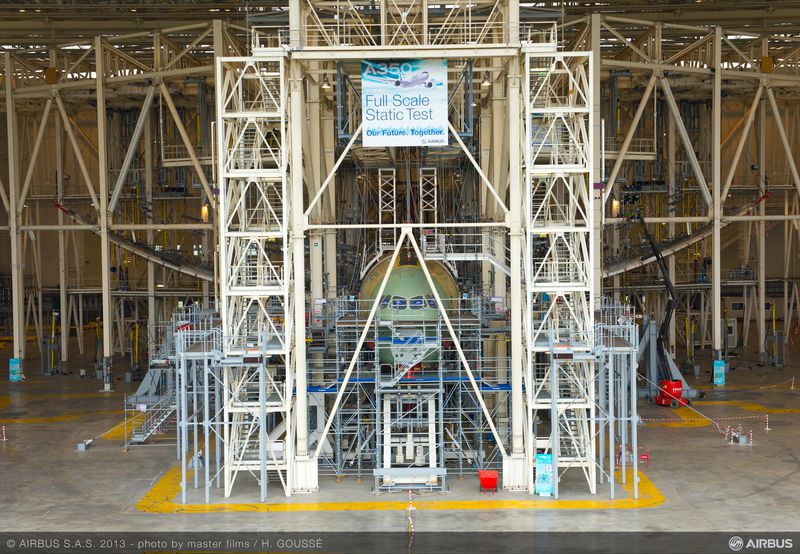
A350 XWB passes Maximum Wing Bending test [from: http://www.airbus.com/galleries/photo-gallery%5D

Garbage in, garbage out (GIGO) is a perennial problem in computational simulations of engineering structures.  If the description of the geometry of the structure, the material behaviour, the loading conditions or the boundary conditions are incorrect (garbage in), then the simulation generates predictions that are wrong (garbage out), or least an unreliable representation of reality.  It is not easy to describe precisely the geometry, material, loading and environment of a complex structure, such as an aircraft or a powerstation; because, the complete description is either unavailable or too complicated.  Hence, modellers make assumptions about the unknown information and, or to simplify the description.  This means the predictions from the simulation have to be tested against reality in order to establish confidence in them – a process known as model validation [see my post entitled ‘Model validation‘ on September 18th, 2012].

It is good practice to design experiments specifically to generate data for model validation but it is expensive, especially when your structure is a huge passenger aircraft.  So naturally, you would like to extract as much information from each experiment as possible and to perform as few experiments as possible, whilst both ensuring predictions are reliable and providing confidence in them.  In other words, you have to be very smart about designing and conducting the experiments as well as performing the validation process.

Together with researchers at Empa in Zurich, the Industrial Systems Institute of the Athena Research Centre in Athens and Dantec Dynamics in Ulm, I am embarking on a new EU Horizon 2020 project to try and make us smarter about experiments and validation.  The project, known as MOTIVATE [Matrix Optimization for Testing by Interaction of Virtual and Test Environments (Grant Nr. 754660)], is funded through the Clean Sky 2 Joint Undertaking with Airbus acting as our topic manager to guide us towards an outcome that will be applicable in industry.  We held our kick-off meeting in Liverpool last week, which is why it is uppermost in my mind at the moment.  We have 36-months to get smarter on an industrial scale and demonstrate it in a full-scale test on an aircraft structure.  So, some sleepness nights ahead…

Bibliography:


ASME V&V 10-2006, Guide for verification & validation in computational solid mechanics, American Society of Mech. Engineers, New York, 2006.

European Committee for Standardisation (CEN), Validation of computational solid mechanics models, CEN Workshop Agreement, CWA 16799:2014 E.

Hack E & Lampeas G (Guest Editors) & Patterson EA (Editor), Special issue on advances in validation of computational mechanics models, J. Strain Analysis, 51 (1), 2016.

http://www.engineeringvalidation.org/

Alan Arnold Griffith

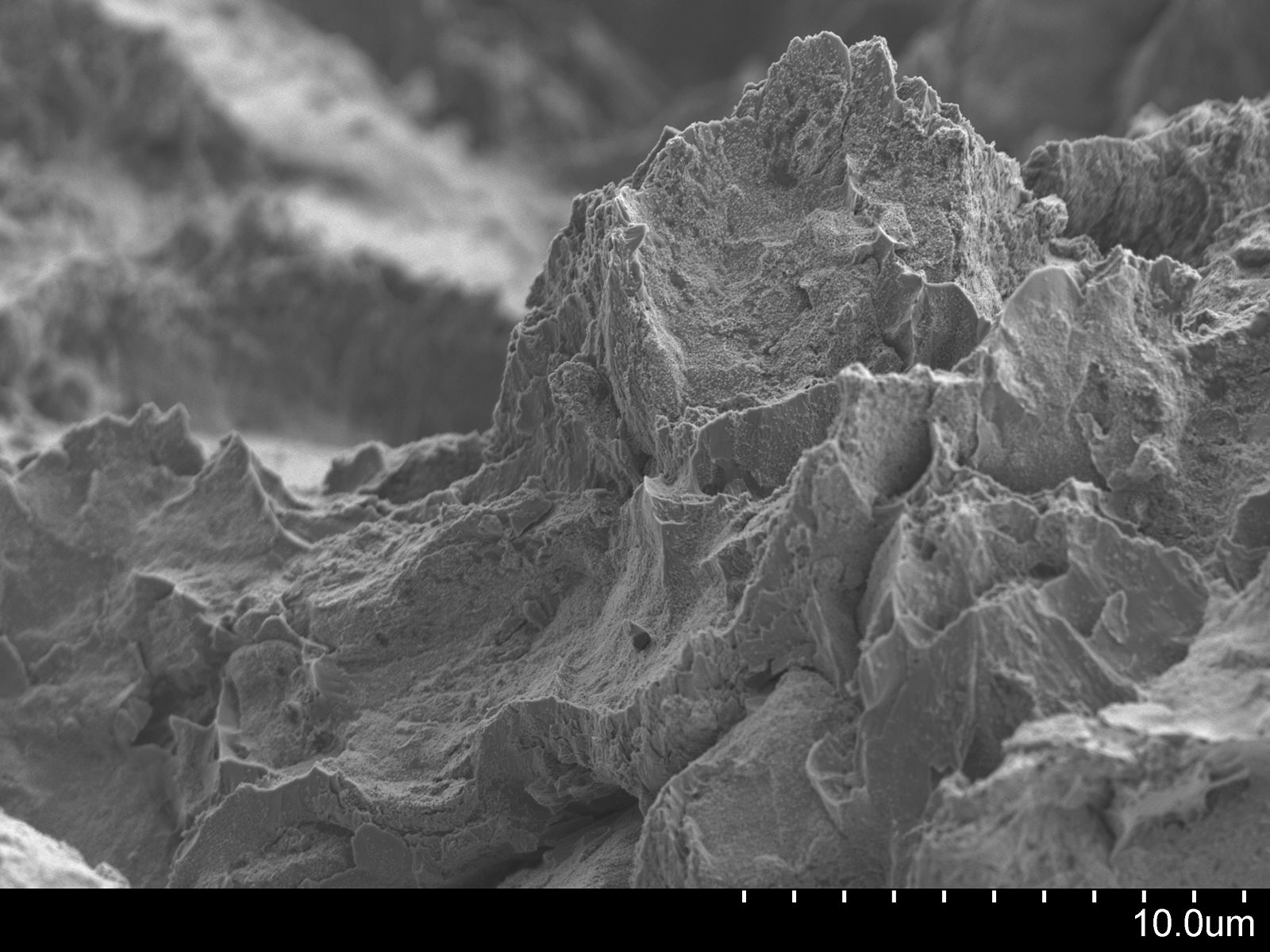
Everest of fracture surface [By Kaspar Kallip (CC BY-SA 4.0), via Wikimedia Commons]

Some of you maybe aware that I hold the AA Griffith Chair of Structural Materials and Mechanics at the University of Liverpool.  I feel that some comment on this blog about Griffith’s seminal work is long overdue and so I am correcting that this week.  I wrote this piece for a step in week 4 of a five-week MOOC on Understanding Super Structures which will start on May 22nd, 2017.

Alan Arnold Griffith was a pioneer in fracture mechanics who studied mechanical engineering at the University of Liverpool at the beginning of the last century.  He earned a Bachelor’s degree, a Master’s degree and a PhD before moving to work for the Royal Aircraft Establishment, Farnborough in 1915.

He is famous for his study of failure in materials.  He observed that there were microscopic cracks or flaws in materials that concentrated the stress.  And he postulated that these cracks were the source of failure in a material.  He used strain energy concepts to analyse the circumstances in which a crack or flaw would propagate and cause failure of a component.  In order to break open a material, we need to separate adjacent atoms from one another, and break the bonds between them.  This requires a steady supply of energy to do the work required to separate one pair of atoms after another and break their bonds.  It’s a bit like unpicking a seam to let out your trousers when you’ve put on some weight.  You have to unpick each stitch and if you stop working the seam stays half undone.  In a material with a stress raiser or concentration, then the concentration is quite good at delivering stress and strain to the local area to separate atoms and break bonds.  This is fine when external work is being applied to the material so that there is a constant supply of new energy that can be used to break bonds.  But what about, if the supply of external energy dries up, then can the crack continue to grow?  Griffith concluded that in certain circumstances it could continue to grow.

He arrived at this conclusion by postulating that the energy required to propagate the crack was the work of fracture per unit length of crack, that’s the work needed to separate two atoms and break their bond.  Since atoms are usually distributed uniformly in a material, this energy requirement increases linearly with the length of the crack.  However, as the crack grows the material in its wake can no longer sustain any load because the free surface formed by the crack cannot react against a load to satisfy Newton’s Law.  The material in the wake of the crack relaxes, and gives up strain energy [see my post entitled ‘Slow down time to think (about strain energy)‘ on March 8th, 2017], which can be used to break more bonds at the crack tip.  Griffith postulated that the material in the wake of the crack tip would look like the wake from a ship, in other words it would be triangular, and so the strain energy released would proportional to area of the wake, which in turn would be related to the crack length squared.

So, for a short crack, the energy requirement to extend the crack exceeds the strain energy released in its wake and the crack will be stable and stationary; but there is a critical crack length, at which the energy release is greater than the energy requirements, and the crack will grow spontaneously and rapidly leading to very sudden failure.

While I have followed James Gordon’s lucid explanation of Griffith’s theory and used a two-dimensional approach, Griffith actually did it in three-dimensions, using some challenging mathematics, and arrived at an expression for the critical length of crack. However, the conclusion is the same, that the critical length is related to the ratio of the work required for new surfaces and the stored strain energy released as the crack advances.  Griffith demonstrated his theory for glass and then others quickly demonstrated that it could be applied to a range of materials.

For instance, rubber can absorb a lot of strain energy and has a low work of fracture, so the critical crack length for spontaneous failure is very low, which is why balloons go pop when you stick a pin in them.  Nowadays, tyre blowouts are relatively rare because the rubber in a tyre is reinforced with steel cords that increase the work required to create new surfaces – it’s harder to separate the rubber because it’s held together by the cords.

By the way, James Gordon’s explanation of Griffith’s theory of fracture, which I mentioned, can be found in his seminal book: ‘Structures, or Why Things Don’t Fall Down’ published by Penguin Books Ltd in 1978.  The original work was published in the Proceedings of the Royal Society as ‘The Phenomena of Rupture and Flow in Solids’ by AA Griffith, February 26, 1920.