It seems unlikely that global warming will be limited to only 1.5 degrees Centigrade above pre-industrial levels in the light of recent trends in temperature data [see ‘It was hot in June and its getting hotter’ on July 12th, 2023 ]. It is probable global warming will lead to average surface temperatures on the planet rising by 4 or 5 degrees, perhaps within a matter of decades. A global average temperature rise of only 2 degrees would make the Earth as warm as it was 3 million years ago when sea levels were 25 to 35 m (80 to 130 ft) high (Blockstein & Wiegman, 2010). While it is still important to aim for zero carbon emissions in order to limit global warming and avoid global temperatures reaching a tipping point, it seems improbable that politicians worldwide will be able to agree and implement effective actions to achieve the goal in part because of the massive, vested interests in industrialised economies based on fossil fuels [see ‘Are we all free-riders?’ On April 6th, 2016]. Hence, we need to start planning for potentially existential changes in the climate and environment that will force us to adapt the way we live and work. In addition to rises in sea levels, a world that is 4 degrees hotter is likely to have an equatorial belt with high humidity causing heat stress across tropical regions that make them uninhabitable for most of the year. To the north and south of this equatorial belt will be mid-latitude belts of inhospitable deserts extending as far north as a line through Liverpool, Manchester, Hamburg, the straits north of Sapporo in Japan, Prince Rupert in British Columbia and Waskaganish on the Hudson Bay. The habitable zones for humans are likely to be north of this line and in the south in Antarctica, Patagonia, Tasmania and the south island of New Zealand. Agriculture will probably be viable in these polar regions but will compete with a very dense population [see ‘Belts of habitability in a 4° world’ in Nomad Century by Gaia Vince]. In other words, there will likely be mass migrations that will force a re-organisation of society and a restructuring of our economies. Some estimates suggest that there could be as many as 1.2 billion environmental migrants by 2050 (Bellizzi et al, 2023). We need to start adapting now, the world around us is already adapting [see ‘Collaboration and competition’ on June 8th, 2022].
Tag Archives: liverpool
Merseyside Totemy
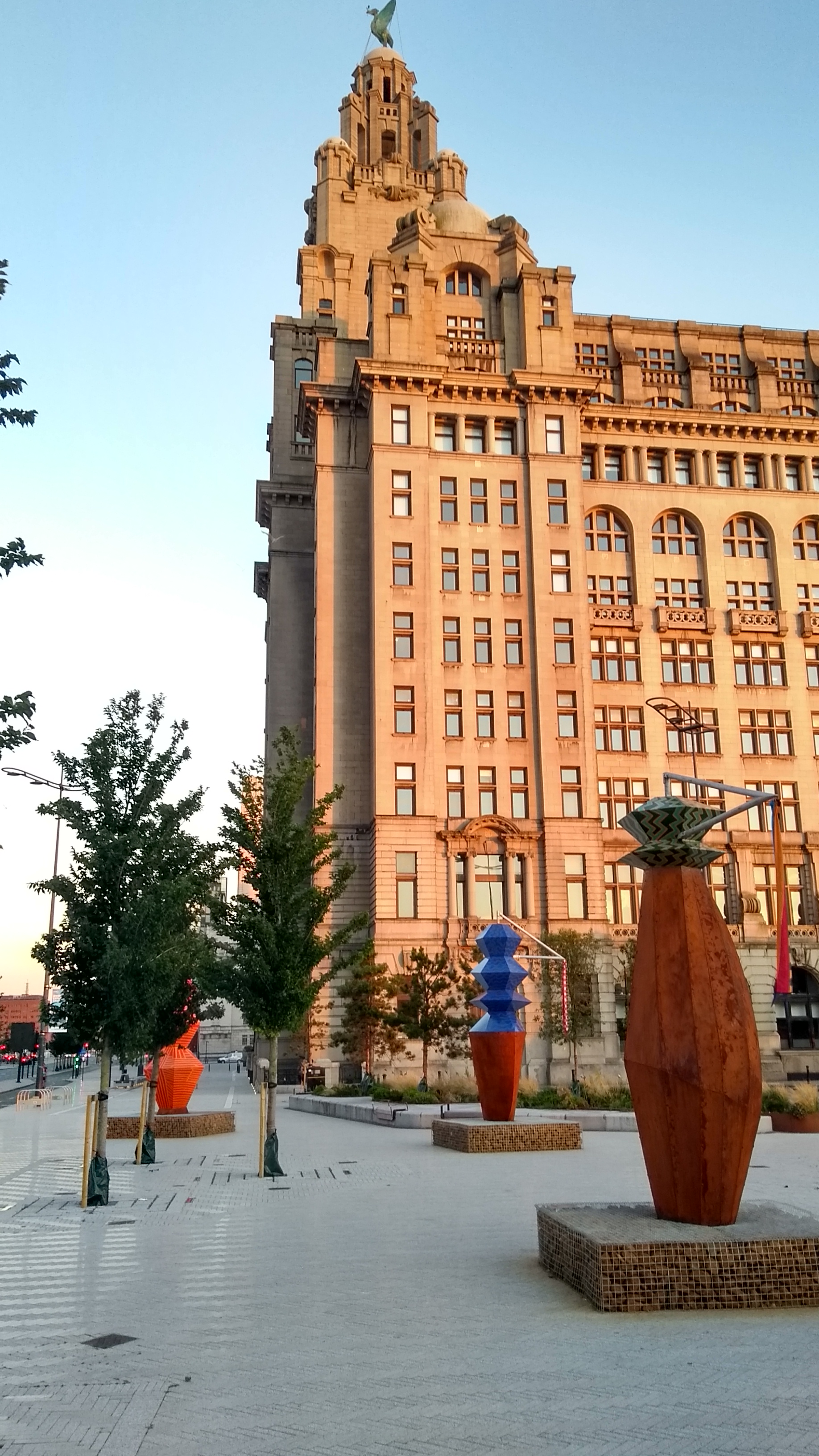
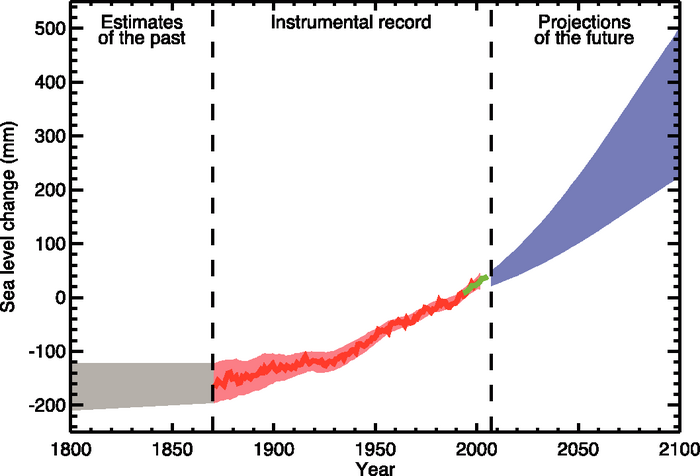
The recent extreme weather is perhaps leading more people to appreciate the changes in our climate are real and likely to have a serious impact on our way of life [see ‘Climate change and tides in Liverpool‘ on May 11th, 2016]. However, I suspect that most people do not appreciate the likely catastrophic effect of global warming. For example, during the 20th century, the average rise is sea level was 1.7 mm per year; however, since the early 1990s it has been rising at 3 mm per year, and sea levels are currently rising at about 4mm per year according to the Intergovernmental Panel on Climate Change. It is difficult to translate statistics of this type into a meaningful format – the graph below helps in recognising the trends but does not convey anything about the impact. However, I am impressed by a new art installation on the Liverpool waterfront by Alicja Biala called ‘Merseyside Totemy’ which illustrates the percentage of each of three high-risk local areas that will be underwater by 2080 if current trends continue: Birkenhead (centre of photograph), Formby (left) and Liverpool City Centre (right behind tree) [see www.biennial.com/collaborations/alicjabiala]. Perhaps using data for 30 years time rather than 60 years would have focussed people’s attention on the need to make changes to alleviate the impact.

Figure 1. Time series of global mean sea level (deviation from the 1980-1999 mean) in the past and as projected for the future. For the period before 1870, global measurements of sea level are not available. The grey shading shows the uncertainty in the estimated long-term rate of sea level change. The red line is a reconstruction of global mean sea level from tide gauges, and the red shading denotes the range of variations from a smooth curve. The green line shows global mean sea level observed from satellite altimetry. The blue shading represents the range of model projections for the SRES A1B scenario for the 21st century, relative to the 1980 to 1999 mean, and has been calculated independently from the observations. Beyond 2100, the projections are increasingly dependent on the emissions scenario. Over many centuries or millennia, sea level could rise by several metres. From https://archive.ipcc.ch/publications_and_data/ar4/wg1/en/faq-5-1-figure-1.html
An upside to lockdown
While pandemic lockdowns and travel bans are having a severe impact on spontaneity and creativity in research [see ‘Lacking creativity‘ on October 28th, 2020], they have induced a high level of ingenuity to achieve the final objective of the DIMES project, which is to conduct prototype demonstrations and evaluation tests of the DIMES integrated measurement system. We have gone beyond the project brief by developing a remote installation system that allows local engineers at a test site to successfully set-up and run our measurement system. This has saved thousands of airmiles and several tonnes of CO2 emissions as well as hours waiting in airport terminals and sitting in planes. These savings were made by members of our project team working remotely from their bases in Chesterfield, Liverpool, Ulm and Zurich instead of flying to the test site in Toulouse to perform the installation in a section of a fuselage, and then visiting a second time to conduct the evaluation tests. For this first remote installation, we were fortunate to have our collaborator from Airbus available to support us [see ‘Most valued player on performs remote installation‘ on December 2nd, 2020]. We are about to stretch our capabilities further by conducting a remote installation and evaluation test during a full-scale aircraft test at the Aerospace Research Centre of the National Research Council Canada in Ottawa, Canada with a team who have never seen the DIMES system and knew nothing about it until about a month ago. I could claim that this remote installation and test will save another couple of tonnes of CO2; but, in practice, we would probably not be performing a demonstration in Canada if we had not developed the remote installation capability.
The University of Liverpool is the coordinator of the DIMES project and the other partners are Empa, Dantec Dynamics GmbH and Strain Solutions Ltd. Airbus is our topic manager.
The DIMES project has received funding from the Clean Sky 2 Joint Undertaking under the European Union’s Horizon 2020 research and innovation programme under grant agreement No. 820951. The opinions expressed in this blog post reflect only the author’s view and the Clean Sky 2 Joint Undertaking is not responsible for any use that may be made of the information it contains.
Most valued player performs remote installation
Many research programmes have been derailed by the pandemic which has closed research laboratories or restricted groups of researchers from working together to solve complex problems. Some research teams have used their problem-solving skills to find new ways of collaborating and to continue to make progress. In the DIMES project we have developed an innovative system for detecting and monitoring the propagation of damage in aircraft structures, and prior to the pandemic, we were planning to demonstrate it on a full-scale test of an aircraft fuselage section at Airbus in Toulouse. However, the closure of our laboratories and travel restrictions across Europe have made it impossible for members of our team based in Liverpool, Chesterfield, Ulm and Zurich to meet or travel to Toulouse to set-up the demonstration. Instead we have used hours of screen-time in meetings to complete our design work and plan the installation of the system in Toulouse. These meetings often involve holding components up to our laptop cameras to show one another what we are doing. The components of the system were manufactured in various locations before being shipped to Empa in Zurich where they were assembled and the complete system was then shipped to Toulouse. At the same time, we designed a communication system that included a headset with camera, microphone and earpieces so that our colleague in Toulouse could be guided through the installation of our system by engineers in Germany, Switzerland and the UK. Amazingly, it all worked and we were half-way through the installation last month when a rise in the COVID infection rate caused a shutdown of the Airbus site in Toulouse. What we need now is remote-controlled robot to complete the installation for us regardless of COVID restrictions; however, I suspect the project budget cannot afford a robot sufficiently sophisticated to replace our Most Valued Player (MVP) in Toulouse.
The University of Liverpool is the coordinator of the DIMES project and the other partners are Empa, Dantec Dynamics GmbH and Strain Solutions Ltd.
The DIMES project has received funding from the Clean Sky 2 Joint Undertaking under the European Union’s Horizon 2020 research and innovation programme under grant agreement No. 820951. The opinions expressed in this blog post reflect only the author’s view and the Clean Sky 2 Joint Undertaking is not responsible for any use that may be made of the information it contains.
Image: Our Most Valued Player (inset) installing a point sensor in the front section of a fuselage at Airbus in Toulouse under the remote direction of engineers in Switzerland and the UK.