Category Archives: Engineering

Jigsaw puzzling without a picture

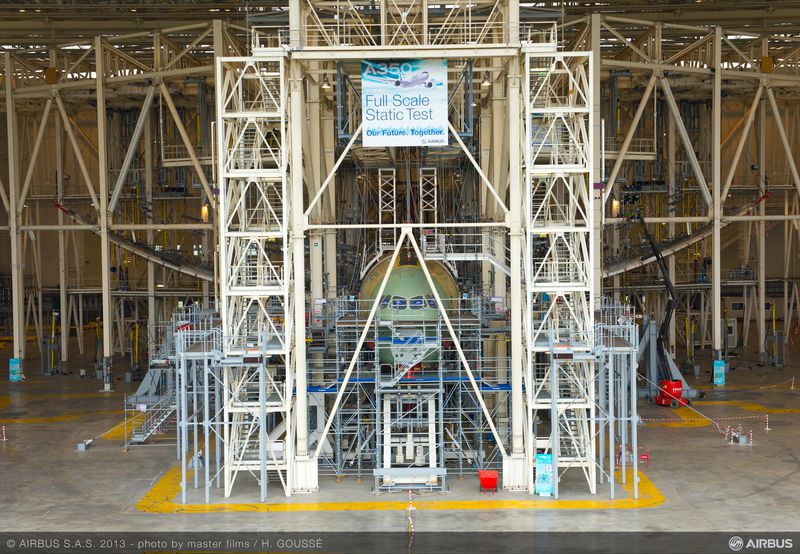
A350 XWB passes Maximum Wing Bending test

A350 XWB passes Maximum Wing Bending test

Research sometimes feels like putting together a jigsaw puzzle without the picture or being sure you have all of the pieces.  The pieces we are trying to fit together at the moment are (i) image decomposition of strain fields [see ‘Recognising strain’ on October 28th 2015] that allows fields containing millions of data values to be represented by a feature vector with only tens of elements which is useful for comparing maps or fields of predictions from a computational model with measurements made in the real-world; (ii) evaluation of the variation in measurement uncertainty over a field of view of measured displacements or strains in a large structure [see ‘Industrial uncertainty’ on December 12th 2018] which provides information about the quality of the measurements; and (iii) a probabilistic validation metric that provides a measure of how well predictions from a computational model represent measurements made in the real world [see ‘Million to one’ on November 21st 2018].  We have found some of the missing pieces of the jigsaw, for example we have established how to represent the distribution of measurement uncertainty in the feature vector domain [see ‘From strain measurements to assessing El Niño events’ on March 17th 2021] so that it can be used to assess the significance of differences between measurements and predictions represented by their feature vectors – this connects (i) and (ii) together.  Very recently we have demonstrated a generic technique for performing image decomposition of irregularly shaped fields of data or data fields with holes [see Christian et al, 2021] which extends the applicability of our method for comparing measurements and predictions to real-world objects rather than idealised shapes.  This allows (i) to be used in industrial applications but we still have to work out how to connect this to the probabilistic metric in (iii) while also incorporating spatially-varying uncertainty.  These techniques can be used in a wide range of applications, as demonstrated in our recent work on El Niño events [see Alexiadis et al, 2021], because, by treating all fields of data as images, the techniques are agnostic about the source and format of the data.  However, at the moment, our main focus is on their application to ground tests on aircraft structures as part of the Smarter Testing project in collaboration with Airbus, Centre for Modelling & Simulation, Dassault Systèmes, GOM UK Ltd, and the National Physical Laboratory with funding from the Aerospace Technology Institute.  Together we are working towards digital continuity across virtual and physical testing of aircraft structures to provide live data fusion and enable condition-led inspections, test control and validation of computational models.  We anticipate these advances will reduce time and costs for physical tests and accelerate the development of new designs of aircraft that will contribute to global sustainability targets (the aerospace industry has committed to reduce CO2 emissions to 50% of 2005 levels by 2050).  The Smarter Testing project has an ambitious goal which reveals that our pieces of the jigsaw puzzle belong to a small section of a much larger one.

For more on the Smarter Testing project see:

https://www.aerospacetestinginternational.com/news/structural-testing/smarter-testing-research-program-to-link-virtual-and-physical-aerospace-testing.html

https://www.aerospacetestinginternational.com/opinion/how-integrating-the-virtual-and-physical-will-make-aerospace-testing-and-certification-smarter.html

References

Alexiadis A, Ferson S, Patterson EA. Transformation of measurement uncertainties into low-dimensional feature vector space. Royal Society open science. 8(3):201086, 2021.

Christian WJ, Dean AD, Dvurecenska K, Middleton CA, Patterson EA. Comparing full-field data from structural components with complicated geometries. Royal Society open science. 8(9):210916, 2021.
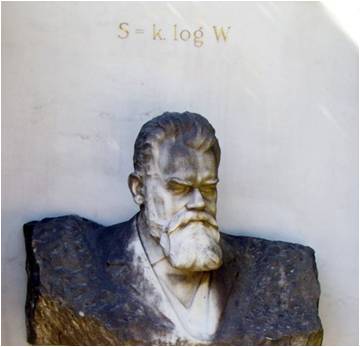
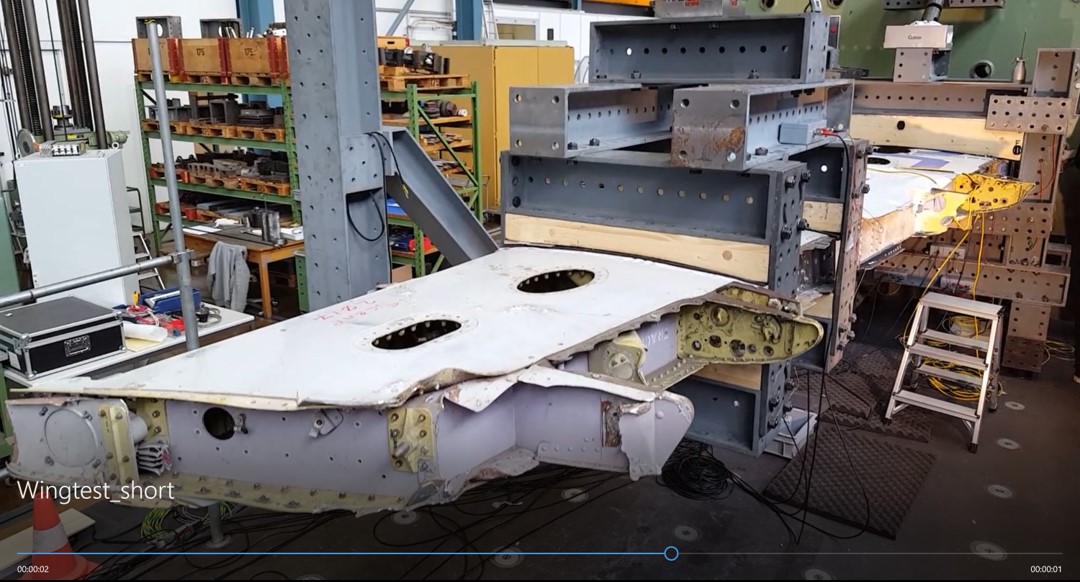
Image: http://www.airbus.com/galleries/photo-gallery

Boltzmann’s brain

Ludwig Boltzmann developed a statistical explanation of the second law of thermodynamics by defining entropy as being proportional to the logarithm of the number ways in which we can arrange a system [see ‘Entropy on the brain‘ on November 29th 2017].  The mathematical expression of this definition is engraved on his head-stone.  The second law states that the entropy of the universe is always increasing and Boltzmann argued it implies that the universe must have been created in a very low entropy state.  Four decades earlier, in 1854, William Thomson concluded the dissipation of heat arising from the second law would lead to the ‘death’ of the universe [see ‘Cosmic heat death‘ on February 18th, 2015] while the big bang theory for the creation of the universe evolved about twenty years after Boltzmann’s death.  The probability of a very low entropy state required to bring the universe into existance is very small because it implies random fluctuations in energy and matter leading to a highly ordered state.  One analogy would be the probability of dead leaves floating on the surface of a pond arranging themselves to spell your name.  It is easy to think of fluctuations that are more likely to occur, involving smaller systems, such as one that would bring only our solar system into existence, or progressively more likely, only our planet, only the room in which you are sitting reading this blog, or only your brain.  The last would imply that everything is in your imagination and ultimately that is why Boltzmann’s argument is not widely accepted although we do not have a good explanation for the apparent low entropy state at the start of the universe.  Jean-Paul Sartre wrote in his book Nausea ‘I exist because I think…and I cannot stop myself from thinking.  At this very moment – it’s frightful – if I exist, it is because I am horrified at existing.’  Perhaps most people would find horrifying the logical extension of Boltzmann’s arguments about the start of the universe to everything only existing in our mind.  Boltzmann’s work on statistical mechanics and the second law of thermodynamics is widely accepted and support the case for him being genius; however, his work raised more questions than answers and was widely criticised during his lifetime which led to him taking his own life in 1906.

Sources:

Paul Sen, Einstein’s fridge: the science of fire, ice and the universe.  London: Harper Collins, 2021.

Jean-Paul Sartre, Nausea.  London: Penguin Modern Classics, 2000.

Too much of a good thing?

I wrote a couple of weeks ago about ‘Our last DIMES’ meetings (on September 22nd, 2021).  They were hybrid meetings with about half the participants attending in person and the remainder on-line.  When the pandemic started we had to master the skill of conducting discussions via our laptops while sitting on our own.  Now, we are learning how to include everyone in a discussion when only half of the participants are in the physical room.  One of our first steps was to re-equip our meeting rooms with higher quality video conferencing facilities so that we can see and hear one another more clearly.  Unfortunately, our new equipment revealed the poor quality of the video clips we have produced during the DIMES project.  Nevertheless, if you have never been present during a wing-bend test or a fatigue test on a large composite panel then you might find these clips interesting (see also the video of ‘Noisy progressive failure of a composite panel’ on June 30th 2021).  We also produced an introductory video for the DIMES project which was to be first in a series of video shorts but the pandemic intervened and we have never been in the same place as our camera crew so we have not made anymore.  Maybe that’s a good thing because 500 hours of video are uploaded every minute to YouTube so you will not have time to watch our DIMES videos 😉.

For more short videos from our earlier projects see ‘Archive video footage from EU projects’ on June 5th, 2019.

The University of Liverpool is the coordinator of the DIMES project and the other partners are Empa, Dantec Dynamics GmbH and Strain Solutions LtdAirbus is the topic manager on behalf of the Clean Sky 2 Joint Undertaking.

Logos of Clean Sky 2 and EUThe DIMES project has received funding from the Clean Sky 2 Joint Undertaking under the European Union’s Horizon 2020 research and innovation programme under grant agreement No. 820951.


The opinions expressed in this blog post reflect only the author’s view and the Clean Sky 2 Joint Undertaking is not responsible for any use that may be made of the information it contains.

If you don’t succeed, try and try again…

Photograph of S-shaped plateYou would not think it was difficult to build a thin flat metallic plate using a digital description of the plate and a Laser Powder Bed Fusion (L-PBF) machine which can build complex components, such as hip prostheses.  But it is.  As we have discovered since we started our research project on the thermoacoustic response of additively manufactured parts (see ‘Slow start to an exciting new project on thermoacoustic response of AM metals‘ on September 9th, 2020).  L-PBF involves using a laser beam to melt selected regions of a thin layer of metal powder spread over a flat bed.  The selected regions represent a cross-section of the desired three-dimensional component and repeating the process for each successive cross-section results in the additive building of the component as each layer solidifies.  And there in those last four words lies the problem because ‘as each layer solidifies’ the temperature distribution between the layers causes different levels of thermal expansion that results in strains being locked into our thin plates.  Our plates are too thin to build with their plane surfaces horizontal or perpendicular to the laser beam so instead we build them with their plane surface parallel to the laser beam, or vertical like a street sign.  In our early attempts, the residual stresses induced by the locked-in strains caused the plate to buckle into an S-shape before it was complete (see image).  We solved this problem by building buttresses at the edges of the plate.  However, when we remove the buttresses and detach the plate from the build platform, it buckles into a dome-shape.  Actually, you can press the centre of the plate and make it snap back and forth noisily.  While we are making progress in understanding the mechanisms at work, we have some way to go before we can confidently produce flat plates using additive manufacturing that we can use in comparisons with our earlier work on the performance of conventionally, or subtractively, manufactured plates subject to the thermoacoustic loading experienced by the skin of a hypersonic vehicle [see ‘Potential dynamic buckling in hypersonic vehicle skin‘ on July 1st 2020) or the containment walls in a fusion reactor.  Sometimes research is painfully slow but no one ever talks about it.  Maybe because we quickly forget the painful parts once we have a successful outcome to brag about. But it is often precisely the painful repetitions of “try and try again” that allow us to reach the bragging stage of a successful outcome.

The research is funded jointly by the National Science Foundation (NSF) in the USA and the Engineering and Physical Sciences Research Council (EPSRC) in the UK (see Grants on the Web).

References

Silva AS, Sebastian CM, Lambros J and Patterson EA, 2019. High temperature modal analysis of a non-uniformly heated rectangular plate: Experiments and simulations. J. Sound & Vibration, 443, pp.397-410.

Magana-Carranza R, Sutcliffe CJ, Patterson EA, 2021, The effect of processing parameters and material properties on residual forces induced in Laser Powder Bed Fusion (L-PBF). Additive Manufacturing. 46:102192