Author Archives: Eann Patterson

Time at the heart of our problems

This week I started teaching thermodynamics to first year undergraduate students for the first time in twelve months.  I have had a break for a year because my course, which is only delivered once per year, was moved from first to second semester.  Although I have continued to teach postgraduate courses, it’s been like a sabbatical enforced by timetable changes.  Sadly, it’s over and I am back in the large lecture theatre in front of a couple of hundred of students – that makes it sound as if I don’t enjoy it which is not true but it does increase the intensity of the job because all of the other aspects of the role continue unabated.  So, for me time appears to accelerate as I attempt to jam more activities into a week.

Time lies at the heart of much of thermodynamics although we tend not to deal with it explicitly; however, it is implicit in our use of changes in the state of a system to understand it.  Quote Anaximander, the pre-Socratic philosopher & pupil of Thales of Miletus: ‘We understand the world by studying change, not by studying things’.  Time also lies at the centre of the tangle of problems found at the intersection of the theories of gravity, quantum mechanics and thermodynamics.  As Carlo Rovelli has remarked we are still in the dark about this tangle of problems; so, I will touch on it in my thermodynamics course but just to show students the limits of our knowledge and perhaps inspire one or two of them to think about tackling them in postgraduate studies.

Meanwhile, I plan tackle my challenges with time by slowing it down once a week with a walk in the Clwydian Hills where the landscape appears unchanging so that time stands still allowing me to relax.

Sources:

Rovelli C, Seven brief lessons on physics, London, Penguin Books. 2016.

Wohllerben P, The hidden life of trees, London, William Collins, 2017.
Nuclear winter school

I spent the first full-week of January 2019 at a Winter School for a pair of Centres for Doctoral Training focussed on Nuclear Energy (see NGN CDT & ICO CDT).  Together the two centres involve eight UK universities and most of the key players in the UK industry.  So, the Winter School offers an opportunity for researchers in nuclear science and engineering, from academia and industry, to gather together for a week and share their knowledge and experience with more than 80 PhD students.  Each student gives a report on the progress of their research to the whole gathering as either a short oral presentation or a poster.  It’s an exhausting but stimulating week for everyone due to both the packed programmme and the range of subjects covered from fundamental science through to large-scale engineering and socio-economic issues.

Here are a few things that caught my eye:

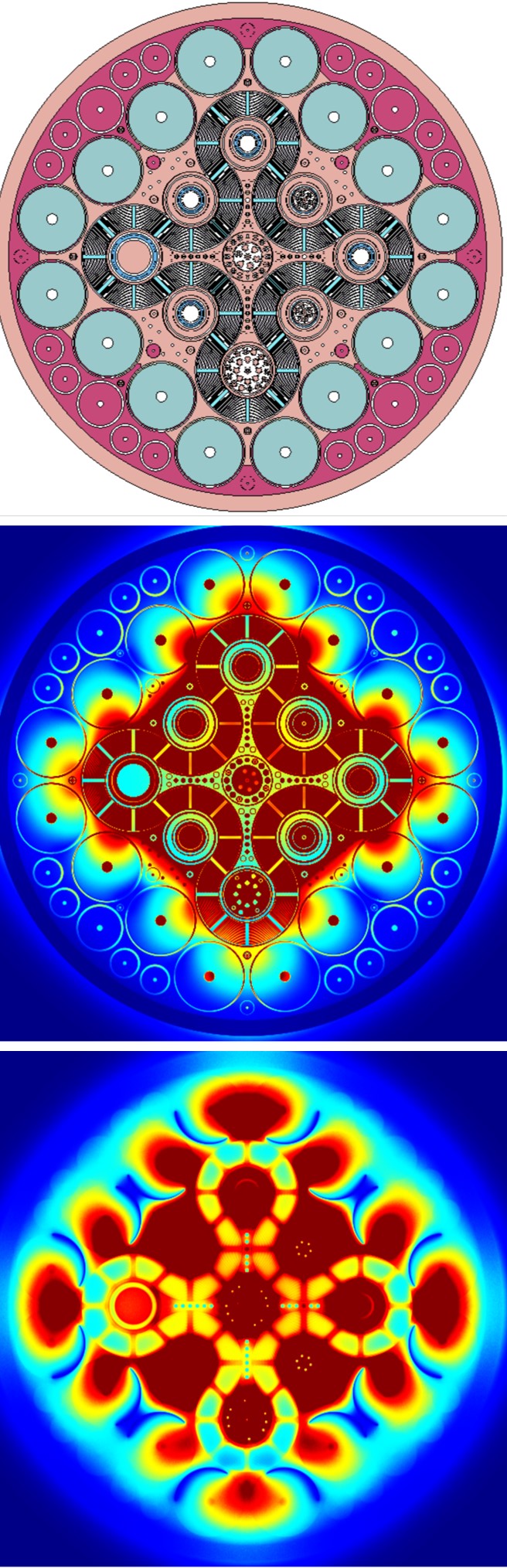
First, the images in the thumbnail above which Paul Cosgrove from the University of Cambridge used to introduce his talk on modelling thermal and neutron fluxes.  They could be from an art gallery but actually they are from the VTT Technical Research Centre of Finland and show the geometry of an advanced test reactor [ATR] (top); the rate of collisions in the ATR (middle); and the neutron density distribution (bottom).

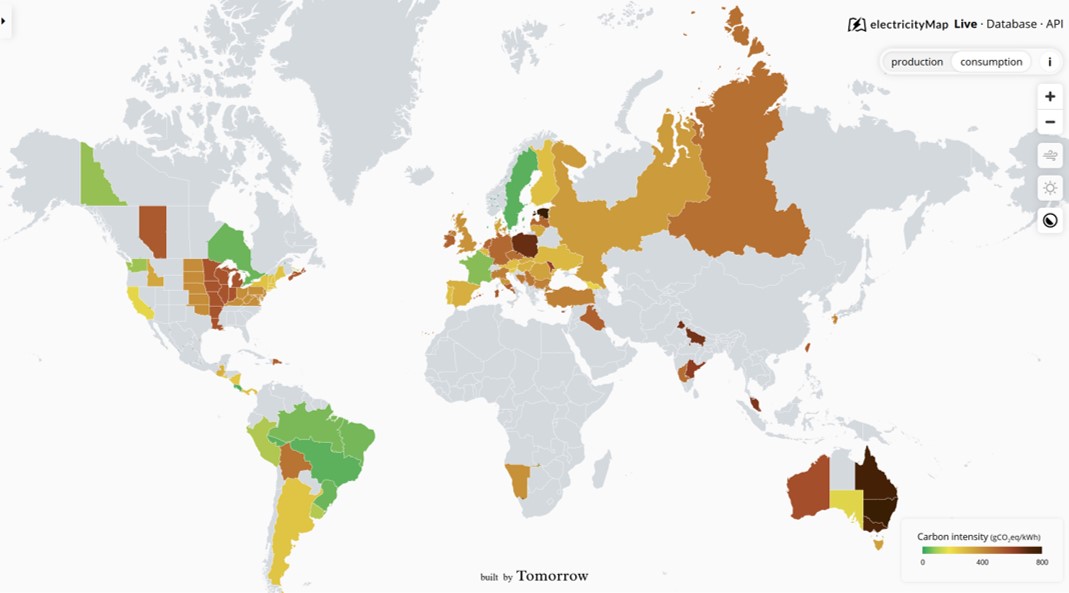
Second, a great app for your phone called electricityMap that shows you a live map of global carbon emissions and when you click on a country it reveals the sources of electricity by type, i.e. nuclear, gas, wind etc, as well as imports and exports of electricity.  Dame Sue Ion told us about it during her key-note lecture.  I think all politicians and journalists need it installed on their phones to check their facts before they start talking about energy policy.

Third, the scale of the concrete infrastructure required in current designs of nuclear power stations compared to the reactor vessel where the energy is generated.  The pictures show the construction site for the Vogtle nuclear power station in Georgia, USA (left) and the reactor pressure vessel being lowered into position (right).  The scale of nuclear power stations was one of the reasons highlighted by Steve Smith from Algometrics for why investors are not showing much interest in them (see ‘Small is beautiful and affordable in nuclear power-stations‘ on January 14th, 2015).  Amongst the other reasons are: too expensive (about £25 billion), too long to build (often decades), too back-end loaded (i.e. no revenue until complete), too complicated (legally, economically & socially), too uncertain politically, too toxic due to poor track record of returns to investors, too opaque in terms of management of industry.  That’s quite a few challenges for the next generation of nuclear scientists and engineers to tackle.  We are making a start by creating design tools that will enable mass-production of nuclear power stations (see ‘Enabling or disruptive technology for nuclear engineering?‘ on January 28th, 2015) following the processes used to produce other massive engineering structures, such as the Airbus A380 (see Integrated Digital Nuclear Design Programme); but the nuclear industry has to move fast to catch up with other sectors of the energy business, such as gas-fired powerstations or wind turbines.  If it were to succeed then the energy market would be massively transformed.


Intelligent aliens?

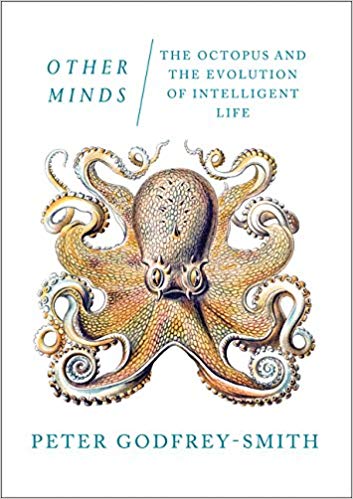
A couple of weeks ago I wrote about cuttlefish [see ‘Wearing your heart on your sleeve‘ on January 16th, 2019]  based on a wonderful book, that I was given for Christmas, called ‘Other Minds: The Octopus and the Evolution of Intelligent Life‘ by Peter Godfrey-Smith.  Cuttlefish and octopuses are cephalopods that Peter Godfrey-Smith describes as ‘an island of mental complexity in the sea of invertebrate animals’.  The most recent common ancestor of cephalopods and humans is so distant and was so simple that cephalopods represent an independent experiment in the evolution of large brains and complex behaviour.  An octopus has about 500 million neurons, which is not as many as humans, we have about 100 billion; but still a large number and connectivity is probably more important than absolute size [see ‘Digital hive mind‘ on November 30th, 2016].  Whereas we have a central nervous system, an octopus has a distributed system with neurons located in its arms which appears to give each arm a high-level of autonomy.  In addition to tactile sensory information from its suckers, each arm receives visual information from its skin which is sensitive to light.  The extent to which information and control is shared between the neurons in the brain and the network of neurons in its body is unknown.  It is difficult for us to imagine our fingers as being able to respond independently to visual as well as tactile stimuli, even more so to think of them as independent problem-solvers.  Peter Godfrey-Smith suggests that cephalopods are the closest that we are likely to come to meeting intelligent aliens – their thought processes and capabilities appear so different to ours that our scientific studies and experiments are unlikely to fully reveal their intelligence or level of consciousness.  A first step would be to stop eating them!

Peter Godfrey-Smith, Other Minds: The Octopus and the Evolution of Intelligent Life, London: William Collins, 2018.

INSTRUCTIVE final reckoning

Our EU project, INSTRUCTIVE came to an end with the closing of 2018.  We have achieved all of our milestones and deliverables; and, now have 51 (=60-9) days to submit our final reports.  We have already presented the technical contents of those reports to representatives of our sponsors in a final review meeting just before the Christmas break.  I think that they were pleased with our progress; our findings certainly stimulated debate about how to move forward and implement the new technologies – lots of new questions that we did not know we should be asking when we started the project.

We are also disseminating the key results more publicly because this is an obligation inherent with receiving public funding for our research; but also, because I see no purpose in advancing knowledge without sharing it. During the course of the project we have given research updates at three conferences and the papers/abstracts for these are available via the University of Liverpool Repository [#1, #2 & #3].  And, we are in the process of producing three papers for publication in archived journals.

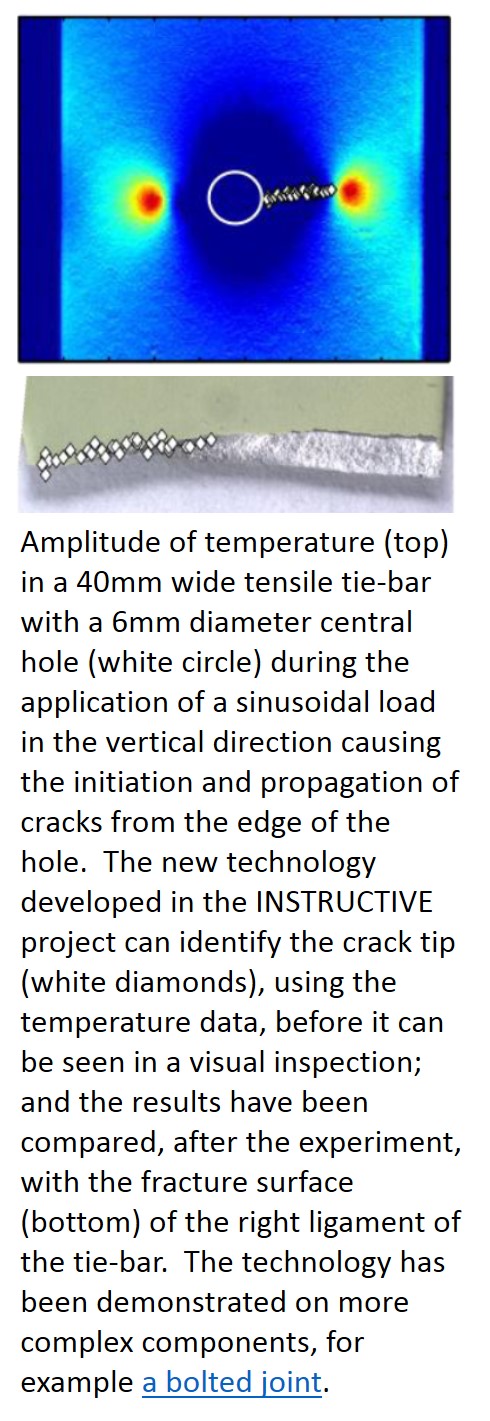
However, the real tangible benefit of the project is the move to next stage of development for the technology supported by a new project, called DIMES, that started on January 1st, 2019.  The aim of the DIMES project is to develop and demonstrate systems with the capability to detect a crack or delamination in a metallic or composite structure, and the potential to be deployed as part of an on-board structural health monitoring system for passenger aircraft.  In other words, the INSTRUCTIVE project has successfully demonstrated that a new philosophy for monitoring damage in aerospace structures, using disturbances to the strain field caused by the damage, is at least as effective as traditional non-destructive evaluation (NDE) techniques and in some circumstances provides much more sensitivity about the initiation and propagation of damage.  This has been sufficiently successful in the laboratory and on aircraft components in an industrial environment that is worth exploring its deployment for on-board monitoring and the first step is to use it in ground-based tests.

There will be more on DIMES as the project gets underway and updates on its progress will replace the twice-yearly ones on INSTRUCTIVE.

The series of posts on the INSTRUCTIVE project can be found at https://realizeengineering.blog/category/myresearch/instructive-project/

instructive acknowledgement