Tag Archives: science

Where we are and what we have

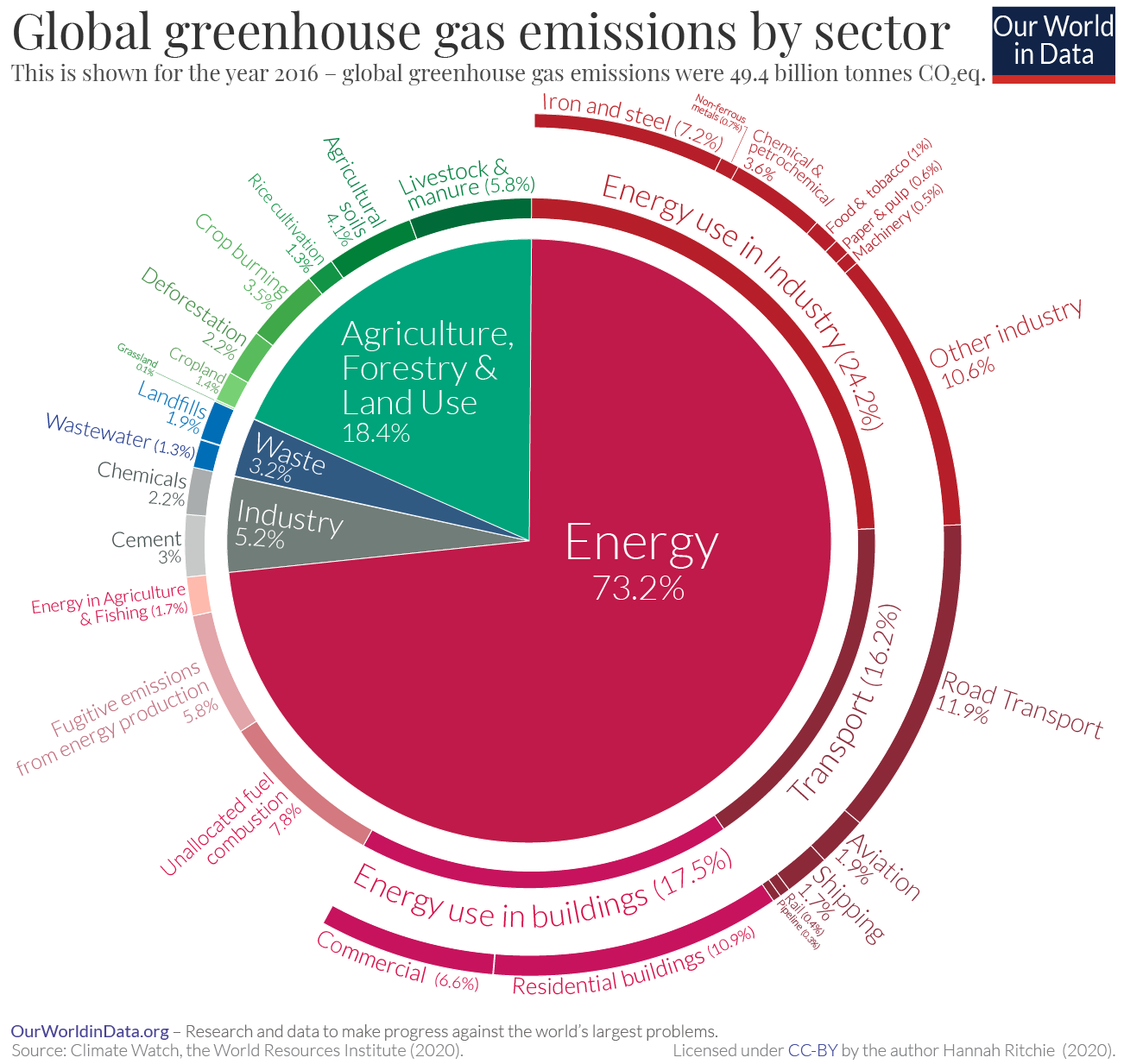
Pie chart showing green house gas emissions by sectorIn his closing statement at COP26 in Glasgow earlier this month, António Guterres, the Secretary-General of the UN stated that ‘Science tells us that the absolute priority must be rapid, deep and sustained emissions reductions in this decade. Specifically – a 45% cut by 2030 compared to 2010 levels.’   About three-quarters of global green house gas emissions are carbon dioxide (30.4 billions tons in 2010 according to the IEA). A reduction in carbon emissions of 45% by 2030 would reduce this to 16.7 billion tons or an average of about 2 tons per person per year (tCO2/person/yr) allowing for the predicted 9% growth in the global population to 8.5 billion people by 2030. This requires the average resident of Asia, Europe and North America to reduce their carbon emissions to about a half, a quarter and a tenth respectively of their current levels (3.8, 7.6 & 17.6 tCO2/person/yr respectively, see the graphic below and ‘Two Earths‘ on August 13th, 2012).  These are massive reductions to achieve in a very short timescale, less than a decade.  Lots of people are talking about global and national targets; however, very few people have any idea at all about how to achieve the massive reductions in emissions being talked about at COP26 and elsewhere.  The graphic above shows global greenhouse gas emissions by sector with almost three-quarters arising from our use of energy to make stuff (energy use in industry: 24%), to move stuff and us (transport: 16%), and to use stuff and keep us comfortable (energy use in building: 17.5%).  Hence, to achieve the target reductions in emissions and prevent the temperature of the planet rising more than 1.5 degrees compared to pre-industrial levels, we need to stop making, buying, moving and consuming stuff.  We need to learn to live with our local climate because cooling and heating buildings consumes energy and heats the planet.  And, we need to use public transport, a bicycle or walk.  By the way, for stuff read all matter, materials, articles, i.e., everything!  We will need to be satisfied with where we are and what we have, to learn to love old but serviceable belongings [see ‘Loving the daily current of existence‘ on August 11th, 2021 and ‘Old is beautiful‘ on May 1st, 2013].

Infographic showing CO2 emission by region and wealth

Follow your gut

Decorative image of a fruit fly nervous system Albert Cardona HHMI Janelia Research Campus Welcome Image Awards 2015Data centres worldwide consume about 1% of global electricity generation, that’s 200-250 TWh (Masenet et al, 2020), and if you add in mining of cryptocurrencies then consumption jumps by about 50% (Gallersdörfer et al, 2020). Data transmission consumes about 260-340 TWh or at least another 1% of global energy consumption (IEA, 2020).  The energy efficiency of modern computers has been improving; however, their consumption is still many millions times greater than the theoretical limit defined by Landauer’s principle which was verified in 2012 by Bérut et al.  According to Landauer’s principle, a computer operating at room temperature would only need 3 zJ (300 billion billionths of a Joule) to erase a bit of information.  The quantity of energy used by modern computers is many millions times the Landauer limit.  Of course, progress is being made almost continuously, for example a team at EPFL in Lausanne and ETH Zurich recently described a new technology that uses only a tenth of the energy of current transistors (Oliva et al 2020).  Perhaps we need turn to biomimetics because Escherichia Coli, which are bacteria that live in our gut and have to process information to reproduce, have been found to use ten thousand times less energy to process a bit of information than the average human-built device for processing information (Zhirnov & Cavin, 2013).  So, E.coli are still some way from the Landauer limit but demonstrate that there is considerable potential for improvement in engineered devices.

References

Bérut A, Arakelyan A, Petrosyan A, Ciliberto S, Dillenschneider R & Lutz E. Experimental verification of Landauer’s principle linking information and thermodynamics. Nature, 483: 187–189, 2012.

IEA (2021), Data Centres and Data Transmission Networks, IEA, Paris https://www.iea.org/reports/data-centres-and-data-transmission-networks

Gallersdörfer U, Klaaßen L, Stoll C. Energy consumption of cryptocurrencies beyond bitcoin. Joule. 4(9):1843-6, 2020.

Masanet E, Shehabi A, Lei N, Smith S, Koomey J. Recalibrating global data center energy-use estimates. Science. 367(6481):984-6, 2020.

Oliva N, Backman J, Capua L, Cavalieri M, Luisier M, Ionescu AM. WSe 2/SnSe 2 vdW heterojunction Tunnel FET with subthermionic characteristic and MOSFET co-integrated on same WSe 2 flake. npj 2D Materials and Applications. 4(1):1-8, 2020.

Zhirnov VV, Cavin RK. Future microsystems for information processing: limits and lessons from the living systems. IEEE Journal of the Electron Devices Society. 1(2):29-47, 2013.

Boltzmann’s brain

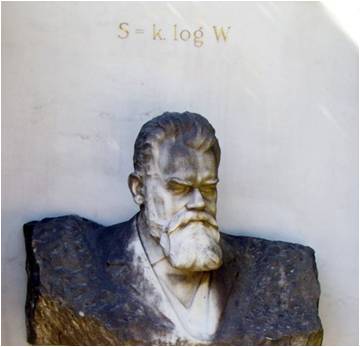
Ludwig Boltzmann developed a statistical explanation of the second law of thermodynamics by defining entropy as being proportional to the logarithm of the number ways in which we can arrange a system [see ‘Entropy on the brain‘ on November 29th 2017].  The mathematical expression of this definition is engraved on his head-stone.  The second law states that the entropy of the universe is always increasing and Boltzmann argued it implies that the universe must have been created in a very low entropy state.  Four decades earlier, in 1854, William Thomson concluded the dissipation of heat arising from the second law would lead to the ‘death’ of the universe [see ‘Cosmic heat death‘ on February 18th, 2015] while the big bang theory for the creation of the universe evolved about twenty years after Boltzmann’s death.  The probability of a very low entropy state required to bring the universe into existance is very small because it implies random fluctuations in energy and matter leading to a highly ordered state.  One analogy would be the probability of dead leaves floating on the surface of a pond arranging themselves to spell your name.  It is easy to think of fluctuations that are more likely to occur, involving smaller systems, such as one that would bring only our solar system into existence, or progressively more likely, only our planet, only the room in which you are sitting reading this blog, or only your brain.  The last would imply that everything is in your imagination and ultimately that is why Boltzmann’s argument is not widely accepted although we do not have a good explanation for the apparent low entropy state at the start of the universe.  Jean-Paul Sartre wrote in his book Nausea ‘I exist because I think…and I cannot stop myself from thinking.  At this very moment – it’s frightful – if I exist, it is because I am horrified at existing.’  Perhaps most people would find horrifying the logical extension of Boltzmann’s arguments about the start of the universe to everything only existing in our mind.  Boltzmann’s work on statistical mechanics and the second law of thermodynamics is widely accepted and support the case for him being genius; however, his work raised more questions than answers and was widely criticised during his lifetime which led to him taking his own life in 1906.

Sources:

Paul Sen, Einstein’s fridge: the science of fire, ice and the universe.  London: Harper Collins, 2021.

Jean-Paul Sartre, Nausea.  London: Penguin Modern Classics, 2000.

If you don’t succeed, try and try again…

Photograph of S-shaped plateYou would not think it was difficult to build a thin flat metallic plate using a digital description of the plate and a Laser Powder Bed Fusion (L-PBF) machine which can build complex components, such as hip prostheses.  But it is.  As we have discovered since we started our research project on the thermoacoustic response of additively manufactured parts (see ‘Slow start to an exciting new project on thermoacoustic response of AM metals‘ on September 9th, 2020).  L-PBF involves using a laser beam to melt selected regions of a thin layer of metal powder spread over a flat bed.  The selected regions represent a cross-section of the desired three-dimensional component and repeating the process for each successive cross-section results in the additive building of the component as each layer solidifies.  And there in those last four words lies the problem because ‘as each layer solidifies’ the temperature distribution between the layers causes different levels of thermal expansion that results in strains being locked into our thin plates.  Our plates are too thin to build with their plane surfaces horizontal or perpendicular to the laser beam so instead we build them with their plane surface parallel to the laser beam, or vertical like a street sign.  In our early attempts, the residual stresses induced by the locked-in strains caused the plate to buckle into an S-shape before it was complete (see image).  We solved this problem by building buttresses at the edges of the plate.  However, when we remove the buttresses and detach the plate from the build platform, it buckles into a dome-shape.  Actually, you can press the centre of the plate and make it snap back and forth noisily.  While we are making progress in understanding the mechanisms at work, we have some way to go before we can confidently produce flat plates using additive manufacturing that we can use in comparisons with our earlier work on the performance of conventionally, or subtractively, manufactured plates subject to the thermoacoustic loading experienced by the skin of a hypersonic vehicle [see ‘Potential dynamic buckling in hypersonic vehicle skin‘ on July 1st 2020) or the containment walls in a fusion reactor.  Sometimes research is painfully slow but no one ever talks about it.  Maybe because we quickly forget the painful parts once we have a successful outcome to brag about. But it is often precisely the painful repetitions of “try and try again” that allow us to reach the bragging stage of a successful outcome.

The research is funded jointly by the National Science Foundation (NSF) in the USA and the Engineering and Physical Sciences Research Council (EPSRC) in the UK (see Grants on the Web).

References

Silva AS, Sebastian CM, Lambros J and Patterson EA, 2019. High temperature modal analysis of a non-uniformly heated rectangular plate: Experiments and simulations. J. Sound & Vibration, 443, pp.397-410.

Magana-Carranza R, Sutcliffe CJ, Patterson EA, 2021, The effect of processing parameters and material properties on residual forces induced in Laser Powder Bed Fusion (L-PBF). Additive Manufacturing. 46:102192