Tag Archives: nuclear energy

Webs of expertise and knowledge

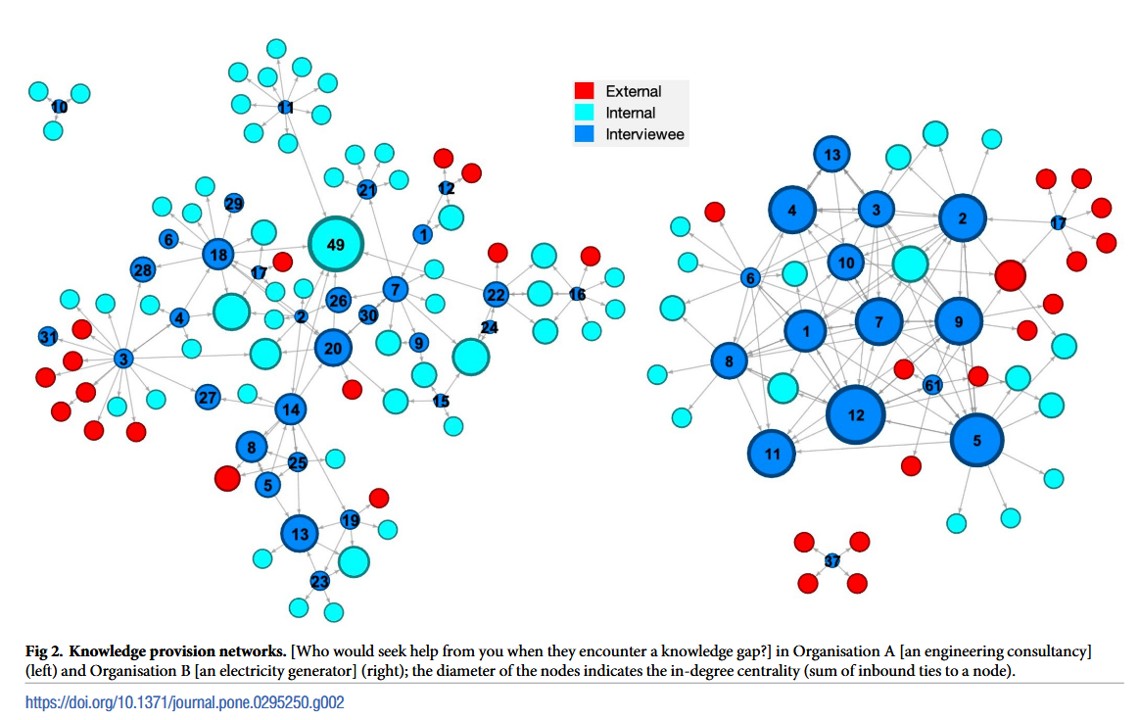
I am writing this post while I am in the middle of leading a breakout activity for more than a hundred PhD students from our Centres for Doctoral Training in nuclear science and engineering, GREEN and SATURN.  We have asked them to construct a knowledge network for a start-up company commissioned to build either a fusion energy power station or a power station based on small modular reactors (SMRs).  A knowledge network is a web of expertise and information whose value comes from the connections and interactions within and outside an organization.  Our aim is to encourage students to think beyond science and engineering and consider the interactions required to deliver safe, economic nuclear power.

We have brought the students together in York from six universities located in the North of England (Lancaster, Leeds, Liverpool, Manchester & Sheffield) and Scotland (Strathclyde).  This is an annual event usually held in the first working week of the New Year (see ‘Nuclear Winter School’ on January 23rd 2019).

The breakout activity has three one-hour time-slots on three consecutive days.  In today’s time-slot, we have divided the students into twenty groups of seven and given them paper, pencils, and a circle stencil plus an eraser with which to draw knowledge networks.  We are hoping for creativity, lively discussions, and some fun.  In yesterday’s one-hour slot, they had briefings from the Chief Manufacturing Engineer for a company building SMRs and the Deputy Chief Engineer of a company developing a fusion power station, as well as from a Digital Knowledge Management Consultant whose PhD led to a paper on knowledge networks, which we shared with the students last month (see ‘Evolutionary model of knowledge management’ on March 6th, 2024).  Tomorrow, one person from each group will have two minutes to present their knowledge network, via a portable visualiser, to an audience of several hundred.  What can go wrong?  Twenty two-minute presentations in one hour with one minute for questions and changeover.

GREEN (Growing skills for Reliable Economic Energy from Nuclear) is co-funded by a consortia of industrial organisations and the UK EPSRC (grant no. EP/S022295/1).

SATURN (Skills And Training Underpinning a Renaissance in Nuclear) succeeded GREEN and is also co-funded by a consortia of industrial organisations and the UK EPSRC (grant no. EP/Y034856/1).

Image shows thumbnail of figure from shared paper with knowledge networks for an engineering consultancy company and an electricity generator, follow this link for full size image.

Commoditisation of civil nuclear power

Logo for BBC Inside ScienceA colleague and I published a paper last month that we hope will bring about a paradigm shift in the nuclear power industry. I was interviewed on BBC Radio 4’s Inside Science on the day following its publication – its the first time one of my scientific papers has made that big a splash in the media!  You can listen to the programme on BBC Sounds at https://www.bbc.co.uk/sounds/play/m001zdwv.

In the paper we describe a blueprint for the factory-production of sealed micro-power units with a digitally-enabled, holistic assurance framework.  Currently, several designs of micro-reactors are progressing to the prototype stage with hazards contained on-site.  The integration of these approaches enables a transformation of the regulatory regime to type or series approval at the factory, similar to the aerospace industry, and supported by digital tools such as block chains to provide transparent quality assurance within the supply chain.  The transformation of the regulatory regime and the shift to ‘flow’ production in a factory would remove the financial risk from the power plant to the factory thereby enabling nuclear power to become a realistic competitor for intermittent green energy sources, such as wind and solar, both in terms of financial and ecological costs.  The output from three production lines could replace the current electricity generating capacity from fossil fuels in the UK over approximately 15 years thus making a significant contribution to achieving net zero greenhouse gas emissions.  We propose a design philosophy for the micro-power units that will allow them to go unnoticed in an urban environment or even become an iconic product that signals a community’s commitment to responsible stewardship of the Earth’s resources.  Our blueprint represents a revolutionary change for the nuclear power industry that would likely lead to the commoditisation of nuclear power whereas the status quo probably leads to extinction.

The paper is published with open access (its free) at Patterson EA & Taylor RJ, 2024, The commoditisation of civil nuclear power, Royal Society Open Science, 11:240021.

Opportunities lost in knowledge management using digital technology

Decorative imageRegular readers of this blog will know that I occasionally feature publications from my research group.  The most recent was ‘Predicting release rates of hydrogen from stainless steel’ on September 13th, 2023 and before that ‘Label-free real-tracking of individual bacterium’ on January 25th 2023 and ‘A thermal emissions-based real-time monitoring system for in situ detection of cracks’ in ‘Seeing small changes is a big achievement’ on October 26th 2023.  The subject of these publications might seem a long way apart but they are linked by my interest in trying to measure events in the real-world and use the data to develop and validate high-fidelity digital models.  Recently, I have stretched my research interests still further through supervising a clutch of PhD students with a relatively new collaborator working in the social sciences.  Two of the students have had their first papers published by the ASME (American Society of Mechanical Engineers) and the IEEE (Institute of Electrical and Electronics Engineers).  Their papers are not directly connected but they both explore the use of published information to gain new insights on a topic.  In the first one [1], we have explored the similarities and differences between safety cases for three nuclear reactors: a pair of research reactors – one fission and one fusion reactor; and a commercial fission reactor.  We have developed a graphical representation of the safety features in the reactors and their relationships to the fundamental safety principles set out by the nuclear regulators. This has allowed us to gain a better understanding of the hazard profiles of fission and fusion reactors that could be used to create the safety case for a commercial fusion reactor.  Fundamentally, this paper is about exploiting existing knowledge and looking at it in a new way to gain fresh insights, which we did manually rather than automating the process using digital technology.  In the second paper [2], we have explored the extent to which digital technologies are being used to create, collate and curate knowledge during and beyond the life-cycle of an engineering product.  We found that these processes were happening but generally not in a holistic manner.  Consequently, opportunities were being lost through not deploying digital technology in knowledge management to undertake multiple roles simultaneously, e.g., acting as repositories, transactive memory systems (group-level knowledge sharing), communication spaces, boundary objects (contact points between multiple disciplines, systems or worlds) and non-human actors.  There are significant challenges, as well as competitive advantages and organisational value to be gained, in deploying digital technology in holistic approaches to knowledge management.  However, despite the rapid advances in machine learning and artificial intelligence [see ‘Update on position of AI on hype curve: it cannot dream’ on July 26th 2023] that will certainly accelerate and enhance knowledge management in a digital environment, a human is still required to realise the value of the knowledge and use it creatively.

References

  1. Nguyen, T., Patterson, E.A., Taylor, R.J., Tseng, Y.S. and Waldon, C., 2023. Comparative maps of safety features for fission and fusion reactors. Journal of Nuclear Engineering and Radiation Science, pp.1-24
  2. Yao, Y., Patterson, E.A. and Taylor, R.J., 2023. The Influence of Digital Technologies on Knowledge Management in Engineering: A Systematic Literature Review. IEEE Transactions on Knowledge and Data Engineering.

Inconvenient data about electricity generation

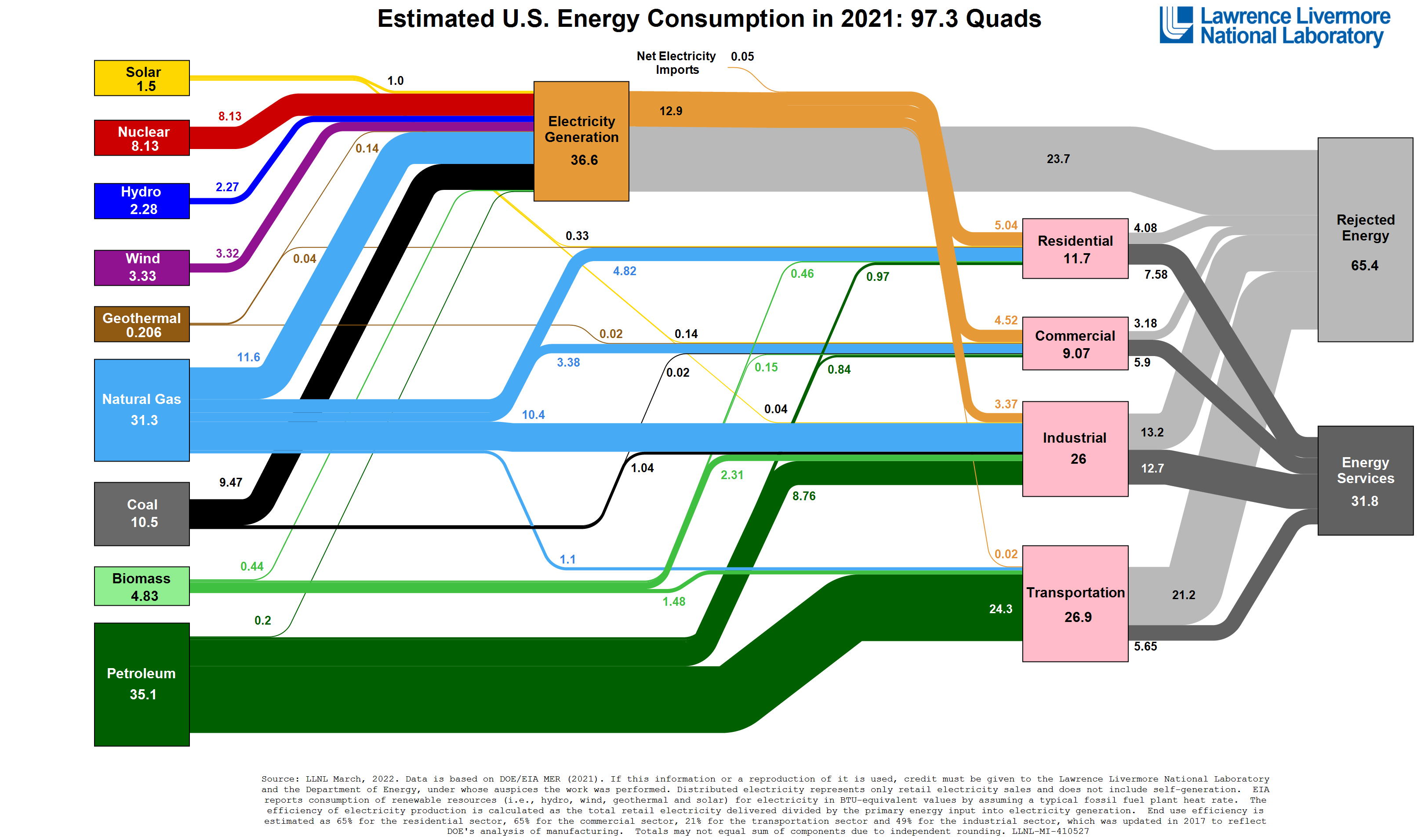
Decorative infographicI like a good infographic and this one showing annual energy flows for a country  is one of my favourites [see ‘Energy blending’ on May 22nd 2013].  Some governments produce them annually.  The image shows the latest one for the UK [2021]. It makes interesting but perhaps depressing reading.  Transportation using fossil fuels accounts for 31% (41.6/134.1 million tonnes oil equivalent) of the UK energy consumption while electricity output accounts for only 21% (28.6/134.1 million tonnes oil equivalent).  This implies that if all vehicles were powered by electricity then the output of our power stations would need to increase to 70.2 million tonnes oil equivalent or between two- and three-fold (excluding conversion & transmission losses).  You can perform a similar analysis for the USA [see 2021 Energy flow chart from LLNL].  Fossil-fuelled transportation accounted for 25%  (24.3/97.3 Quads) and electricity output 13% (12.9/97.3 Quads) so converting all transportation to be electrically powered requires a three-fold increase in electrical output from power stations. It is more difficult to find equivalent data for Japan; however, in 2014 [see Energy flow chart from I2CNER Kyushu University] fossil-fuelled transportation accounted for 32% (3.03/9.52 EJ) and electricity output 38% (3.66/9.52 EJ) so converting all transportation to be electrically powered requires a two-fold increase in electrical output from power stations.  None of the above takes account of space heating mainly via fossil fuel or that many existing power stations are fossil-fuelled and need to be replaced in order to achieve net zero carbon emissions.  Hence, the required scale of construction of power stations using renewable sources, including nuclear, solar and wind, is enormous and in most countries it is barely discussed let alone planned or started; leading to the conclusion that there is little chance of achieving net zero carbon emissions by 2050 as called for by the Paris agreement.