Category Archives: Learning & Teaching

Collegiality as a defence against pandemic burnout

photograph of a flower for decorative purposes onlyMany of my less experienced colleagues ask, ‘what is collegiality?’  Collegiality is the glue that holds universities together according to Neeta Baporikar.  While Roland S. Barth suggested that if students are to learn and develop, then their teachers must also learn and develop and collegiality is the set of practices and culture that support this adult growth.  In this context, Thomas Hoerr has proposed that collegiality has five components: (i) teachers talking about students with teachers; (ii) teachers working together to develop education programmes; (iii) teachers observing one another; (iv) teachers teaching each other; and (v) teachers talking about education and working together on committees.  Neeta Baporikar echoes this view by concluding that if we hope to teach students to participate, examine issues, collaborate, think critically and synthesise new approaches then we should be their model.  

In an environment where research is a priority, it is possible to substitute ‘researcher’ for ‘teacher’ in the descriptions above.  Then collegiality becomes researchers talking about [research] students, researchers working together to develop research programmes, researchers observing one another, researchers teaching each other, and researchers talking about research and working together on committees.  The idea that collegiality is a strategy for excellence holds as well as for research as it does for teaching.

The pressures on early career academics in a research university can be intense and the temptation to focus exclusively on delivering teaching and performing research can lead individuals to work in isolation and to neglect the opportunities provided by active engagement with their colleagues.  However, leaders must also take responsibility for creating an environment in which collegiality can thrive and encouraging active participation – it is part our service to the academic community as leaders to create and maintain a culture of scholarship and excellence [see ‘Clueless on leadership style’ on June 14th, 2017].  Neeta Baporikar provides steps that heads of departments can take to nurture collegiality, including providing a vision, encouraging collaborative participation, listening to diverse opinions, building on people’s strengths, and being aware of the world outside the department.  This is similar to the shepherding approach to leadership that I wrote about in May 2017 [‘Leadership is like shepherding’ on May 10th, 2017].  However, it has all become much more difficult in a pandemic – both collegiality and leadership.  Last week an article in Nature suggested that pandemic burnout is rife amongst academics working long hours in isolation to transpose and deliver their teaching materials online, to maintain their research without the spontaneity of face-to-face discussions with their team or collaborators, and to support the well-being and mental health of students who are also at risk of burnout.  It is suggested that burnout can be managed by finding a forum to express your feelings, creating ways to detach from stress, prioritizing and normalizing conversations about mental health, and fighting the isolation through meeting with peers.  These steps are a combination of traditional collegiality and the five ways to well-being: connect, be active, take notice, keep learning and give [see graphic in ‘On the impact of writing on well-being’ on March 3rd, 2021].

References

Neeta Baporikar, Collegiality as a strategy for excellence in academia, IJ Strategic Change Management, 6(1), 2015.

Roland Barth, Improving schools from within, Jossey-Bass, 2010.

Virginia Gewin, Pandemic burnout is rampant in academia, Nature, 591: 489-491, 2021.

Thomas R. Hoerr, Principal Connection: The Juggler’s Guide to Collegiality, Communication Skills for Leaders, 72(7): 88 -89, 2015.

Puzzles and mysteries

Detail from abstract by Zahrah ReshPuzzles and mysteries are a pair of words that have taken on a whole new meaning for me since reading John Kay’s and Mervyn King’s book called ‘Radical uncertainty: decision-making for an unknowable future‘ during the summer vacation [see ‘Where is AI on the hype curve?‘ on August 12th, 2020]. They describe puzzles as well-defined problems with knowable solutions; whereas mysteries are ill-defined problems, that have no objectively correct solution and are imbued with vagueness and indeterminacy.  I have written before about engineers being creative problems-solvers [see ‘Learning problem-solving skills‘ on October 24th, 2018] which leads to the question of whether we specialise in solving puzzles or mysteries, or perhaps both types of problems.  The problems that I set for students to solve for homework to refine and evaluate their knowledge of thermodynamics [see ‘Problem-solving in thermodynamics‘ on May 6th, 2015] clearly fall into the puzzle category because they are well-defined and there is a worked solution available.  Although for many students these problems might appear to be mysteries, the intention is that with greater knowledge and understanding the mysteries will be transformed into mere puzzles.  It is also true that many real-world mysteries can be transformed into puzzles by research that advances the collective knowledge and understanding of society.  Part of the purpose of an engineering education is to equip students with the skills to make this transformation from mysteries to puzzles.  At an undergraduate level we use problems that are mysteries only to the students so that success is achievable; however, at the post-graduate level we use problems that are perceived as mysteries to both the student and the professor with the intention that the professor can guide the student towards a solution.  Of course, some mysteries are intractable often because we do not know enough to define the problem sufficiently that we can even start to think about possible solutions.  These are tricky to tackle because it is unreasonable to expect a research student to solve them in limited timeframe and it is risky to offer to solve them in exchange for a research grant because you are likely to damage your reputation and prospects of future funding when you fail.  On the other hand, they are what makes research interesting and exciting.

Image: Extract from abstract by Zahrah Resh.

Democratizing education

One motivation for developing Massive Open Online Courses (MOOC) has been to democratize education by giving everyone access to knowledge often presented by leading professors.  It was certainly one reason why I developed and delivered two MOOCs on ‘Energy: Thermodynamics in Everyday Life‘ in 2015/16 and ‘Understanding Super Structures’ in 2017.  The workload involved in supporting thousands of learners around the global is not insignificant and was unsustainable for me so I gave up after running them for a couple of years despite the intangible rewards [see ‘Knowledge spheres‘ on March 9th, 2016 and ‘A liberal engineering education‘ on March 2nd, 2016] . However, I incorporated the MOOC on energy into my undergraduate module on thermodynamics to create a blended approach to learning [see ‘Blended learning environments‘ on November 14th, 2018].  This paid dividends for me when the pandemic forced our campus into lock-down in the middle of semester last March and I already had a large number of bite-sized activities available online for our students.  Most universities have had to move their teaching online due to the pandemic; but not all students are able to access the online materials as easily others.  The Booker shortlisted novelist, Tsitsi Dangarembga has reported how one of her neighbours has struggled to access resources recommended to him by lecturers at his college in Bulawayo due to the cost and unreliability of Wi-Fi in Zimbabwe.  She tried to help him by registering him for her hotspot package but, in common with many students, he studies mainly at night when hotspot venues are closed.  The maps shows the global distribution of learners in one of the Energy MOOCs that I delivered and you can see the holes in Africa and South America which, at the time, we thought might be due to a lack of computer and internet access and Dangarembga’s account seems to support this hypothesis.  So, we designed our second MOOC on Structures to be accessible via a mobile phone by using fewer videos and more audio clips that could be quickly downloaded and listened to offline.  Unfortunately, we ran out of resources to complete the research on whether it was accessed more successfully in those grey areas on the map; however, the audio recordings were unpopular with the more traditional audience in the USA and UK who gave us immediate and vocal feedback!

Source:

Tsitsi Dangarembga, Protest and prizes, FT Weekend, 26/27 September 2020.

Patterson EA, Using everyday engineering examples to engage learners on a massive open online courseInternational Journal of Mechanical Engineering Education, p.0306419018818551


Shaping the mind during COVID-19

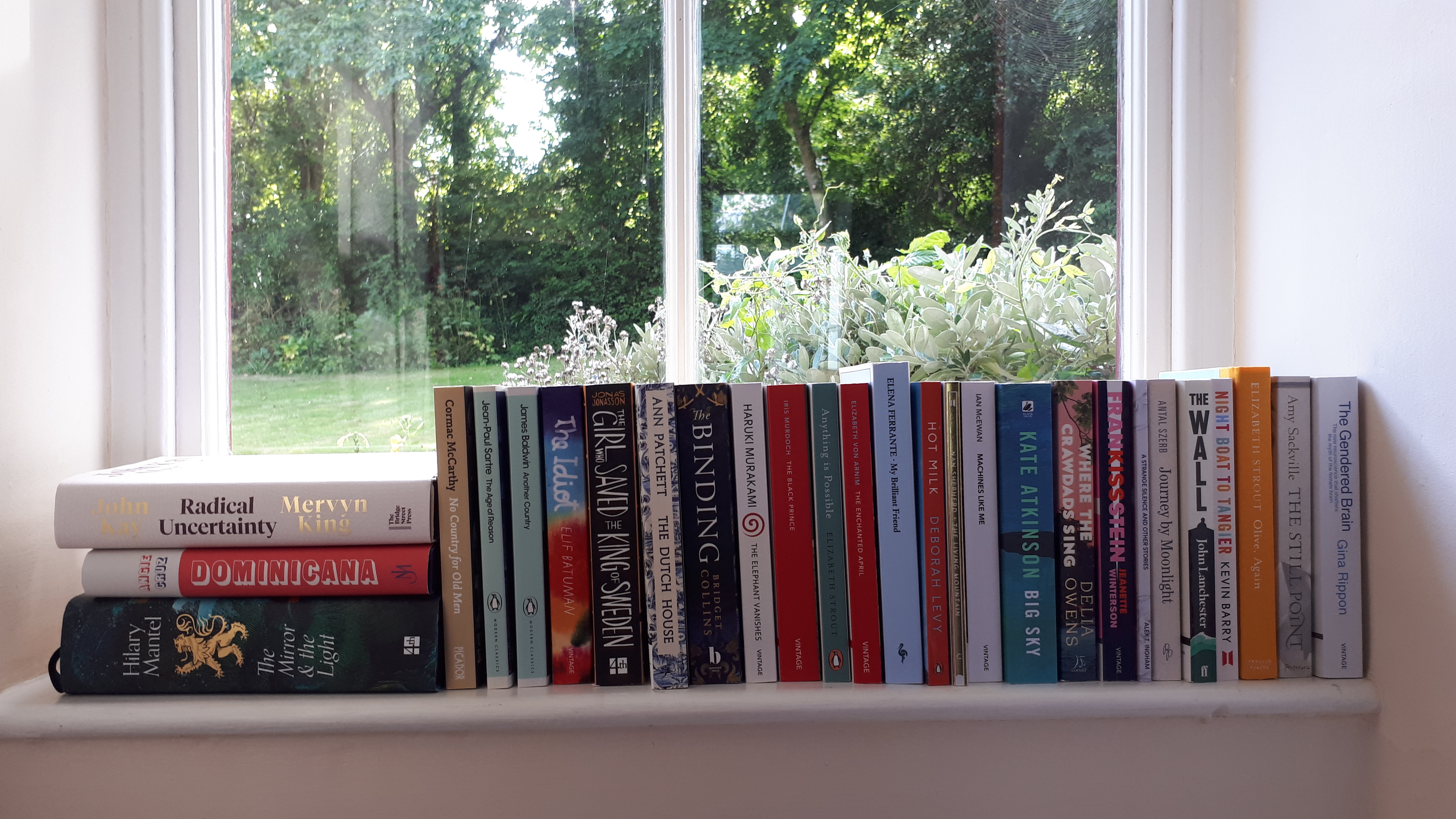
Books on a window sillIf you looked closely at our holiday bookshelf in my post on August 12th 2020, you might have spotted ‘The Living Mountain‘ by Nan Shepherd [1893-1981] which a review in the Guardian newspaper described as ‘The finest book ever written on nature and landscape in Britain’.  It is an account of the author’s journeys in the Cairngorm mountains of Scotland.  Although it is  short, only 108 pages, I have to admit that it did not resonate with me and I did not finish it.  However, I did enjoy the Introduction by Robert MacFarlane and the Afterword by Jeanette Winterson, which together make up about a third of the book. MacFarlane draws parallels between Shepherd’s writing and one of her contemporaries, the French philosopher,  Maurice Merleau-Ponty [1908-1961] who was a leading proponent of existentialism and phenomenology.  Existentialists believe that the nature of our existence is based on our experiences, not just what we think but what we do and feel; while phenomenology is about the connections between experience and consciousness.  Echoing Shepherd and in the spirit of Merleau-Ponty, MacFarlane wrote in 2011 in his introduction that ‘we have come increasingly to forget that our minds are shaped by the bodily experience of being in the world’.  It made me think that as the COVID-19 pandemic pushes most university teaching on-line we need to remember that sitting at a computer screen day after day in the same room will shape the mind rather differently to the diverse experiences of the university education of previous generations.  I find it hard to imagine how we can develop the minds of the next generation of engineers and scientists without providing them with real, as opposed to virtual, experiences in the field, design studio, workshop and laboratory.

Source:

Nan Shepherd, The Living Mountain, Edinburgh: Canongate Books Ltd, 2014 (first published in 1977 by Aberdeen University Press)