Author Archives: Eann Patterson

Credibility is in the eye of the beholder

Picture1Last month I described how computational models were used as more than fables in many areas of applied science, including engineering and precision medicine [‘Models as fables’ on March 16th, 2016].  When people need to make decisions with socioeconomic and, or personal costs, based on the predictions from these models, then the models need to be credible.  Credibility is like beauty, it is in the eye of the beholder.   It is a challenging problem to convince decision-makers, who are often not expert in the technology or modelling techniques, that the predictions are reliable and accurate.  After all, a model that is reliable and accurate but in which decision-makers have no confidence is almost useless.  In my research we are interested in the credibility of computational mechanics models that are used to optimise the design of load-bearing structures, whether it is the frame of a building, the wing of an aircraft or a hip prosthesis.  We have techniques that allow us to characterise maps of strain using feature vectors [see my post entitled ‘Recognising strain‘ on October 28th, 2015] and then to compare the ‘distances’ between the vectors representing the predictions and measurements.  If the predicted map of strain  is an perfect representation of the map measured in a physical prototype, then this ‘distance’ will be zero.  Of course, this never happens because there is noise in the measured data and our models are never perfect because they contain simplifying assumptions that make the modelling viable.  The difficult question is how much difference is acceptable between the predictions and measurements .  The public expect certainty with respect to the performance of an engineering structure whereas engineers know that there is always some uncertainty – we can reduce it but that costs money.  Money for more sophisticated models, for more computational resources to execute the models, and for more and better quality measurements.

Super channel system

polina bayvelPerhaps we can be characterized by whether or not we believe we have an acceptable speed of internet access.  At home and work, I’m in the category that’s never satisfied by the speed provided.  Well, now there is a completely new standard: 1.125 Tb/s.  That’s 50,000 times faster than anything commercially available at the moment.  You could download a boxed set of the entire Games of Thrones saga in a second; at least that’s how Professor Polina Bayvel described her latest research in a recent conference that I attended at the Royal Society.  Professor Bayvel is head of the Optical Networks Group at University College London.  I think the UK government should abandon attempting to extend the current internet technology to everyone in the country and instead leap-frog the rest of the world by working on rolling out Prof Bayvel’s new technology.

Sources:

Maher R, Xu T, Galdino L, Sato M, Alvarado A, Shi K, Savory SJ, Thomsen BC, Killey RI & Bayvel P, Spectrally shaped DP-16QAM super-channel transmission with multi-channel digital back propagation, Scientific Reports, 5:8214, 2015.

Are we all free riders?

girl in smogThe ‘tragedy of the commons’ is an economic theory founded on the idea that when there is unregulated use of a shared resource then the rational consumer, acting independently and in their own interests, will maximise their consumption leading to the depletion or destruction of the resource.  For example, if there is no cost or limit to grazing sheep on common land then a rational shepherd would maximise their flock size in order to maximise profit.  Eventually, the commons’ ability to sustain the sheep is overwhelmed and it becomes a wasteland.  Are we all taking a free ride on the world’s ecosystem?  Our cars and houses freely pump out huge quantities of carbon dioxide that are overwhelming our ecosystem.  Most of us do nothing – either because we refuse to believe the evidence, or we believe it is not in our interests to act, or we don’t think it is our problem, or we don’t know what to do, or a combination of these excuses.

This might seem a low priority to you.  But, for the 40% of the world’s population that live in the five countries with the worst air quality, it is a high priority.  If you visit these countries, you experience days when it is difficult to breathe because the pollution is so bad and it is hard to read your smartphone because the air is so thick with particles.  We are all part of a single ecosystem on the planet, Gaia if you like, and we are joined to one another through a myriad of connections.  So we ignore this issue at our peril, or the peril of our grandchildren.

It seems unlikely that our leaders will take effective coordinated action and so grass roots action is needed as suggested by Kofi AnnanAssess your carbon footprint now and think about ways to become carbon neutral.  If you want to find out the carbon footprint of your organization then the Carbon Trust has useful information and services.

Sources:

The Economist Pocket World in Figures 2015 edition, Profile Books Ltd, London 2014

Thumbnail: http://blogs-images.forbes.com/benjaminshobert/files/2015/01/China_Smog2-1940×1293.jpg

Not all who wander are lost

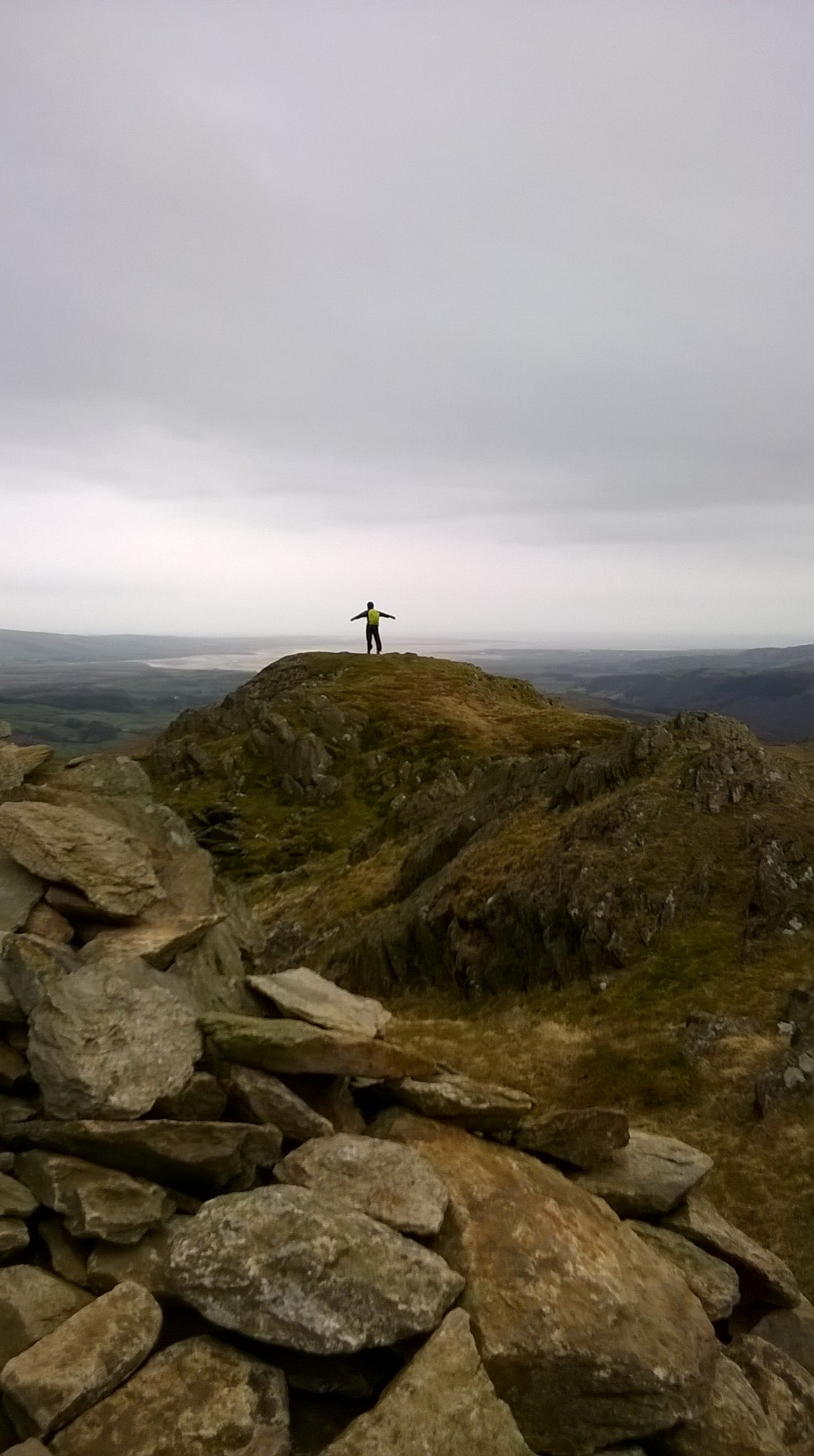
moelfamauSometime ago, when lost in Edinburgh, I came across the line in the title painted on the gable end of a building. It is a line from a poem recited by Bilbo Baggins in The Lord of Rings by JRR Tolkein.  At the time, it struck a chord with me because I was lost, though not wandering, but I am an advocate of mind-wandering, which it seemed to characterize nicely [see my post entitled ‘Mind-wandering’ on September 3rd, 2014]. This week I am on leave. I will be wandering the hills, though hopefully not lost, and I am optimistic that this will induce some mind-wandering.  If you don’t have the opportunity for a vacation, then at least ‘Slow down, breathe your own air‘ [see my post on December 23rd, 2015].

Sources:

JRR Tolkien, The Lord of the Rings, George Allen & Unwin, London, 1954