Tag Archives: radical uncertainty

Is the autonomous individual ceasing to exist?

Society consists of a series of bubbles.  A century or so ago, your bubble was largely defined by where you lived, your village or neighbourhood, because few people travelled any significant distance and you probably knew everyone living around you.  A decade or so ago, your bubble was probably defined by the newspaper you read or the radio/TV channels you preferred [see ‘You’re all weird!’ on February 8th, 2017]. Today social media defines bubbles that are geographically widely-dispersed.  This both fractures local communities and gives a global reach to influencers on social media.  Some social media ‘dictates what you shall think, it creates an ideology for you, it tries to govern your emotional life’.  The quote is from George Orwell’s 1941 essay, Literature and Totalitarianism.  He goes on ‘And as far as possible it isolates you from the outside world, it shuts you up in an artificial universe in which you have no standards of comparison.’  Of course, he is writing about totalitarianism not social media but his words seem sinisterly appropriate to the apparent intention of some social media influencers and platforms that promote alternative narratives which are not consistent with reality.  Orwell suggested that if totalitarianism becomes world-wide and permanent then literature, the truthful expression of what one person thinks and feels, could not survive.  Despite Orwell’s fear that he was living ‘in an age in which the autonomous individual is ceasing to exist’, totalitarianism did not abolish freedom of thought in the 1940s.  Now in the 2020s, we have to ensure that social media does not become a modern instrument of totalitarianism, suffocating freedom of thought, isolating large sections of society from reality, dictating ideology and governing emotional life. We need to think for ourselves and encourage others to do the same.  In their book, ‘Radical Uncertainty – Decision-making for an Unknowable Future‘, John Kay and Mervyn King repeatedly ask ‘What is going on here?’ as a device for thinking about and reviewing the evidence before reaching a conclusion.  It is a simple device that we could all usefully deploy in 2025. Happy New Year!

Sources:

George Orwell, Literature and Totalitarianism, 1941 available at https://hackneybooks.co.uk/books/64/1006/LiteratureAndTotalitarianism.html

Nazanin Zaghari-Ratcliffe, The feeling of freedom, FT Weekend, 7th & 8th December 2024.

John Kay and Mervyn King, Radical Uncertainty – Decision-making for an Unknowable Future, Little Brown Book Group, 2020.

Deep uncertainty and meta-ignorance

Decorative imageThe term ‘unknown unknowns’ was made famous by Donald Rumsfeld almost 20 years ago when, as US Secretary of State for Defense, he used it in describing the lack of evidence about terrorist groups being supplied with weapons of mass destruction by the Iraqi government. However, the term was probably coined by almost 50 years earlier by Joseph Luft and Harrington Ingham when they developed the Johari window as a heuristic tool to help people to better understand their relationships.  In engineering, and other fields in which predictive models are important tools, it is used to describe situations about which there is deep uncertainty.  Deep uncertainty refers situations where experts do not know or cannot agree about what models to use, how to describe the uncertainties present, or how to interpret the outcomes from predictive models.  Rumsfeld talked about known knowns, known unknowns, and unknown unknowns; and an alternative simpler but perhaps less catchy classification is ‘The knowns, the unknown, and the unknowable‘ which was used by Diebold, Doherty and Herring as part of the title of their book on financial risk management.  David Spiegelhalter suggests ‘risk, uncertainty and ignorance’ before providing a more sophisticated classification: aleatory uncertainty, epistemic uncertainty and ontological uncertainty.  Aleatory uncertainty is the inevitable unpredictability of the future that can be fully described using probability.  Epistemic uncertainty is a lack of knowledge about the structure and parameters of models used to predict the future.  While ontological uncertainty is a complete lack of knowledge and understanding about the entire modelling process, i.e. deep uncertainty.  When it is not recognised that ontological uncertainty is present then we have meta-ignorance which means failing to even consider the possibility of being wrong.  For a number of years, part of my research effort has been focussed on predictive models that are unprincipled and untestable; in other words, they are not built on widely-accepted principles or scientific laws and it is not feasible to conduct physical tests to acquire data to demonstrate their validity [see editorial ‘On the credibility of engineering models and meta-models‘, JSA 50(4):2015].  Some people would say untestability implies a model is not scientific based on Popper’s statement about scientific method requiring a theory to be refutable.  However, in reality unprincipled and untestable models are encountered in a range of fields, including space engineering, fusion energy and toxicology.  We have developed a set of credibility factors that are designed as a heuristic tool to allow the relevance of such models and their predictions to be evaluated systematically [see ‘Credible predictions for regulatory decision-making‘ on December 9th, 2020].  One outcome is to allow experts to agree on their disagreements and ignorance, i.e., to define the extent of our ontological uncertainty, which is an important step towards making rational decisions about the future when there is deep uncertainty.

References

Diebold FX, Doherty NA, Herring RJ, eds. The Known, the Unknown, and the Unknowable in Financial Risk Management: Measurement and Theory Advancing Practice. Princeton, NJ: Princeton University Press, 2010.

Spiegelhalter D,  Risk and uncertainty communication. Annual Review of Statistics and Its Application, 4, pp.31-60, 2017.

Patterson EA, Whelan MP. On the validation of variable fidelity multi-physics simulations. J. Sound and Vibration. 448:247-58, 2019.

Patterson EA, Whelan MP, Worth AP. The role of validation in establishing the scientific credibility of predictive toxicology approaches intended for regulatory application. Computational Toxicology. 100144, 2020.

Certainty is unattainable and near-certainty unaffordable

The economists John Kay and Mervyn King assert in their book ‘Radical Uncertainty – decision-making beyond numbers‘ that ‘economic forecasting is necessarily harder than weather forecasting’ because the world of economics is non-stationary whereas the weather is governed by unchanging laws of nature. Kay and King observe that both central banks and meteorological offices have ‘to convey inescapable uncertainty to people who crave unavailable certainty’. In other words, the necessary assumptions and idealisations combined with the inaccuracies of the input data of both economic and meteorological models produce inevitable uncertainty in the predictions. However, people seeking to make decisions based on the predictions want certainty because it is very difficult to make choices when faced with uncertainty – it raises our psychological entropy [see ‘Psychological entropy increased by ineffective leaders‘ on February 10th, 2021].  Engineers face similar difficulties providing systems with inescapable uncertainties to people desiring unavailable certainty in terms of the reliability.  The second law of thermodynamics ensures that perfection is unattainable [see ‘Impossible perfection‘ on June 5th, 2013] and there will always be flaws of some description present in a system [see ‘Scattering electrons reveal dislocations in material structure‘ on November 11th, 2020].  Of course, we can expend more resources to eliminate flaws and increase the reliability of a system but the second law will always limit our success. Consequently, to finish where I started with a quote from Kay and King, ‘certainty is unattainable and the price of near-certainty unaffordable’ in both economics and engineering.

Where is AI on the hype curve?

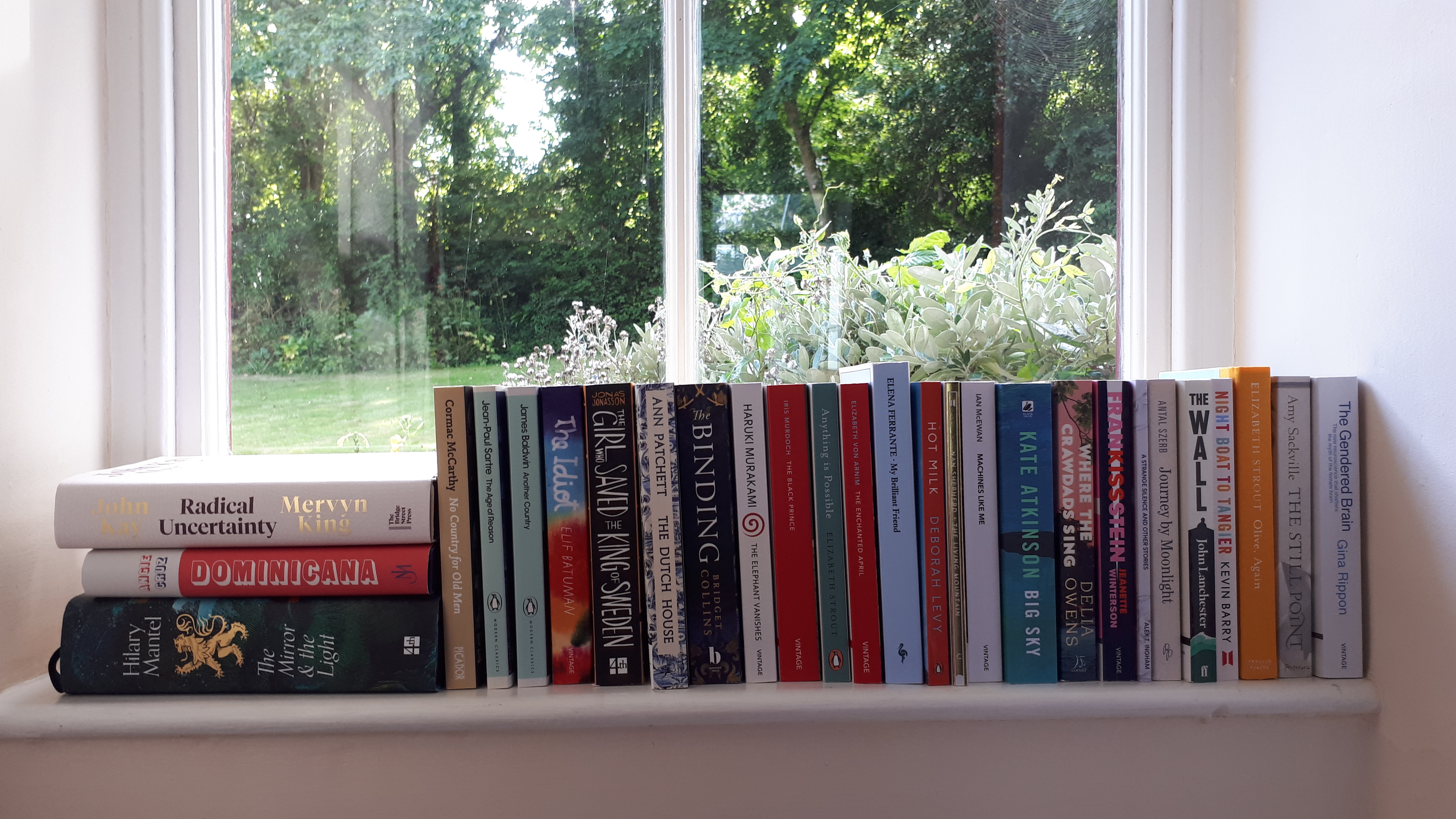
I suspect that artificial intelligence is somewhere near the top of the ‘Hype Curve’ [see ‘Hype cycle’ on September 23rd, 2015].  At the beginning of the year, I read Max Tegmark’s book, ‘Life 3.0 – being a human in the age of artificial intelligence’ in which he discusses the prospects for artificial general intelligence and its likely impact on life for humans.  Artificial intelligence means non-biological intelligence and artificial general intelligence is the ability to accomplish any cognitive task at least as well as humans.  Predictions vary about when we might develop artificial general intelligence but developments in machine learning and robotics have energised people in both science and the arts.  Machine learning consists of algorithms that use training data to build a mathematical model and make predictions or decisions without being explicitly programmed for the task.  Three of the books that I read while on vacation last month featured or discussed artificial intelligence which stimulated my opening remark about its position on the hype curve.  Jeanette Winterson in her novel, ‘Frankissstein‘ foresees a world in which humanoid robots can be bought by mail order; while Ian McEwan in his novel, ‘Machines Like Me‘, goes back to the early 1980s and describes a world in which robots with a level of consciousness close to or equal to humans are just being introduced to the market the place.  However, John Kay and Mervyn King in their recently published book, ‘Radical Uncertainty – decision-making beyond numbers‘, suggest that artificial intelligence will only ever enhance rather replace human intelligence because it will not be able to handle non-stationary ill-defined problems, i.e. problems for which there no objectively correct solution and that change with time.  I think I am with Kay & King and that we will shortly slide down into the trough of the hype curve before we start to see the true potential of artificial general intelligence implemented in robots.

The picture shows our holiday bookshelf.