Tag Archives: mechanics

INSTRUCTIVE final reckoning

Our EU project, INSTRUCTIVE came to an end with the closing of 2018.  We have achieved all of our milestones and deliverables; and, now have 51 (=60-9) days to submit our final reports.  We have already presented the technical contents of those reports to representatives of our sponsors in a final review meeting just before the Christmas break.  I think that they were pleased with our progress; our findings certainly stimulated debate about how to move forward and implement the new technologies – lots of new questions that we did not know we should be asking when we started the project.

We are also disseminating the key results more publicly because this is an obligation inherent with receiving public funding for our research; but also, because I see no purpose in advancing knowledge without sharing it. During the course of the project we have given research updates at three conferences and the papers/abstracts for these are available via the University of Liverpool Repository [#1, #2 & #3].  And, we are in the process of producing three papers for publication in archived journals.

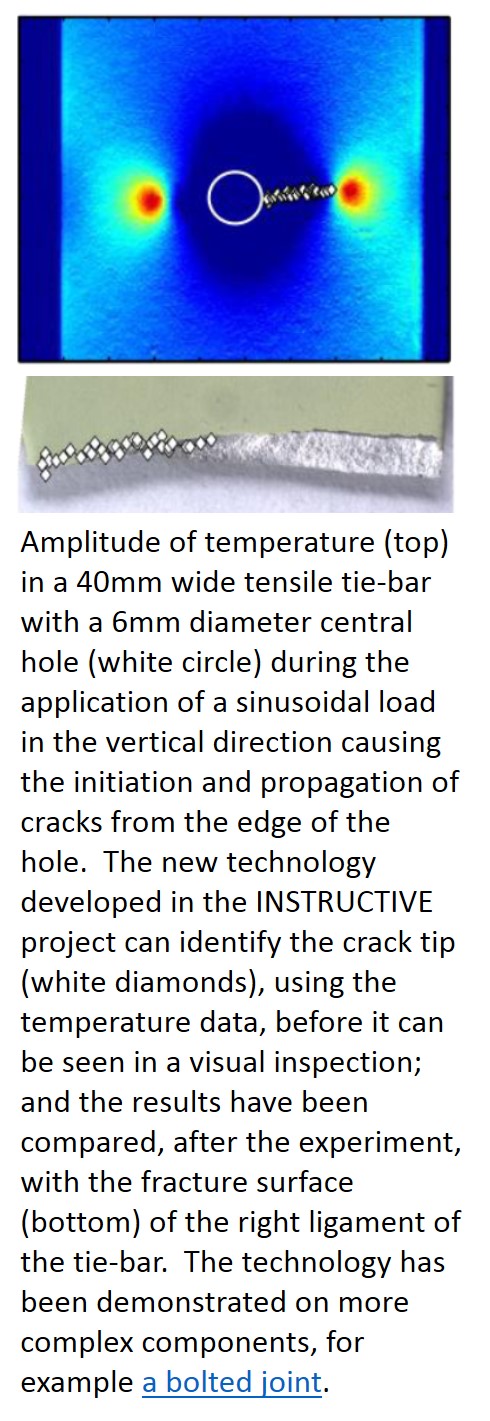
However, the real tangible benefit of the project is the move to next stage of development for the technology supported by a new project, called DIMES, that started on January 1st, 2019.  The aim of the DIMES project is to develop and demonstrate systems with the capability to detect a crack or delamination in a metallic or composite structure, and the potential to be deployed as part of an on-board structural health monitoring system for passenger aircraft.  In other words, the INSTRUCTIVE project has successfully demonstrated that a new philosophy for monitoring damage in aerospace structures, using disturbances to the strain field caused by the damage, is at least as effective as traditional non-destructive evaluation (NDE) techniques and in some circumstances provides much more sensitivity about the initiation and propagation of damage.  This has been sufficiently successful in the laboratory and on aircraft components in an industrial environment that is worth exploring its deployment for on-board monitoring and the first step is to use it in ground-based tests.

There will be more on DIMES as the project gets underway and updates on its progress will replace the twice-yearly ones on INSTRUCTIVE.

The series of posts on the INSTRUCTIVE project can be found at https://realizeengineering.blog/category/myresearch/instructive-project/

instructive acknowledgement

Industrial uncertainty

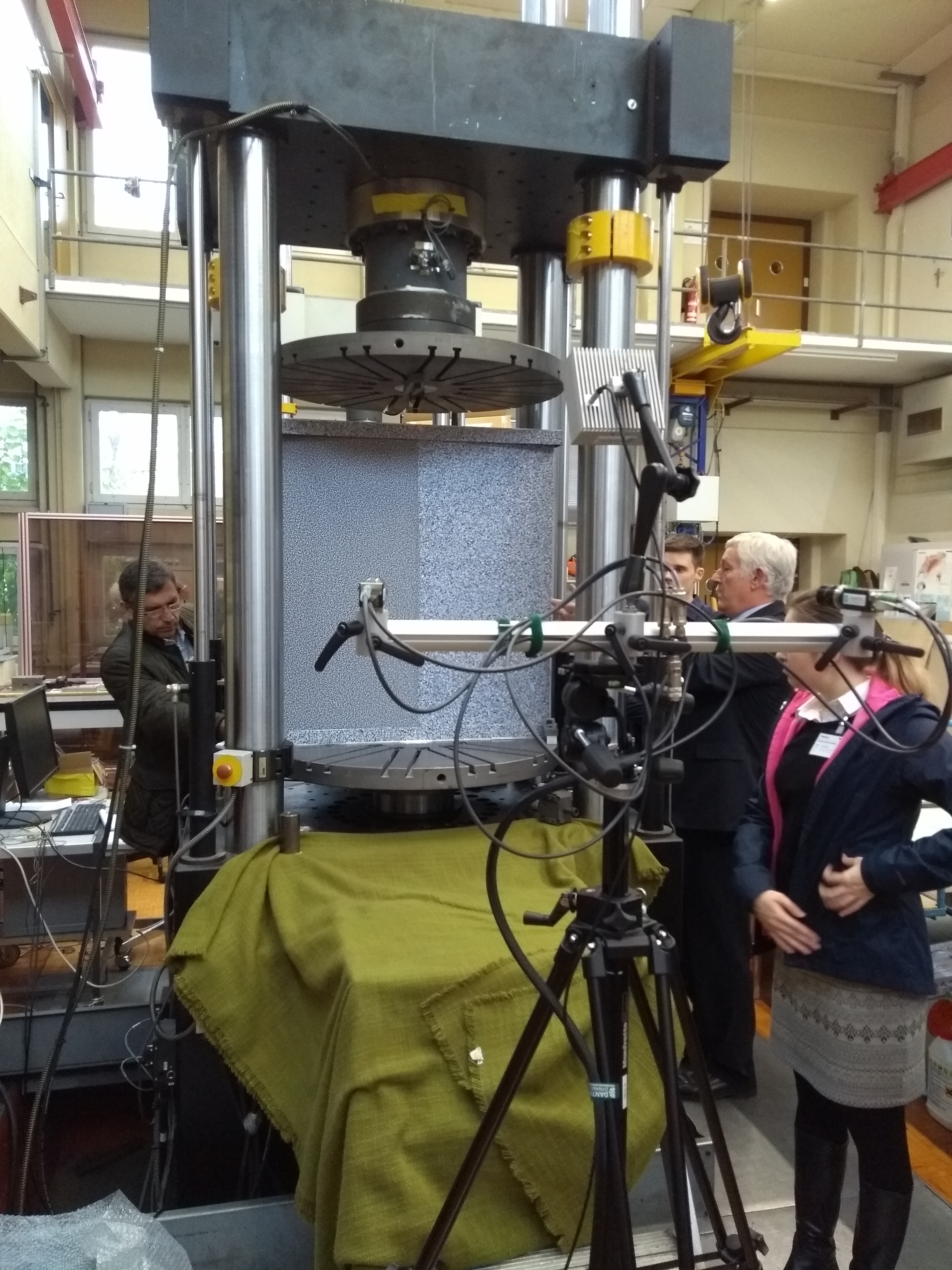
Last month I spent almost a week in Zurich.  It is one of our favourite European cities [see ‘A reflection of existentialism‘ on December 20th, 2017]; however, on this occasion there was no time for sight-seeing because I was there for the mid-term meeting of the MOTIVATE project and to conduct some tests and demonstrations in the laboratories of our host, EMPA, the Swiss Federal Laboratories for Materials Science and Technology.  Two of our project partners, Dantec Dynamics GmbH based in Ulm, Germany, and the Athena Research Centre in Patras, Greece, have developed methods for quantifying the uncertainty present in measurements of deformation made in an industrial environment using digital image correlation (DIC) [see ‘256 shades of grey‘ on January 22, 2014].  Digital image correlation is a technique in which we usually apply a random speckle pattern to the object which allows us to track the movement of the object surface over time by searching for the new position of the speckles in the photographs of the object.  If we use a pair of cameras in a stereoscopic arrangement, then we can measure in-plane and out-of-plane displacements.  Digital image correlation is a well-established measurement technique that has become ubiquitous in mechanics laboratories. In previous EU projects, we have developed technology for quantifying uncertainty in in-plane [SPOTS project] and out-of-plane [ADVISE project] measurements in a laboratory environment.  However, when you take the digital image correlation equipment into an industrial environment, for instance an aircraft hangar to make measurements during a full-scale test, then additional sources of uncertainty and error appear. The new technology demonstrated last month allows these additional uncertainties to be quantified.  As part of the MOTIVATE project, we will be involved in a full-scale test on a large section of an Airbus aircraft next year and so, we will be able to utilise the new technology for the first time.

The photograph shows preparations for the demonstrations in EMPA’s laboratories.  In the foreground is a stereoscopic digital image correlation system with which we are about to make measurements of deformation of a section of aircraft skin, supplied by Airbus, which has a speckle pattern on its surface and is about to be loaded in compression by the large servo-hydraulic test machine.

References:

From SPOTS project:

Patterson EA, Hack E, Brailly P, Burguete RL, Saleem Q, Seibert T, Tomlinson RA & Whelan M, Calibration and evaluation of optical systems for full-field strain measurement, Optics and Lasers in Engineering, 45(5):550-564, 2007.

Whelan MP, Albrecht D, Hack E & Patterson EA, Calibration of a speckle interferometry full-field strain measurement system, Strain, 44(2):180-190, 2008.

From ADVISE project:

Hack E, Lin X, Patterson EA & Sebastian CM, A reference material for establishing uncertainties in full-field displacement measurements, Measurement Science and Technology, 26:075004, 2015.

Engineering idiom

Many of us, either as students or as instructors, will have experienced the phenomenon that students are more likely to give a correct answer when the context is familiar [Linn & Hyde, 1989; Chapman et al 1991].  Conversely, a lack of familiarity may induce students to panic about the context and fail to listen in a lecture [Rosser, 2004] or to appreciate the point of a question in an examination.  Your dictionary probably gives two meanings for context: ‘surrounding conditions’ and ‘a construction of speech’.  You would think that the importance of teaching by reference to the surrounding condition is so obvious as to require no comment; except professors forget that conditions experienced by students are different to their own, both now and when they were students [Nathan, 2005 & ‘Creating an evolving learning environment’ on February 21st, 2018].  To get an appreciation of how different consult the ‘Mindset List‘ produced each year by Beloit College; for example as far as the class of 2020 are concerned robots have always been surgical partners in the operating room [#55 on the 2020 Mindset List].

What about the construction of speech?  I think that there is an engineering idiom because engineering education has its own ‘language’ of models and analogies.  Engineering science is usually taught in the context of idealised applications, such as colliding spheres, springs and dashpots, and shafts.  It would be wrong to say that they have no relevance to the subject; but, the relevance is often only apparent to those well-versed in the subject; and, by definition, students are not.  The result is a loss of perceived usefulness of learning which adversely influences student motivation [Wigfield & Eccles, 2000] – they are more likely to switch off, so keep the language simple.

References:

Chipman S, Marshall S, Scott P. Content effects on word problem performance: A possible source of test bias? American Educational Research Journal, 28(4), 897-915, 1991.

Linn M, Hyde J, Gender, mathematics, and science, Educational Researcher, 18(8), 17-19, 22-27, 1989.

Nathan R, My freshman year: what a professor learned by becoming a student, Cornell University Press, Ithaca, New York, 2005.

Rosser SV, Gender issues in teaching science, in S. Rose. and B. Brown (eds.), Report on the 2003 Workshop on Gender Issues in the Sciences, pp. 28-37, 2004.

Wigfield A, Eccles JS, Expectancy-value theory of motivation, Contemporary Educational Psychology, 25(1): 68-81, 2000.


CALE #7 [Creating A Learning Environment: a series of posts based on a workshop given periodically by Pat Campbell and Eann Patterson in the USA supported by NSF and the UK supported by HEA]

Establishing fidelity and credibility in tests & simulations (FACTS)

A month or so ago I gave a lecture entitled ‘Establishing FACTS (Fidelity And Credibility in Tests & Simulations)’ to the local branch of the Institution of Engineering Technology (IET). Of course my title was a play on words because the Oxford English Dictionary defines a ‘fact’ as ‘a thing that is known or proved to be true’ or ‘information used as evidence or as part of report’.   One of my current research interests is how we establish predictions from simulations as evidence that can be used reliably in decision-making.  This is important because simulations based on computational models have become ubiquitous in engineering for, amongst other things, design optimisation and evaluation of structural integrity.   These models need to possess the appropriate level of fidelity and to be credible in the eyes of decision-makers, not just their creators.  Model credibility is usually provided through validation processes using a small number of physical tests that must yield a large quantity of reliable and relevant data [see ‘Getting smarter‘ on June 21st, 2017].  Reliable and relevant data means making measurements with low levels of uncertainty under real-world conditions which is usually challenging.

These topics recur through much of my research and have found applications in aerospace engineering, nuclear engineering and biology. My lecture to the IET gave an overview of these ideas using applications from each of these fields, some of which I have described in past posts.  So, I have now created a new page on this blog with a catalogue of these past posts on the theme of ‘FACTS‘.  Feel free to have a browse!