Tag Archives: Engineering

Ample sufficiency of solar energy?

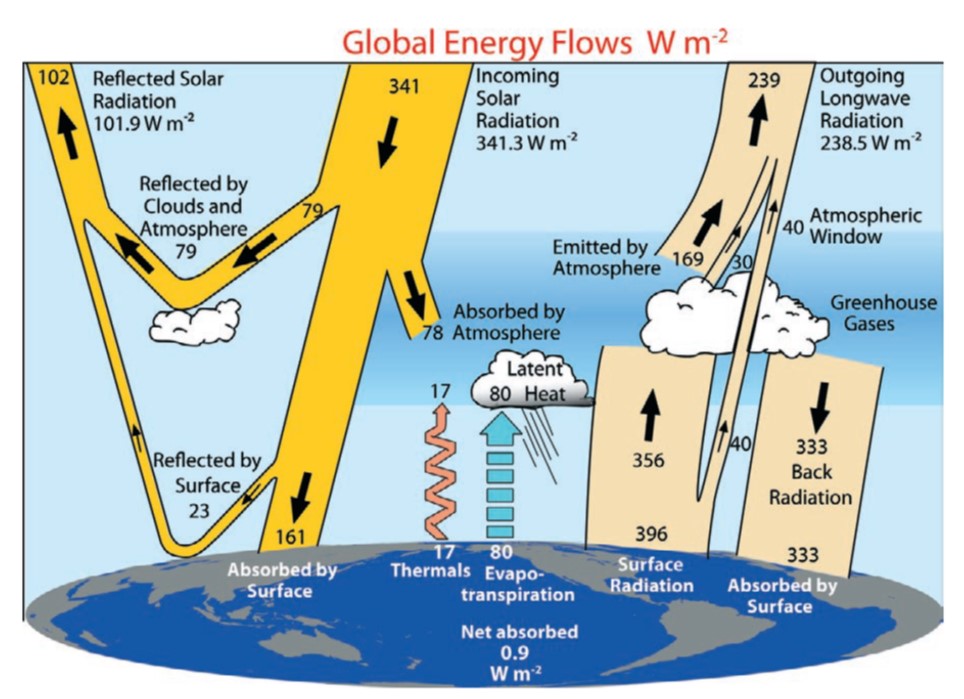
Global energy budget from Trenberth et al 2009

I have written several times about whether or not the Earth is a closed system [see for example: ‘Is Earth a closed system? Does it matter‘ on December 10th, 2014] & ‘Revisiting closed systems in Nature‘ on October 5th, 2016).  The Earth is not a closed thermodynamic system because there is energy transfer between the Earth and its surroundings as illustrated by the schematic diagram. Although, the total incoming solar radiation (341 Watts/sq. metre (W/m²)) is balanced by the sum of the reflected solar radiation (102 W/m²) and the outgoing longwave radiation (239 W/m²); so, there appears to be no net inflow or outflow of energy.  To put these values into perspective, the world energy use per capita in 2014 was 1919 kilograms oil equivalent, or 2550 Watts (according to World Bank data); hence, in crude terms we each require 16 m² of the Earth’s surface to generate our energy needs from the solar energy reaching the ground (161 W/m²), assuming that we have 100% efficient solar cells available. That’s a big assumption because the best efficiencies achieved in research labs are around 48% and for production solar cells it’s about 26%.

There are 7.6 billion of us, so at 16 m² each, we need  120,000 square kilometres of 100% efficient solar cells – that’s about the land area of Greece, or about 500,000 square kilometres with current solar cells, which is equivalent to the land area of Spain.  I picked these countries because, compared to Liverpool, the sun always shines there; but of course it doesn’t, and we would need more than this half million square kilometres of solar cells distributed around the world to allow the hours of darkness and cloudy days.

At the moment, China has the most generating capacity from photovoltaic (PV) cells at 78.07 GigaWatts or about 25% of global PV capacity and Germany is leading in terms of per capita generating capacity at 511 Watts per capita, or 7% of their electricity demand.  Photovoltaic cells have their own ecological footprint in terms of the energy and material required for their production but this is considerably lower than most of our current sources of energy [see, for example Emissions from photovoltaic life cycles by Fthenakis et al, 2008].

Sources:

Trenberth KE, Fasullo JT & Kiehl J, Earth’s global energy budget, Bulletin of  the American Meteorological Society, March 2009, 311-324, https://doi.org/10.1175/2008BAMS2634.1.

World Bank Databank: https://data.worldbank.org/indicator/EG.USE.PCAP.KG.OE

Nield D, Scientists have broken the efficiency record for mass-produced solar panels, Science Alert, 24th March 2017.

2016 Snapshot of Global Photovoltaic Markets, International Energy Agency Report IEA PVPS T1-31:2017.

Fthenakis VM, Kim HC & Alsema E, Emissions from photovoltaic life cycles, Environmental Science Technology, 42:2168-2174, 2008.

Instructive Update

Six months ago I wrote about our EU research project, called INSTRUCTIVE, and the likely consequences of Brexit for research [see my post: ‘Instructive report and Brexit‘ on March 29th, 2017].  We seem to be no closer to knowing the repercussions of Brexit on research in the UK and EU – a quarter of EU funding allocated to universities goes to UK universities so the potential impacts will hit both the UK and EU.  Some researchers take every opportunity to highlight these risks and the economic benefits of EU research; for instance the previous EU research programme, Framework Programme 7, is estimated to have created 900,000 jobs in Europe and increased GDP by about 1% in perpetuity.  However, most researchers are quietly getting on with their research and hoping that our political leaders will eventually arrive at a solution that safeguards our prosperity and security.  Our INSTRUCTIVE team is no exception to this approach.  We are about half-way through our project and delivered our first public presentation of our work at the International Conference on Advances in Experimental Mechanics last month.  We described how we are able to identify cracks in metallic structures before they are long enough to be visible to the naked eye, or any other inspection technique commonly used for aircraft structures.  We identify the cracks using an infra-red camera by detecting the energy released during the formation and accumulation of dislocations in the atomic structure that coalesce into voids and eventually into cracks [see my post entitled ‘Alan Arnold Griffith‘ on April 26th, 2017 for more on energy release during crack formation].  We can identify cracks at sub-millimetre lengths and then track them as they propagate through a structure.  At the moment, we are quantifying our ability to detect cracks forming underneath the heads of fasteners [see picture] and other features in real aerospace structures; so that we can move our technology out of the laboratory and into an industrial environment.  We have a big chunk of airplane sitting in the laboratory that we will use for future tests – more on that in later blog posts!

INSTRUCTIVE is an EU Horizon 2020 project funded under the Clean Sky 2 programme [project no. 686777] and involves Strain Solutions Ltd and the University of Liverpool working with Airbus.

Statistics on funding from http://russellgroup.ac.uk/news/horizon-2020-latest-statistics/and https://www.russellgroup.ac.uk/media/5068/24horizon-2020-the-contribution-of-russell-group-universities-june-201.pdf

For other posts on similar research topics, see ‘Counting photons to measure stress‘ on November 18th, 2015 and ‘Forensic engineering‘ on July 22nd, 2015.

Airborne urban mobility

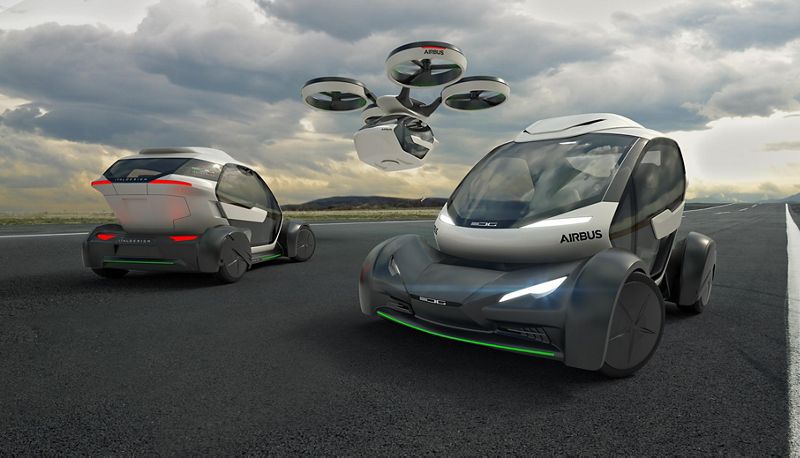
Pop.Up_copyright Italdesign 2

At the Airbus PhD workshop that I attended a couple of weeks ago [see my post entitled Making Engineering Work for Society on September 13th 2017], Axel Flaig, Head of Airbus Research and Technology, gave us an excellent opening presentation describing their vision for the future.  Besides their vision for the next generation of passenger aircraft with reductions in CO2, NOx and noise emissions of 75%, 90% and 65% respectively against 2000 levels by 2050, they are also looking at urban air mobility.  We have 55 megacities [cities with a population of more than 10 million] and it is expected that this will increase to 93 by 2035 [see my post entitled ‘Hurrying Feet in Crowded Camps’ on August 16th, 2017].  These megacities are characterized by congestion and time-wasted moving around them; so, Airbus is working on designs for intra-city transport that takes us off the roads and into the air.  Perhaps the most exciting is the electric Pop.up concept that is being developed with Italdesign.  But, Airbus are beyond concepts: they have a demonstrator single-seater, self-pilot vehicle, the Vahana that will fly in 2017 and a multi-passenger demonstrator scheduled to fly in 2018.

Soon, we will have to look left, right and up before we cross the road, or maybe nobody will walk anywhere – though that would be bad news for creative thinking [see my post on ‘Gone Walking’ on 19th April 2017], amongst other things!


Image from http://www.airbus.com/newsroom/press-releases/en/2017/03/ITALDESIGN-AND-AIRBUS-UNVEIL-POPUP.html where there is also a video.

Making engineering work for society

Last week I attended a one-day workshop for PhD students sponsored by Airbus.  Most of the students produced a poster describing their research; and a dozen brave ones gave a three-minute presentation on their PhD thesis.  It’s a challenge to describe three years of research in three minutes to an audience that are not experts in your specialist field.  However, the result was an exciting and stimulating morning covering subjects as diverse as multidisciplinary design optimization and cognitive sources of ethical behaviour in business.  The latter was presented by Solenne Avet who was the only woman amongst the twelve three-minute thesis presenters.  The gender diversity was better for the other, longer talks with two women out of six presenters.  Interestingly, the female PhD students were the only ones tackling the interaction between engineering and human behaviour, including system-human communication, collective engineering work and innovation processes, which I have suggested is essential for viable engineering solutions to our global and societal challenges [see my post ‘Re-engineering engineering’ on August 30th, 2017].  This population sample is too small to make a reliable generalization; however, it suggests that a gender-balanced engineering profession would be more likely to succeed in making substantial contributions to our current challenges [see UN Global Issues Overview].

Image from https://members.architecture.com/custom/bespoke/directory/view_images.asp?id=257460&type=O&dir=1&CaseRef=140776&imgName=43535_100017586_1.jpg