 Regular readers have probably already realised that I have very broad interests in engineering from aircraft and power stations [see ‘Conversations about engineering over dinner and haircut‘ on February 16th, 2022] to nanoparticles interacting with cells [see ‘Fancy a pint of science‘ on April 27th, 2022]. So, it will come as no surprise to hear that I gave a welcome address to a workshop on ‘Aorta: Structure to Rupture‘ last week. The workshop was organised in Liverpool by one of my colleagues, with sponsorship from the British Heart Foundation, and I was invited to welcome delegates in my capacity as Dean of the School of Engineering. It was exciting on two levels: speaking, for the first time in more than two years, to an audience who had travelled from around the world to discuss research. And because the topic was closely associated with cardiac dynamics, which is a field that I worked in for nearly twenty years until around 2006. I was part of an interdisciplinary team modelling the fluid-structure interaction in the aortic valve as it opens when blood is pumped through it by the heart and then closes to prevent back flow into the heart. The team dispersed after I moved to the USA in 2004. So speaking to the workshop last week was something of a trip down memory lane for me and led me to look up our last publication in the field. I was surprised to find it was cited seven times last year.
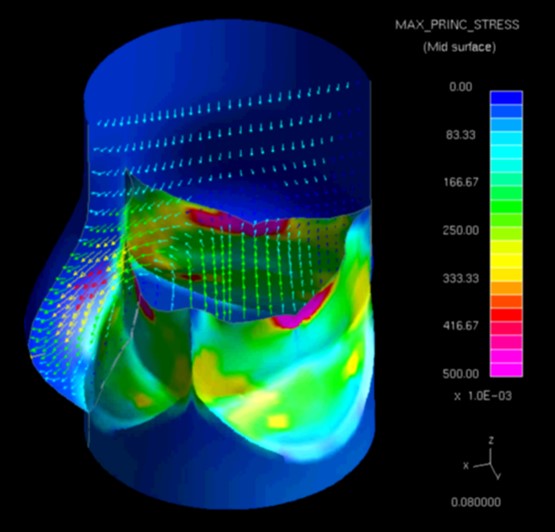
The image in the thumbnail is a snapshot from a video showing the predicted time-varying distribution of blood flow through the aortic valve and the resultant distribution of stress in the leaflets of the valve during a heart beat. The simultation is described in our last publication in cardiac dynamics: Carmody, C. J., Burriesci, G., Howard, I. C., & Patterson, E. A., An approach to the simulation of fluid–structure interaction in the aortic valve. J. Biomechanics, 39(1), 158-169, 2006.