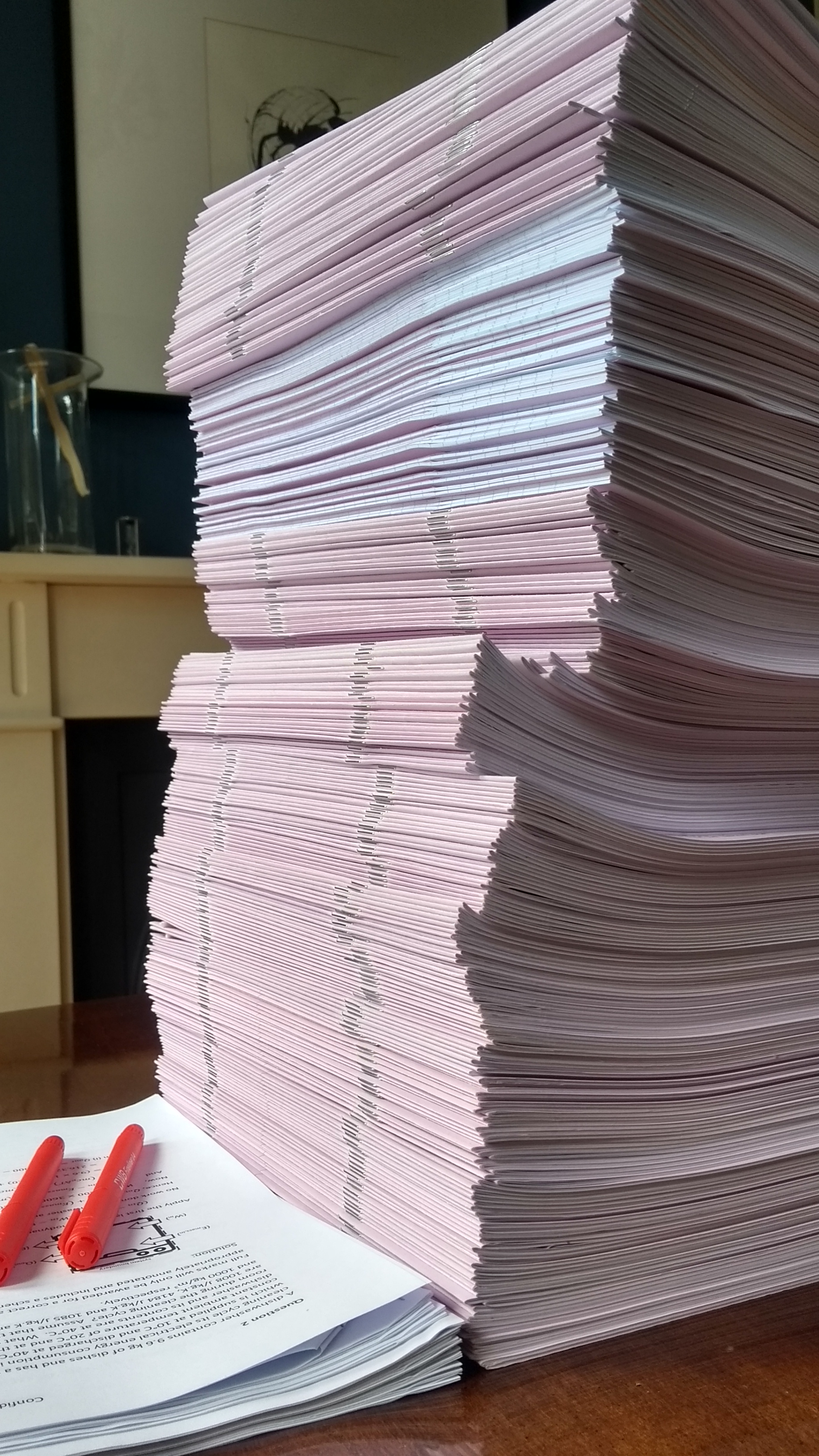
I am in the midst of marking examination scripts. I have about two weeks to award a maximum of about 26,000 marks which is a huge number of decisions to make in a relatively short time [see ‘Depressed by exams‘ on January 31st 2018]. Although the pile of examination scripts is tall and the task can feel overwhelming, it represents a return to normality following the pandemic when we conducted on-line, open-book examinations [see ‘Limited bandwidth’ on June 2nd, 2021]. We have been teaching 100% on-campus for the whole semester and all of our examinations have returned to their pre-pandemic format, i.e., the majority have been in-person, closed-book and invigilated. I have enjoyed teaching thermodynamics in a huge lecture-theatre filled with students and it is relief that I do not have to set examination questions whose answers cannot be found using a search engine or solved using a programme. Anyway I need to pick up my red pen and return to my marking so only a brief post this week.
Category Archives: Engineering
Diving into three-dimensional fluids
My research group has been working for some years on methods that allow straightforward comparison of large datasets [see ‘Recognizing strain’ on October 28th 2015]. Our original motivation was to compare maps of predicted strain over the surface of engineering structures with maps of measurements. We have used these comparison methods to validate predictions produced by computational models [see ‘Million to one’ on November 21st 2018] and to identify and track changes in the condition of engineering structures [see ‘Out of the valley of death into a hype cycle’ on February 24th 2021]. Recently, we have extended this second application to tracking changes in the environment including the occurance of El Niño events [see ‘From strain measurements to assessing El Niño events’ on March 17th, 2021]. Now, we are hoping to extend this research into fluid mechanics by using our techniques to compare flow patterns. We have had some success in exploring the use of methods to optimise the design of the mesh of elements used in computational fluid dynamics to model some simple flow regimes. We are looking for a PhD student to work on extending our model validation techniques into fluid mechanics using volumes of data from measurement and predictions rather than fields, i.e., moving from two-dimensional to three-dimensional datasets. If you are interested or know someone who might be interested then please get in touch.
There is more information on the PhD project here.
Existential connection between capitalism and entropy
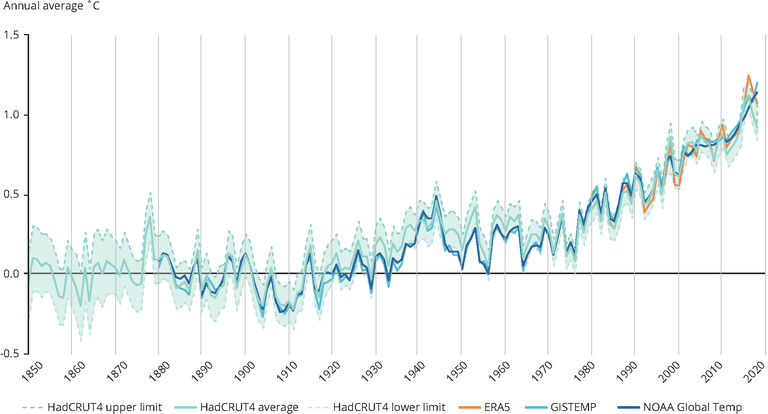
According to Raj Patel and Jason W Moore, in his treatise ‘Das Kapital’ Karl Marx defined capitalism as combining labour power, machines and raw materials to produce commodities that are sold for profit which is re-invested in yet more labour power, machines and raw materials. In other words, capitalism involves processes that produce profit from an economic perspective, and from a thermodynamic perspective produce entropy because the second law of thermodynamics demands that all real processes produce entropy. Thermodynamically, entropy usually takes the form of heat dissipated into the environment which raises the temperature of the environment; however, it can also be interpreted as an increase in the disorder of a system [see ‘Will it all be over soon?’ on November 2nd, 2016]. The ever-expanding cycle of profit being turned into capital implies that the processes of producing commodities must also become ever larger. The ever-expanding processes of production implies that the rate of generation of entropy also increases with time. If no profit were reinvested in economic processes then the processes would still increase the entropy in the universe but when profit is re-invested and expands the economic processes then the rate of entropy production increases and the entropy in the universe increases exponentially – that’s why the graphs of atmospheric temperature curve upwards at an increasing rate since the industrial revolution. As if that is not bad enough, the French social economist, Thomas Piketty has proposed that the rate of return on capital, “r” is always greater than the rate of growth of the economy, “g” in his famous formula “r>g”. Hence, even with zero economic growth, the rate of return will be above zero and the level of entropy will rise exponentially. Piketty identified inequality as a principal effect of his formula and suggested that only cataclysmic events, such as world wars or revolutions, can reduce inequality. The pessimistic thermodynamicist in me would conclude that an existential cataclysmic event might be the only way that this story ends.
Sources
Raj Patel & Jason W. Moore, A history of the world in seven cheap things, London: Verso, 2018.
Thomas Piketty, A brief history of equality, translated by Steven Rendall, Harvard: Belknap, 2022.
Diane Coyle, Piketty the positive, FT Weekend, 16 April/17 April 2022.
Image: Global average near surface temperature since the pre-industrial period from www.eea.europa.eu/data-and-maps/figures/global-average-near-surface-temperature
From nozzles and diffusers to stars and stripes
At the end of a lecture on energy flows in my first year undergraduate course on thermodynamics, I talk about nozzles and diffusers as examples of practical applications of the rest of the material in the lecture. It is hazardous to sit in the front row of the lecture theatre because I take in a water bottle with a trigger spray to demonstrate how the nozzle increases the velocity of the fluid at the expense of pressure while gently sprinkling water on the front row. I am always intrigued by the symmetry of nozzles and diffusers. Diffusers increase pressure of a fluid at the expense of its velocity, i.e., a mirror image of the action of a nozzle. The cross-sections are also mirror images because a nozzle has a cross-section that decreases in the flow direction while a diffuser has a cross-section that increases in the flow direction. At least for sub-sonic flows, because the shapes are reversed for super-sonic flow; so a sub-sonic nozzle looks like a super-sonic diffuser and a sub-sonic diffuser looks like a super-sonic nozzle. If that all sounds like fluid mechanics then the thermodynamic message is that, in nozzles and diffusers, the rates of heat and work transfer are approximately zero while the change in the kinetic energy of the fluid is very large. I finish the lecture with a video clip of a school quartet of trombones playing ‘Stars and Stripes Forever’ which wakes up the students who have slept through the lecture and allows me to point out the diffusers (bell of the trombone) transmitting acoustic pressure.
You can watch the video clip on YouTube at https://www.youtube.com/watch?v=mHw8P8NnUvI