Tag Archives: research

Salt increases nanoparticle diffusion

About two and half years ago, I wrote about an article we had published on the motion of nanoparticles [see ‘Slow moving nanoparticles‘ on December 13th, 2017] in which we had shown that, for very small particles at low concentrations, the motion of a particle is independent of its size and does not flow the well-known Stokes-Einstein law.  Our article presented convincing evidence from experiments to support our conclusions but was light on explanation in terms of the mechanics.  At the end of last year, we published a short article in Scientific Reports, in which we demonstrated that the motion of nanoparticles at low concentrations is dependent on the interaction of van der Waals forces and electrostatic forces.  Van der Waals forces are short-range attractive forces between uncharged molecules due to interacting dipole moments, whereas the electrostatic forces are the repulsion of electric charges.  We changed both of these forces by using salt solutions of different concentration and observing the changes in nanoparticle behaviour.  Increasing the molarity increases the diffusion of the particles until the solution is saturated, as shown in the picture for 50 nanometre diameter gold particles (that’s about half the diameter of a coronavirus particle or one thousandth of the diameter of a human hair).  Our findings have implications for understanding the behaviour of nanoparticles dispersed in biological media, which typically contain salt in solution, because the concentration of salt ions in the medium affects nanoparticle diffusion that has been shown to influence cellular uptake and toxicity.

Sources:

Coglitore D, Edwardson SP, Macko P, Patterson EA, Whelan MP, Transition from fractional to classical Stokes-Einstein behaviour in simple fluids, Royal Society Open Science, 4:170507, 2017.

Giorgi F, Coglitore D, Curran JM, Gilliland D, Macko P, Whelan M, Worth A & Patterson EA, The influence of inter-particle forces on diffusion at the nanoscale, Scientific Reports, 9:12689, 2019.

First law of geography: everything is related to everything else

One of the benefits of supervising research students is that you can read a large number of scientific papers by proxy.  In other words, my research students read more papers than I would ever have time to read and then they write reviews of the scientific literature that allow me to quickly gain an understanding of research in a particular field.  Every now and again, a student refers to a paper that raises my curiosity to read it for myself.  One of these was a paper published by Waldo Tobler in 1970 in which he describes the computational modelling of urban growth in Detroit, Michigan.  Although, I used to live in Michigan, it was not the geographical connection that interested me but his invocation of the first law of geography: ‘everything is related to everything else, but near things are more related than distant things’.  Professor Tobler was writing from the University of Michigan in Ann Arbor which he used in an example by highlighting that the population growth in Ann Arbor from 1930 to 1940 depended not only on the 1930 population of Ann Arbor, but also on the 1930 population of Vancouver, Singapore, Cape Town, Berlin and so on.  Perhaps if he had been writing in 2020 he would have suggested that the rate of infection from coronavirus in Ann Arbor depends not only on the number of cases in Ann Arbor, but also on the number of cases Taipei, Milan, Toulouse, Dublin and so on.

Source:

Tobler WR, A computer movie simulating urban growth in the Detroit Region, Economic Geography, vol. 46, Supplement: Proceedings. Int. Geog. Union. Commission on Quantitative Methods, 234-240, 1970.

Image: Crisco 1492 – Own work

Devaluing novelty: not all that glitters is gold

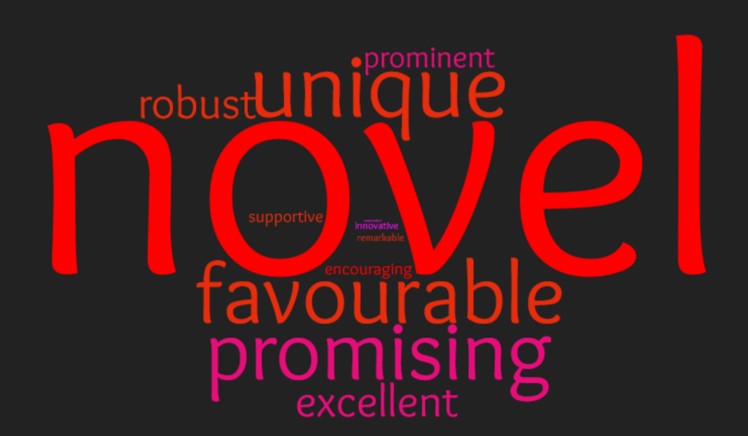
My regular readers will have recognised the novel nature of a blog that seeks, in a unique way, to present promising engineering ideas in a favourable and robust manner.  Actually, I hope my regular readers will recognise this opening sentence as completely uncharacteristic.  It was a blatant effort on my part to include the five words, underlined, with positive meanings that are most used in the titles and abstracts of articles published in clinical research and the life sciences.  A recent survey of more than 100,000 articles showed the prevalence of these words, with them being used significantly more in articles in which the first or last authors were male compared to those in which the first and last authors were female.  In other words, female authors are significantly less likely to describe their research findings in these positive terms and this influences the subsequent citations of their work and probably their prospects for research funding and advancement.  Sunday was International Women’s Day and, hence this is an appropriate week for everyone responsible for decisions about research to be conscious of this trend.  They should also be aware that the use of these positive words has increased in clinical and life sciences research by around 150% in the fifteen years to 2017.  In other words, the modesty of researchers has declined and they are more likely to describe their results as ‘novel’; however, I think it is unlikely that the results are any more novel than typical results published 20 years.  Of course, like most researchers, I always think my last breakthrough is the most exciting yet but many of us have been letting that enthusiasm lead us to exaggerate its novelty and value.

Source: Lerchenmueller MJ, Sorensen O & Jena AB, Gender differences in how scientists present the importance of their research: observational study, BMJ, 367:16573, 2019.

The Stone Raft adrift in the Atlantic Ocean

I spent most of last week at the European Union’s Joint Research Centre in Ispra, Italy.  I have been collaborating with the scientists in  the European Union Reference Laboratory for alternatives to animal testing [EURL ECVAM].  We have been working together on tracking nanoparticles and, more recently, on the validity and credibility of models.  Last week I was there to participate in a workshop on Validation and Acceptance of Artificial Intelligence Models in Health.  I presented our work on the credibility matrix and on a set of factors that we have developed for establishing trust in a model and its predictions. I left the JRC on Friday evening and slipped back in the UK just before she left the Europe Union.  The departure of the UK from Europe reminds me of a novel by José Saramago called ‘The Stone Raft‘ in which the Iberian penisula breaks off from the Europe mainland and drifts around the Atlantic ocean.  The bureaucrats in Europe have to run around dealing with the ensuing disruption while five people in Spain and Portugal are drawn together by surreal events on the stone raft adrift in the ocean.