Tag Archives: Engineering

Recognizing strain

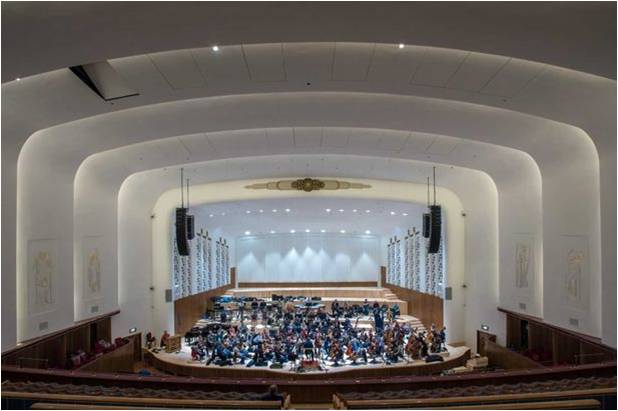
rlpoYou can step off an express train but you can’t speed up a donkey. This is paraphrased from ‘The Fly Trap’ by Fredrik Sjöberg in the context of our adoption of faster and faster technology and the associated life style. Last week we stepped briefly off the ‘express train’ and lowered our strain levels by going to a concert given by the Royal Liverpool Philharmonic Orchestra, including pieces by Dvorak, Chopin and Tchaikovsky. I am not musical at all and so I am unable to tell you much about the performances or compositions, except to say that I enjoyed the performances as did the rest of the audience to judge from the enthusiastic applause. A good deal of my enjoyment arose from the energy of the orchestra and my ability to recognise the musical themes or acoustic features in the pieces. The previous sentence was not intended as a critic’s perspective on the concert but a tenuous link…

Recognising features is one aspect of my recent research, though in strain data rather than music. Modern digital technology allows us to acquire information-rich data maps with tens of thousands of individual data values arranged in arrays or matrices, in which it can be difficult to spot patterns or features. We treat our strain data as images and use image decomposition to compress a data matrix into a feature vector. The diagram shows the process of image decomposition, in which a colour image is converted to a map of intensity in the image. The intensity values can be stored in a matrix and we can fit sets of polynomials to them by ‘tuning’ the coefficients in the polynomials. The coefficients are gathered together in a feature vector. The original data can be reconstructed from the feature vector if you know the set of polynomials used in the decomposition process, so decomposition is also a form of data compression. It is easier to recognise features in the small number of coefficients than in the original data map, which is why we use the process and why it was developed to allow computers to perform pattern recognition tasks such as facial recognition.

decompositionSources:

Wang W, Mottershead JE, Patki A, Patterson EA, Construction of shape features for the representation of full-field displacement/strain data, Applied Mechanics and Materials, 24-25:365-370, 2010.

Patki, A.S., Patterson, E.A, Decomposing strain maps using Fourier-Zernike shape descriptors, Exptl. Mech., 52(8):1137-1149, 2012.

Nabatchian A., Abdel-Raheem E., and Ahmadi M., 2008, Human face recognition using different moment invariants: a comparative review. Congress on Image and Signal Processing, 661-666.


Engineers, moral compasses and society

Picture1One of my regular correspondents has commented last week about teaching ethics to engineering undergraduate students in order to reduce the probability of repetition of events similar to the Volkswagen emissions scandal (see my post on October 14th, 2015 on ‘Greed overwhelms ethics‘). My experience of talking to professional engineers is that there is nothing wrong with their ethical values but that they feel helpless in the face of corporate intransigence or worse. Many engineers feel unable to shift the moral compass of the organisation in which they work. Ethics is concerned with one’s personal values whereas morality is about what is permissible and forbidden in particular realms of behaviour, according to AC Grayling. The frequent revelations of scandals across a range of industries would suggest that we have a crisis of morality in our society. I don’t know how to resolve it but perhaps a first step would be for everyone, including the rich and powerful, to admit we have a problem.

Greed overwhelms ethics

My car but not my house!

My car but not my house!

The scandal about Volkswagen emissions has already caused journalists and others to wring their hands or to preach sermons, or both, about the ethical standards of the engineering profession, see for example the Editor’s blog in Professional Engineer where he reminds us that professional engineers should conduct their professional work and relationships with “integrity and objectivity and with due regard for the welfare of the people, the organisations and the environment with which they interact”. The quotation is from the Royal Charter of the Institution of Mechanical Engineers. Fine words written to induce good intentions that rarely survive in the face of greed or simply the need to keep your job so that you can feed and house your family.

In my view, the emissions scandal seems to have parallels with the banking scandals of the past decade, in which corporate greed has trampled over ethics and morals in the pursuit of ever larger profits while government regulators through incompetence or acquiescence have allowed it to continue. Volkswagen were wrong to design a device to cheat the Government emission tests, but Government regulators were naive to design a test in which it was so easy to cheat. Senior executives at Volkswagen have blamed their employees following other recent examples.  These company leaders were paid gigantic salaries to provide both leadership and management and, in my opinion, they have failed in both by blaming the people they are supposed to be leading and by allowing the scandals to happen in the first place.

The evidence would suggest that we can trust neither corporations nor governments to take care of the environment. One solution is for all vehicles to provide real-time information on the dashboard about NOX and Carbon emissions as well fuel consumption then we can make our own choices. When I moved to the US more than a decade ago, I was surprised to find that fuel consumption data was not available on the dashboard of most cars as it was already commonplace in Europe. Perhaps its presence was a factor in the development of fuel efficient cars in Europe although clearly higher fuel prices play a large role.  However, in the absence of a tax on emissions, real-time emission data on the dashboard would motivate engineering ingenuity to compete to produce lower emission designs instead of wasting creativity on cheating in useless Government tests.

Here are some of facts to support my statements above about large profits and gigantic salaries:

Volkswagen profits rose 21% in 2014 to more than $12billion on an annual turnover of $230 billion which is comparable to the GDP of Portugal.

The CEO of Volkswagen was paid almost $18million per year which is about 250 times the average salary of a Volkswagen engineer.

Sources:

Hibbert, L., Editor’s comment: October 2015 The Volkswagen emissions testing scandal has put the issue of professional ethics in the spotlight, Professional Engineer, October 07, 2015.

Wall Street Journal, Feb 27th, 2015

Volkswagen AG Annual Report 2014

World Bank Data Bank

Reuters, March 12th, 2012

glassdoor.com


Ideal employee

graduationSome years ago during a visit to South Korea, I listened to a speech by an Executive Vice-President of KEPCO, the Korea Electric Power Corporation.  He talked about the need to blend the desire of consumers who want to buy cheaper goods in a clean environment with the will of a company to make more money and to do this in the context of the world running in a ‘green race’ for survival.  He identified their employees as his company’s most valuable asset and went on to describe the ideal employee as having three key attributes:

A team player – cooperative and capable of growing together with their colleagues

A creativity-driven professional – flexible and globally competitive

A passionate executor – innovative and able to make things happen

He did not list these attributes in any order of importance but gave them equal weighting as nodes on a circle around which the ideal employee could move effortlessly.  Of course I am biased but this description sounds like an engineer!

If you are just starting a new course of education then perhaps these are the qualities that you should aim to acquire or cultivate.

If you are an employer and are lucky enough to hire one or even a group of these ‘ideal employees’ then your problems as a manager may only just be beginning.  They are likely to be what is known as ‘knowledge workers’ who will share certain characteristics, including being highly educated or experienced, hate being told what to do and reluctant to share knowledge with their managers.  So many employers resort to HSPALTA: Hire Smart People And Leave Them Alone.