Tag Archives: Engineering

More on fairy lights and volume decomposition (with ice cream included)

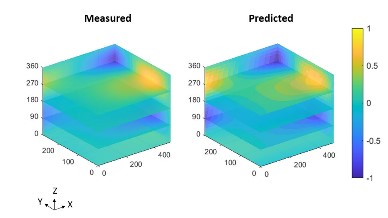
Explanation in textLast June, I wrote about representing five-dimensional data using a three-dimensional stack of transparent cubes containing fairy lights whose brightness varied with time and also using feature vectors in which the data are compressed into a relatively short string of numbers [see ‘Fairy lights and decomposing multi-dimensional datasets’ on June 14th, 2023].  After many iterations, we have finally had an article published describing our method of orthogonally decomposing multi-dimensional data arrays using Chebyshev polynomials.  In this context, orthogonal means that components of the resultant feature vector are statistically independent of one another.  The decomposition process consists of fitting a particular form of polynomials, or equations, to the data by varying the coefficients in the polynomials.  The values of the coefficients become the components of the feature vector.  This is what we do when we fit a straight line of the form y=mx+c to set of values of x and y and the coefficients are m and c which can be used to compare data from different sources, instead of the datasets themselves.  For example, x and y might be the daily sales of ice cream and the daily average temperature with different datasets relating to different locations.  Of course, it is much harder for data that is non-linear and varying with w, x, y and z, such as the intensity of light in the stack of transparent cubes with fairy lights inside.  In our article, we did not use fairy lights or icecream sales, instead we compared the measurements and predictions in two case studies: the internal stresses in a simple composite specimen and the time-varying surface displacements of a vibrating panel.

The image shows the normalised out-of-plane displacements as the colour as a function of time in the z-direction for the surface of a panel represented by the xy-plane.

Source:

Amjad KH, Christian WJ, Dvurecenska KS, Mollenhauer D, Przybyla CP, Patterson EA. Quantitative Comparisons of Volumetric Datasets from Experiments and Computational Models. IEEE Access. 11: 123401-123417, 2023.

Evolutionary model of knowledge management

Towards the end of last year, I wrote about the challenges in deploying digital technologies in holistic approaches to knowledge management in order to gain organizational value and competitive advantage [see ‘Opportunities lost in knowledge management using digital technology’ on October 25th, 2023].  Almost on the last working day of 2023, we had an article published in PLOS ONE (my first in the journal) in which we explored ‘The impact of digital technologies on knowledge networks in two engineering organizations’.  We used social network analysis and semi-structured interviews to investigate the culture around knowledge management, and the deployment of digital technologies in support of it, in an engineering consultancy and an electricity generator.  The two organizations had different cultures and levels of deployment of digital technologies.  We proposed a new evolutionary model of the culture of knowledge management based on Hudson’s evolutional model of safety culture that is widely used in industry. Our new model is illustrated in the figure from our article, starting from ‘Ignored: we have no knowledge management and no plans for knowledge management’ through to ‘Embedded: knowledge management is integrated naturally into the daily workflow’.  We also proposed that social networks could be used as an indicator of the stage of evolution of knowledge management with low network density and dispersed networks representing higher stages of evolution, based on our findings for the two engineering organizations.

Sources:

Hudson, P.T.W., 2001. Safety management and safety culture: the long, hard and winding road. Occupational health and safety management systems, pp.3-32, 2001

Patterson EA, Taylor RJ, Yao Y. The impact of digital technologies on knowledge networks in two engineering organisations. PLoS ONE 18(12): e0295250, 2023.


Predicting release rates of hydrogen from stainless steel

Decorative photograph showing electrolysis cellThe influence of hydrogen on the structural integrity of nuclear power plant, where water molecules in the coolant circuit can be split by electrolysis or radiolysis to produce hydrogen, has been a concern to engineers for decades.  However, plans for a hydrogen economy and commercial fusion reactors, in which plasma-facing structural components will likely be exposed to hydrogen, has accelerated interest in understanding the complex interactions of hydrogen with metals, especially in the presence of irradiation.  A key step in advancing our understanding of these interactions is the measurement and prediction of the uptake and release of hydrogen by key structural materials.  We have recently published a study in Scientific Reports in which we developed a method for predicting the amount hydrogen in a steel under test conditions.  We used a sample of stainless steel as an electrode (cathode) in an electrolysis cell that split water molecules producing hydrogen atoms that were attracted to the steel. After loading the steel with hydrogen in the cell, we measured the rate of release of the hydrogen from the steel over two minutes by monitoring the drop in current in the cell, using a technique called potentiostatic discharge.  We used our measurements to calibrate a model of hydrogen release rate, based on Fick’s second law of diffusion, which relates the rate of hydrogen motion (diffusion) to the surface area perpendicular to the motion and the concentration gradient in the direction of motion.  Finally, we used our calibrated model to predict the release rate of hydrogen over 24 hours and checked our predictions using a second measurement based on the hydrogen released when the steel was melted.  So, now we have a method of predicting the amount of hydrogen in a steel remaining in a sample many hours after exposure during electrolysis without destroying the test sample.  This will allow us to perform better defined tests on the influence of hydrogen on the performance of stainless steel in the extreme environments of fission and fusion reactors.

Source:

Weihrauch M, Patel M, Patterson EA. Measurements and predictions of diffusible hydrogen escape and absorption in cathodically charged 316LN austenitic stainless steel. Scientific Reports. 13(1):10545, 2023.

Image:

Figure 2a from Weihrauch et al , 2023 showing electrolysis cell setup for potentiostatic discharge experiments.

Entropy has taken its toll

Decorative imageI am on vacation so this is the third in a series of ‘reprints’ from my archive of more than 570 posts.  It was published in July 2014 under title ‘Engineering archaeology‘.  Entropy has done its bit and repainting of our railings is long overdue.

Last week I spent a relaxing day painting the old railings in front of our house. Since I am not a painter and decorator by trade the end result is not perfect but they look much better in shiny black than two-tone rust and matt black.   One of the fleurs de lis on our railings had been knocked off when either we moved in or the previous occupiers moved out.  It’s a way of life being an engineer, so the shape of the failure surface on the broken railing was bugging me while I was painting the rest.  You would expect wrought iron railings to be ductile, i.e. to deform significantly prior to fracture, and to have a high tensile strength.  Wrought iron’s properties are derived from its very low carbon content (less than 0.25%) and the presence of fibrous slag impurities (typically about 2%), which almost make it a composite material.  It was historically used for railings and gates.  However, my broken railing had exhibited almost no deformation prior to fracture, i.e. it was a brittle failure, and the fleur de lis had broken in half on impact with the stone flags.  So on one of the rainy days last week, when I couldn’t paint outside, I did a little bit of historical research and discovered that in the late 1790s and early 1800s, which is when our house was built, cast iron started to be used for railings.  Cast iron has a high carbon content, typically 2 to 4%, and also contains silicon at between 1 and 3% by weight.  Cast iron is brittle, i.e. it shows almost no deformation prior to fracture, so the failure surface tends be to flat and smooth just like in my fleur de lis.

This seems like a nice interdisciplinary, if not everyday, engineering example.  It would be vandalism to go around breaking iron railings in front of old buildings.  So, if you want Everyday Engineering Examples of ductile and brittle behaviour, then visit a junk shop and buy an old china dinner plate and a set of cutlery.  The ceramic of the china plate is brittle and will fracture without deformation – have some fun and break one!  The stainless steel of the fork and spoon is ductile and can be easily bent, i.e. it is easy to introduce large deformation, in this case permanent or plastic deformation, prior to failure.  In fact you will probably have to bend the fork back and forth repeatedly before it will snap with each bending action introducing additional damage.

The more curious will be wondering why some materials are ductile and others brittle.  The answer is associated with their microstructures, which in turn is dependent on their constituents, as hinted above.  However, I am not going to venture into material science to explain the details.  I have probably already given materials scientists enough to complain about because my Everyday Engineering Examples are not directly analogous at the microstructural level to wrought iron and cast iron but they are more fun.