Tag Archives: aerospace

Hierarchical modelling in engineering and biology

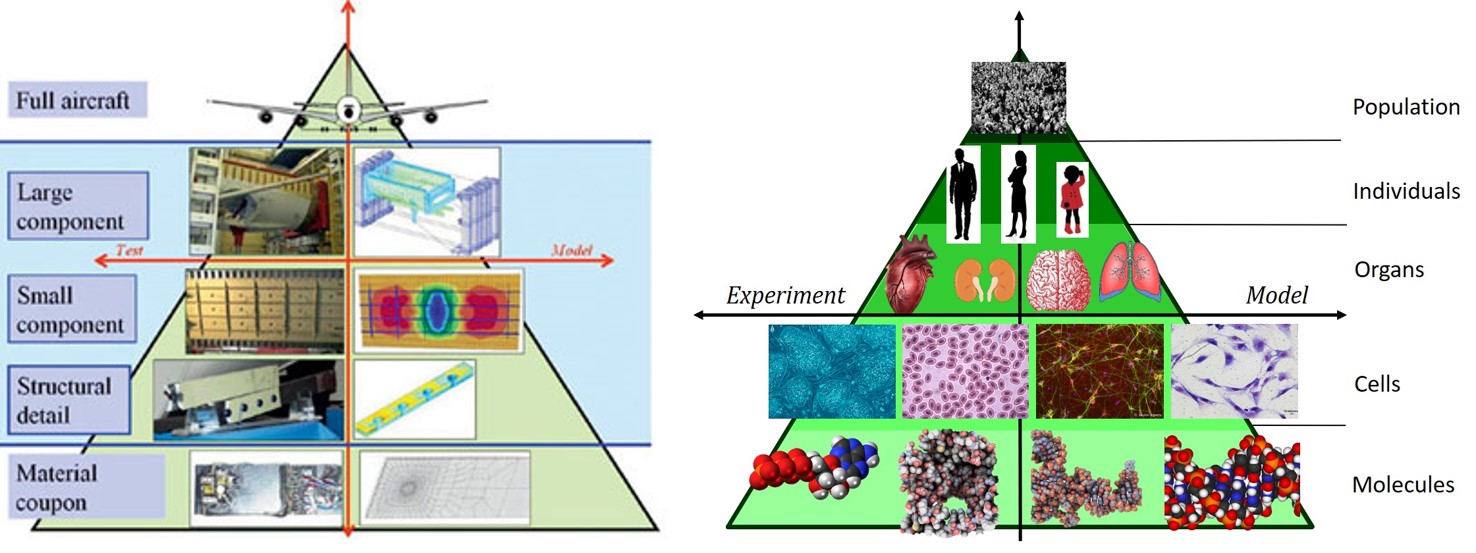
In the 1979 Glenn Harris proposed an analytical hierarchy of models for estimating tactical force effectiveness for the US Army which was represented as a pyramid with four layers with a theatre/campaign simulation at the apex supported by mission level simulations below which was engagement model and engineering models of assets/equipment at the base.  The idea was adopted by the aerospace industry [see the graphic on the left] who place the complete aircraft on the apex supported by systems, sub-systems and components beneath in increasing numbers with the pyramid divided vertically in half to represent physical tests on one side and simulations on the other.  This represents the need to validate predictions from computational models with measurements in the real-world [see post on ‘Model validation‘ on September 18th, 2012]. These diagrams are schematic representations used by engineers to plan and organise the extensive programmes of modelling and physical testing undertaken during the design of new aircraft [see post on ‘Models as fables‘ on March 16th, 2016].  The objective of the MOTIVATE research project is to reduce quantity and increase the quality of the physical tests so that pyramid becomes lop-sided, i.e. the triangle representing the experiments and tests is a much thinner slice than the one representing the modelling and simulations [see post on ‘Brave New World‘ on January 10th, 2018].

At the same time, I am working with colleagues in toxicology on approaches to establishing credibility in predictive models for chemical risk assessment.  I have constructed an equivalent pyramid to represent the system hierarchy which is shown on the right in the graphic.  The challenge is the lack of measurement data in the top left of the pyramid, for both moral and legal reasons, which means that there is very limited real-world data available to confirm the predictions from computational models represented on the right of the pyramid.  In other words, my colleagues in toxicology, and computational biology in general, are where my collaborators in the aerospace industry would like to be while my collaborators in the aerospace want to be where the computational biologists find themselves already.  The challenge is that in both cases a paradigm shift is required from objectivism toward relativism;  since, in the absence of comprehensive real-world measurement data, validation or confirmation of predictions becomes a social process involving judgement about where the predictions lie on a continuum of usefulness.

Sources:

Harris GL, Computer models, laboratory simulators, and test ranges: meeting the challenge of estimating tactical force effectiveness in the 1980’s, US Army Command and General Staff College, May 1979.

Trevisani DA & Sisti AF, Air Force hierarchy of models: a look inside the great pyramid, Proc. SPIE 4026, Enabling Technology for Simulation Science IV, 23 June 2000.

Patterson EA & Whelan MP, A framework to establish credibility of computational models in biology, Progress in Biophysics and Molecular Biology, 129:13-19, 2017.

Designing for damage

Eighteen months ago I wrote about an insight on high-speed photography that Clive Siviour shared during his 2016 JSA Young Investigator Lecture [see my post entitled ‘Popping balloons‘ on June 15th, 2016].  Clive is interested in high-speed photography because he studies the properties of materials when they are subject to very high rates of deformation, in particular polymers used in mobile phones and cycle helmets – the design requirements for these two applications are very different.  The polymer used in the case of your mobile phone needs to protect the electronics inside your phone by absorbing the kinetic energy when you drop the phone on a tiled floor and it needs to be able to do this repeatedly because you are unlikely to replace the case after each accidental drop. A cyclist’s helmet also needs to protect what is inside it but it only needs to do this once because you will replace your helmet after an accident.  So, the kinetic energy resulting from an impact can be dissipated through the propagation of damage in the helmut; but in the phone case, it has to be absorbed temporarily as strain energy and then released, like in a spring.

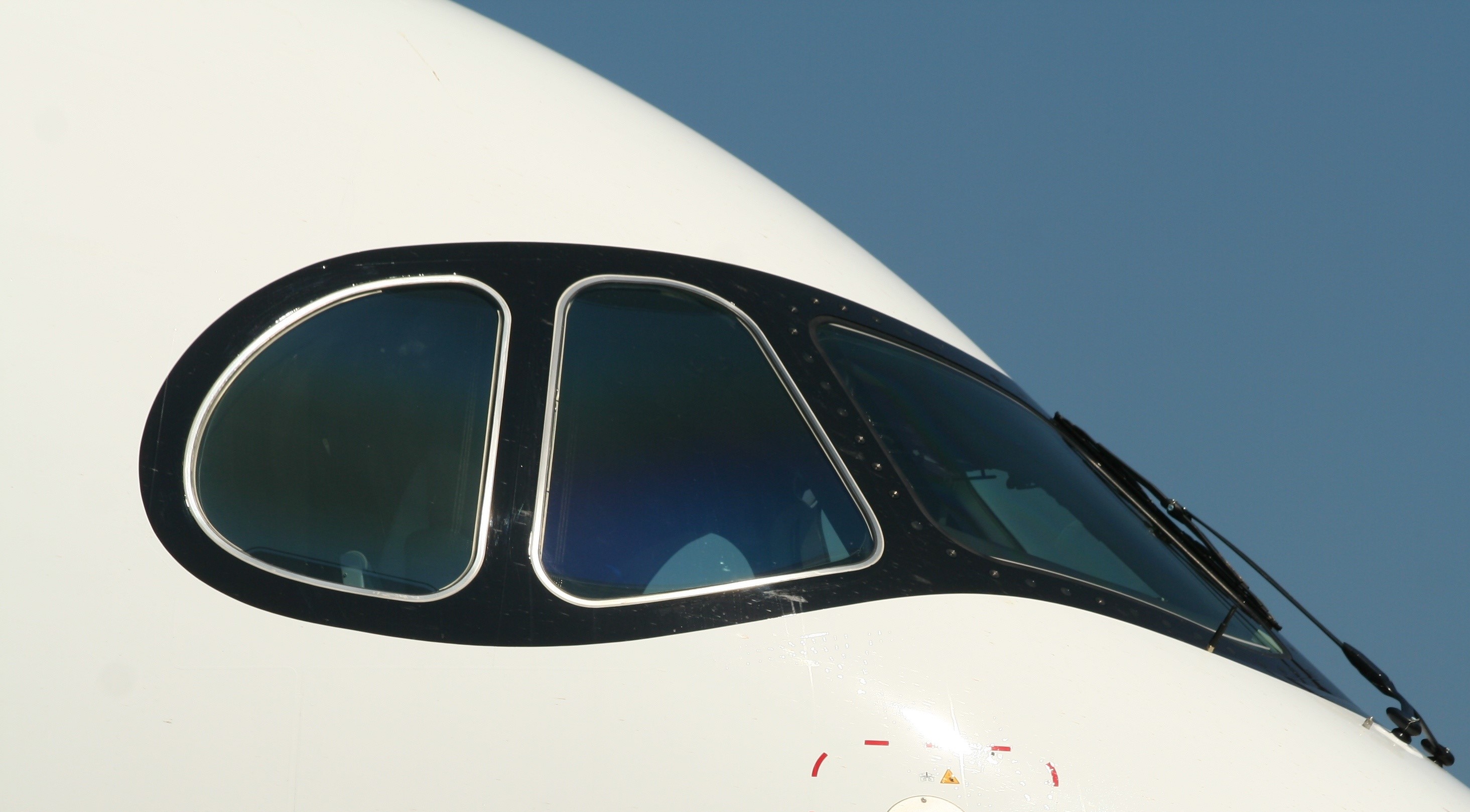
Of course there is at least an order of magnitude difference in the consequences associated with the design of a phone case and a cycle helmet.  We can step up the consequences, at least another order of magnitude, by considering the impact performance of the polycarbonate used in the cockpit windows of airplanes.  These need to able absorb the energy associated with impacts by birds, runway debris and other objects, as well as withstanding the cycles of pressurisation associated with take-off, cruising at altitude and landing.  They can be replaced after an event but only once the plane as landed safely.  Consequently, an in-depth understanding of the material behaviour under these different loading conditions is needed to produce a successful design.  Of course, we also need a detailed knowledge of the loading conditions, which are influenced not just by the conditions and events during flight but also the way in which the window is attached to the rest of the airplane.  A large and diverse team is needed to ensure that all of this knowledge and understanding is effectively integrated in the design of the cockpit window.  The team is likely to include experts in materials, damage mechanics, structural integrity, aerodynamic loading as well as manufacturing and finance, since the window has to be made and fitted into the aircraft at an acceptable cost.  A similar team will be needed to design the mobile phone casing with the addition of product design and marketing expertise because it is a consumer product.  In other words, engineering is team activity and engineers must be able to function as team members and leaders.

I wrote this post shortly after Clive’s lecture but since then it is has languished in my drafts folder – in part because I thought it was too long and boring.  However, my editor encourages me to write about engineering more often and so, I have dusted it off and shortened it (slightly!).

Image: https://commons.wikimedia.org/wiki/File:Airbus_A350_cockpit_windows_(14274972354).jpg

A school trip to Japan

Teachers, students and the parents gather outside their high school one Saturday at the beginning of August.  They chatter anxiously as they wait for everyone to arrive and while bags are loaded into the school mini-bus.  Four teachers and eight students are wearing specially-made name badges with a small silicon chip in one corner.  There are lots of hugs and kisses as these twelve people climb into the mini-bus for the journey to Charles de Gaulle airport.  At Charles de Gaulle airport they go through the usual security procedures, taking off their jackets and coats, which then go through the scanner, before boarding the 12-hour flight to Tokyo.  They arrive tired and bedraggled early on Sunday afternoon.  The following day they visit the French embassy in Toyko and are given a guided tour after passing through a security scanner in the entrance.  On Tuesday they are driven from Tokyo, northwards along the Pacific coast, through Iwaki City to the railway station at Tomioka, which was completely swept away by the tsunami in March 2011.  They have all seen the pictures of the wave overwhelming everthing in its path; but it’s difficult to imagine it as they are shown around.  The next stop is the Miyakoji district of Tamura City whose residents were the first to be allowed to return in April 2014 after being evacuated following the incident at the Fukushima Daiichi nuclear power plant.  The students and teachers stay for two nights in the homes of students from Fukishima high school.  Their hosts are wearing matching name-badges with little silicon chip on them.  On Wednesday they visited Aizu and then a peach farm in northern Fukushima Prefecture on Thursday; before starting their journey home on Friday.

As they leave Fukushima Prefecture, their name badges were collected, and the silicon chips sent off for analysis.  The chips were sensors that detect gamma rays with a sensitivity of 0.1 uSv/hr [micro Sieverts per hour] which record hourly dose rates with a date stamp.  The results for the French school party are shown in the graphic – my account above describes an actual visit mage in August 2015.  The name badges with an onboard sensor are known as D-shuttles and the students were participating in a study that has been published recently by Professor Hayano of the University of Tokyo.  The events described above are highlighted in the D-shuttle data in the figure on-line here.  The highest reading from the D-shuttle, on August 2nd, is due to cosmic radiation received during the 12-hour flight from Paris to Tokyo.

There has been extensive monitoring of Fukushima residents.  In 2012, more than 30,000 people were given full-body scans at Hirata Central Hospital and 100% of children and 99% of adults were below the scanner’s detection limit of 100 Bq per body, which compares with the average body burden of an adult male in Japan of 535 Bq per body found in 1964.  For more on types of radioactivity see my post ‘Hiding in the basement’ on December 18th, 2013.

Source:

Hayano R, Measurement and communication: what worked and what did not in Fukushima, Annals of the ICRP, (45):14-22, 2016.

Hayano RS, Tsubokura M, Miyazaki M et al, Internal radiocesium contamination of adults and children in Fukushima 7 to 20 monts after the Fukushima NPP accident as measured by extensive whole-body-counter survey. Proc. Japan Acad. Ser. B 89:157-163, 2013.

Uchiyama M, Nakamura Y, Kobayashi S, Analysis of bidy-burden measurements of 137Cs and 40K in a Japanese group over a period of 5 years following the Chernobyl accident, Health Phys., 71:320-325, 1996.

Footnotes:

A Sievert is the ionising effect of 1 Joule of energy on 1 kilogram of biological tissue.

A Becquerel is a measure of radioactivity equivalent to the  quantity of radioactive material in which one nucleus decays per second.

Image: http://www.fukushima-dialogues.com/wp-content/uploads/2016/02/schema-D-shuttle-porte.png

Brave New World

OLYMPUS DIGITAL CAMERATerm has started, and our students are preparing for end-of-semester examinations; so, I suspect that they would welcome the opportunity to deploy the sleeping-learning that Aldous Huxley envisaged in his ‘Brave New World’ of 2540.  In the brave new world of digital engineering, some engineers are attempting to conceive of a world in which experiments have become obsolete because we can rely on computational modelling to simulate engineering systems.  This ambitious goal is a driver for the MOTIVATE project [see my post entitled ‘Getting smarter‘ on June 21st, 2017]; an EU-project that kicked-off about six months ago and was the subject of a brainstorming session in the Red Deer in Sheffield last September [see my post entitled ‘Anything other than lager, stout or porter!‘ on September 6th, 2017.  The project has its own website now at www.engineeringvalidation.org

A world without experiments is almost unimaginable for engineers whose education and training is deeply rooted in empiricism, which is the philosophical approach that requires assumptions, models and theories to be tested against observations from the real-world before they can be accepted.  In the MOTIVATE project, we are thinking about ways in which fewer experiments can provide more and better measured data for the validation of computational models of engineering systems.   In December, under the auspices of the project, experts from academia, industry and national labs from across Europe met near Bristol and debated how to reshape the traditional flow-chart used in the validation of engineering models, which places equal weight on experiments and computational models [see ASME V&V 10-2006 Figure 2].  In a smaller follow-up meeting in Zurich, just before Christmas [see my post ‘A reflection of existentialism‘ on December 20th, 2017], we blended the ideas from the Bristol session into a new flow-chart that could lead to the validation of some engineering systems without conducting experiments in parallel.  This is not perhaps as radical as it sounds because this happens already for some evolutionary designs, especially if they are not safety-critical.  Nevertheless, if we are to achieve the paradigm shift towards the new digital world, then we will have to convince the wider engineering community about our novel approach through demonstrations of its successful application, which sounds like empiricism again!  More on that in future updates.

Image by Erwin Hack: Coffee and pastries awaiting technical experts debating behind the closed door.