Category Archives: Learning & Teaching

Fourth industrial revolution

Have you noticed that we are in the throes of a fourth industrial revolution?

The first industrial revolution occurred towards the end of the 18th century with the introduction of steam power and mechanisation.  The second industrial revolution took place at the end of the 19th and beginning of the 20th century and was driven by the invention of electrical devices and mass production.  The third industrial revolution was brought about by computers and automation at the end of the 20th century.  The fourth industrial revolution is happening as result of combining physical and cyber systems.  It is also called Industry 4.0 and is seen as the integration of additive manufacturing, augmented reality, Big Data, cloud computing, cyber security, Internet of Things (IoT), simulation and systems engineering.  Most organisations are struggling with the integration process and, as a consequence, are only exploiting a fraction of the capabilities of the new technology.  Revolutions are, by their nature, disruptive and those organisations that embrace and exploit the innovations will benefit while the existence of the remainder is under threat [see [‘The disrupting benefit of innovation’ on May 23rd, 2018].

Our work on the Integrated Nuclear Digital Environment, on Digital Twins, in the MOTIVATE project and on hierarchical modelling in engineering and biology is all part of the revolution.

Links to these research posts:

Enabling or disruptive technology for nuclear engineering?’ on January 28th, 2015

Can you trust your digital twin?’ on November 23rd, 2016

Getting Smarter’ on June 21st, 2017

‘Hierarchical modelling in engineering and biology’ [March 14th, 2018]


Image: Christoph Roser at AllAboutLean.com from https://commons.wikimedia.org/wiki/File:Industry_4.0.png [CC BY-SA 4.0].

So how do people learn?

Here’s the next in the CALE series.  When designing a learning environment that supports the acquisition of knowledge by all of our students, we need to think about the different ways that people learn.  In the 1970s, Kolb developed his learning style inventory which is illustrated in the diagram above.  Approaches to learning are plotted on two axes: on the horizontal axis is learning by watching at one end and learning by doing at the other; while on the vertical axis is learning by feeling at one end and learning by thinking at the opposite end.  Kolb proposed that people tend to learn by a pair of these attributes, i.e. by watching and feeling, or watching and thinking, or doing and thinking, or doing and feeling, so that an individual can be categorised into one of the four quadrants.  Titles are given to each type of learning as shown in the quadrants, i.e. Divergers, Assimilators, Convergers and Accommodators.

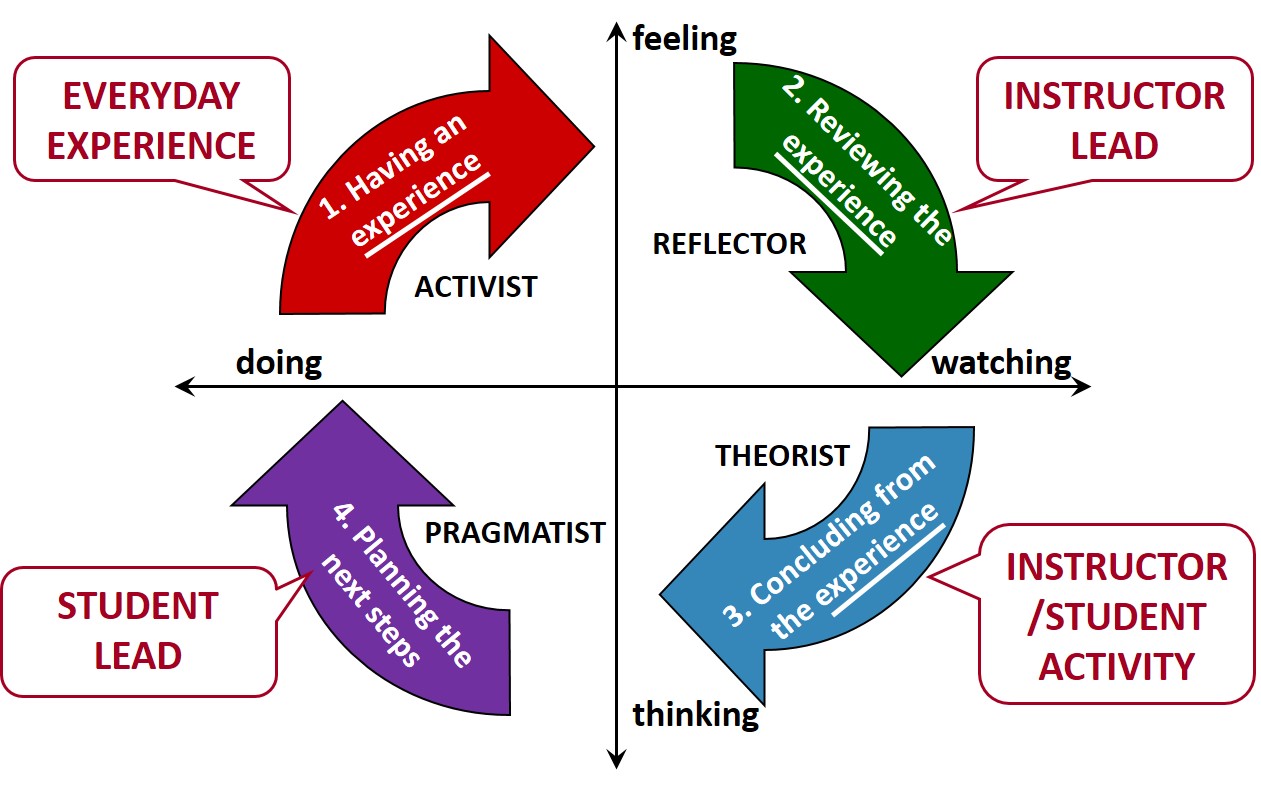
In practice, it seems unlikely that many of us remain in one of these quadrants though we might have a preference for one of them.  Honey and Mumford [1992] proposed that learning is most effective when we rotate around the learning modes represented in the quadrants, as shown in the diagram below.  Starting in the doing & feeling quadrant by have an experience and being an Activist, moving to the feeling & watching quadrant by reviewing the experience as a Reflector, then in watching and thinking mode, drawing conclusions from the experience as a Theorist, culminating with planning the next steps as a Pragmatist in the thinking and doing quadrant before repeating the rotation.

There are other ideas about how we learn but these are two of the classic theories, which I have found useful in creating a learning environment that is dynamic and involves cycling students around Honey and Mumford’s learning modes.

References:

Kolb DA, Learning style inventory technical manual. McBer & Co., Boston, MA, 1976.

Honey P & Mumford A. The Manual of Learning Styles 3rd Ed. Peter Honey Publications Limited, Maidenhead, 1992.


CALE #3 [Creating A Learning Environment: a series of posts based on a workshop given periodically by Pat Campbell and Eann Patterson in the USA supported by NSF and the UK supported by HEA]

Formative experiences

A few weeks ago, I wrote about how we all arrive in the classroom with different experiences that are strongly influenced by the conditions in our formative years.  When I talk about this process in workshops on teaching, I invite attendees to tell us about something that has influenced their approach to learning.  However, I kick-off by sharing one of mine: I joined the Royal Navy straight from school and so I arrived at University having painted the white line down the centre of the flight deck of an aircraft carrier but also having flown a jet.  This meant that my experience of dynamics was somewhat different to most of my peers.  It’s amazing the life experiences that are revealed when we go around the room at these workshops.  Feel free to share your experiences and how they influence your learning using the comments section below.

CALE #2 [Creating A Learning Environment: a series of posts based on a workshop given periodically by Pat Campbell and Eann Patterson in the USA supported by NSF and the UK supported by HEA]

Photo by Pedro Aragao [Creative Commons Attribution-Share Alike 3.0 Unported]

The disrupting benefit of innovation

Most scientific and technical conferences include plenary speeches that are intended to set the agenda and to inspire conference delegates to think, innovate and collaborate.  Andrew Sherry, the Chief Scientist of the UK National Nuclear Laboratory (NNL) delivered a superb example last week at the NNL SciTec 2018 which was held at the Exhibition Centre Liverpool on the waterfront.  With his permission, I have stolen his title and one of his illustrations for this post.  He used a classic 2×2 matrix to illustrate different types of change: creative change in the newspaper industry that has constantly redeveloped its assets from manual type-setting and printing to on-line delivery via your phone or tablet; progressive change in the airline industry that has incrementally tested and adapted so that modern commercial aircraft look superficially the same as the first jet airliner but represent huge advances in economy and reliability; inventive change in Liverpool’s Albert Dock that was made redundant by container ships but has been reinvented as a residential, tourism and business district.  The fourth quadrant, he reserved for the civil nuclear industry in the UK which requires disruptive change because its core assets are threatened by the end-of-life closure of all existing plants and because its core activity, supplying electrical power, is threatened by cheaper alternatives.

At the end of last year, NNL brought together all the prime nuclear organisations in the UK with leaders from other sectors, including aerospace, construction, digital, medical, rail, robotics, satellite and ship building at the Royal Academy of Engineering to discuss the drivers of innovation.  They concluded that innovation is not just about technology, but that successful innovation is driven by five mutually dependent themes that are underpinned by enabling regulation:

  1. innovative technologies;
  2. culture & leadership;
  3. collaboration & supply chain;
  4. programme and risk management; and
  5. financing & commercial models.

SciTec’s focus was ‘Innovation through Collaboration’, i.e. tackling two of these themes, and Andrew tasked delegates to look outside their immediate circle for ideas, input and solutions [to the existential threats facing the nuclear industry] – my words in parentheses.

Innovative technology presents a potentially disruptive threat to all established activities and we ignore it at our peril.  Andrew’s speech was wake up call to an industry that has been innovating at an incremental scale and largely ignoring the disruptive potential of innovation.  Are you part of a similar industry?  Maybe it’s time to check out the threats to your industry’s assets and activities…

Sources:

Sherry AH, The disruptive benefit of innovation, NNL SciTec 2018 (including the graphic & title).

McGahan AM, How industries change, HBR, October 2004.