Author Archives: Eann Patterson

Wading in reflections

I have written before about Daniel Goleman’s analysis of leadership styles [see ‘Clueless on leadership style‘ on June 14th, 2017]; to implement these styles, he identifies, four competencies you require: self-awareness, self-management, social awareness and relationship management.  Once again, I am involved in teaching helping people develop these competencies through our Science & Technology Leadership CPD programme for aspiring leaders in Research & Development [R&D].  As part of the module on Science Leadership and Ethics we have asked our delegates to write a short essay reflecting on the ethics of one or two real events and, either from experience or vicariously, on the leadership associated with them.  Our delegates find this challenging, especially the reflective aspect which is designed to induce them to think about their self, their feelings and their reactions to events.  They are technologists who are used to writing objectively in technical reports and the concept of writing about the inner workings of their mind is alien to them.

Apparently, the author Peter Carey compared writing to ‘wading in the flooded basement of my mind’ and, to stretch the analogy, I suspect that our delegates are worried about getting out of their depth or perhaps they haven’t found the stairs to the basement yet.  We try to help by providing a map in the form of the flowchart in the thumbnail together with the references below.  Nevertheless, this assignment remains an exercise that most undertake by standing at the top of the stairs with a weak flashlight and that few both get their feet wet and tell us what they find in the basement.

References:

A short guide to reflective writing, University of Birmingham, Library Services Academic Skills Centre, https://intranet.birmingham.ac.uk/as/libraryservices/library/skills/asc/documents/public/Short-Guide-Reflective-Writing.pdf

http://www.bbc.co.uk/bitesize/intermediate2/english/folio/personal_reflective_essay/revision/1/

Sources:

Image: https://www.pinterest.co.uk/pin/589901251161855637/

Goleman D, Boyatzis R & McKee A, The new leaders: transforming the art of leadership into the science of results, London: Sphere, 2002.

Dickson A, Books do furnish a lie, FT Weekend, 18/19 August 2018.

Learning problem-solving skills

Inukshuk: meaning ‘in the likeness of a human’ in the Inuit language. A traditional symbol meaning ‘someone was here’ or ‘you are on the right path’.

One definition of engineering given in the Oxford English Dictionary is ‘the action of working artfully to bring something about’.  This action usually requires creative problem-solving which is a common skill possessed by all engineers regardless of their field of specialisation.  In many universities, students acquire this skill though solving example problems set by their instructors and supported by example classes and, or tutorials.

In my lectures, I solve example problems in class using a pen and paper combined with a visualiser and then give the students a set of problems to solve themselves.  The answers but not the solutions are provided; so that students know when they have arrived at the correct answer but not how to get there.  Students find this difficult and complain because I am putting the emphasis on their learning of problem-solving skills which requires considerable effort by them.  There are no short-cuts – it’s a process of deep-learning [see ‘Deep long-term learning’ on April 18th, 2018].

Research shows that students tend to jump into algebraic manipulation of equations whereas experts experiment to find the best approach to solving a problem.  The transition from student to skilled problem-solver requires students to become comfortable with the slow and uncertain process of creating representations of the problem and exploring the possible approaches to the solution [Martin & Schwartz, 2014].  And, it takes extensive practice to develop these problem-solving skills [Martin & Schwartz, 2009].  For instance, it is challenging to persuade students to sketch a representation of the problem that they are trying to solve [see ‘Meta-representational competence’ on May 13th, 2015].  Working in small groups with a tutor or a peer-mentor is an effective way of supporting students in acquiring these skills.  However, it is important to ensure that the students are engaged in the problem-solving so that the tutor acts as consultant or a guide who is not directly involved in solving the problem but can give students confidence that they are on the right path.

[Footnote: a visualiser is the modern equivalent of an OverHead Projector (OHP) which instead of projecting optically uses a digital camera and projector.  It’s probably deserves to be on the Mindset List since it is one of those differences between a professor’s experience as a student and our students’ experience [see ‘Engineering idiom’ on September 12th, 2018]].

References:

Martin L & Schwartz DL, A pragmatic perspective on visual representation and creative thinking, Visual Studies, 29(1):80-93, 2014.

Martin L & Schwartz DL, Prospective adaptation in the use of external representations, Cognition and Instruction, 27(4):370-400, 2009.


CALE #9 [Creating A Learning Environment: a series of posts based on a workshop given periodically by Pat Campbell and Eann Patterson in the USA supported by NSF and the UK supported by HEA] – although this post is based on an introduction to tutorials given to new students and staff at the University of Liverpool in 2015 & 2016.

Photo: ILANAAQ_Whistler by NordicLondon (CC BY-NC 2.0) https://www.flickr.com/photos/25408600@N00/189300958/

Female writers from Sappho to today

A couple of weeks ago, after reviewing one of my posts, my editor commented that I was repeating myself because I had already written on the same topic in an earlier post.  I feel that is inevitable in a weekly blog which has an archive of more than three hundred posts – I am just not sufficiently creative to produce something original every week. Besides, maybe that’s not necessary.  Anyhow, today I am returning to a theme that I have written about previously: the Treasury at the Weston Library in Oxford.  It is a small museum with a rotating collection of treasures from the Bodleian Library, which until the end of February 2019 is on the topic of ‘Sappho to Suffrage: women who dared‘.  As you might expect from the title, the oldest treasure in the exhibition are fragments of a copy from the 2nd century AD of one of Sappho’s poems.  Sappho, who lived on the Greek island of Lesbos between 630 and 580 BC, is the first female writer known to Western civilisation.  Her work was almost lost – the fragments of papyrus on display were found on an ancient Eygptian rubbish dump.  Perhaps this is a good representation of men’s attitude to women’s writing because probably since Sappho, female writers have been neglected by publishers and male readers.  As Nilanjana Roy has reported, publishing houses submit more books by male writers for literary prizes and book reviews tend to highlight more books by men than by women.  In books written by women the gender of characters in evenly divided, whereas in those written by men, women only occupy between a quarter and third of the character-space and men tend to read books written by men.  Perhaps it is unsurprising that many men are lacking in understanding and social awareness of half the population.  Encouraged by my wife and daughters, this imbalance in my reading habits is being addressed by reading the books shortlisted for the Women’s Prize for Fiction each year during our summer holidays. I can recommend the 2018 winner ‘Home Fire’ by Kamila Shamsie – it’s very topical, will make you think and pulls you along to its dramatic final page.  However, you should also read ‘When I hit you’ by Meena Kandasamy – it was both enlightening and shocking to me, and I was left wondering about the line between fiction and non-fiction.  I also really enjoyed last year’s winner: ‘The Power’ by Naomi Alderman.

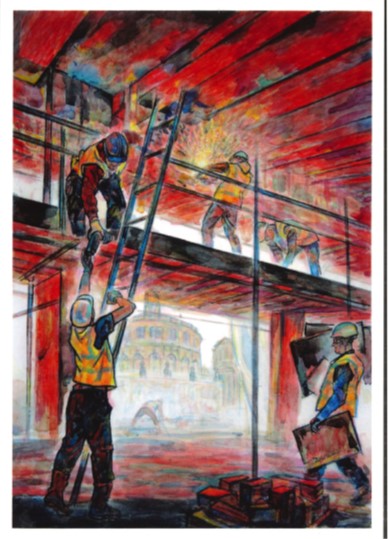
BTW – the thumbnail is a scan of postcard bought in the Weston Library showing a painting by their artist in residence, Dr Weimen He, who captured moments in time during the refurbishment of the library.

Source: Gender and genre: reading the world by Nilanjana Roy in the FT Weekend, Saturday 22 September 2018.

Previous posts featuring the Weston Library Treasury: ‘Pope and Austen‘ on September 9th, 2015, ‘Red Crane‘ on July 26th, 2017 and ‘Ramblings on equality‘ on October 11th, 2017.

Aircraft inspection

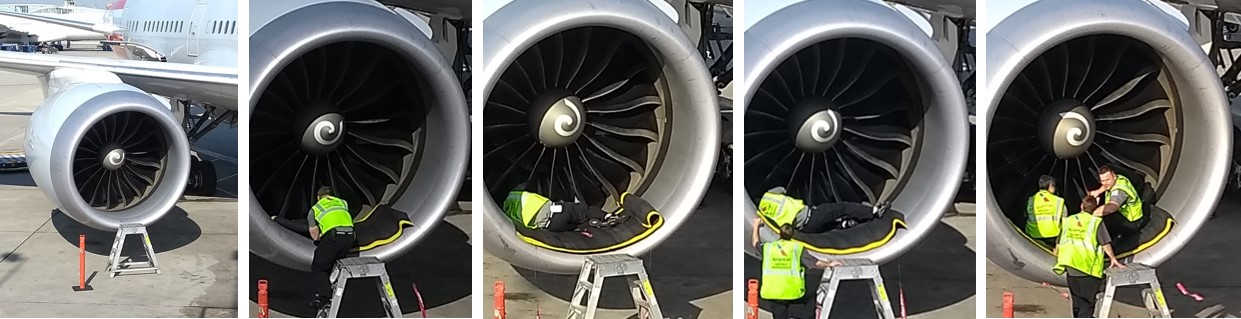
A few months I took this series of photographs while waiting to board a trans-Atlantic flight home.  First, a small ladder was placed in front of the engine.  Then a technician arrived, climbed onto the ladder and spread a blanket on the cowling before kneeling on it and spinning the fan blades slowly.  He must have spotted something that concerned him because he climbed in, lay on the blanket and made a closer inspection.  Then he climbed down, rolled up the blanket and left.  A few minutes later he returned with a colleague, laid out the blanket and they both had a careful look inside the engine, after which they climbed down, rolled up the blanket put it back in a special bag and left.  Five or ten minutes later, they were back with a third colleague.  The blanket was laid out again, the engine inspected by two of them at once and a three-way discussion ensued.  The result was that our flight was postponed while the airline produced a new plane for us.

Throughout this process it appeared that the most sophisticated inspection equipment used was the human eye and a mobile phone.  I suspect that the earlier inspections were reported by phone to the supervisor who came to look for himself before making the decision.  One of the goals of our current research is to develop easy-to-use instrumentation that could be used to provide more information about the structural integrity of components in this type of situation.  In the INSTRUCTIVE project we are investigating the use of low-cost infra-red cameras to identify incipient damage in aerospace structures.  Our vision is that the sort of inspection described above could be performed using an infra-red camera that would provide detailed data about the condition of the structure.  This data would update a digital twin that, in turn, would provide a prognosis for the structure.  The motivation is to improve safety and reduce operating costs by accurate identification of critical damage.