Author Archives: Eann Patterson

Salt increases nanoparticle diffusion

About two and half years ago, I wrote about an article we had published on the motion of nanoparticles [see ‘Slow moving nanoparticles‘ on December 13th, 2017] in which we had shown that, for very small particles at low concentrations, the motion of a particle is independent of its size and does not flow the well-known Stokes-Einstein law.  Our article presented convincing evidence from experiments to support our conclusions but was light on explanation in terms of the mechanics.  At the end of last year, we published a short article in Scientific Reports, in which we demonstrated that the motion of nanoparticles at low concentrations is dependent on the interaction of van der Waals forces and electrostatic forces.  Van der Waals forces are short-range attractive forces between uncharged molecules due to interacting dipole moments, whereas the electrostatic forces are the repulsion of electric charges.  We changed both of these forces by using salt solutions of different concentration and observing the changes in nanoparticle behaviour.  Increasing the molarity increases the diffusion of the particles until the solution is saturated, as shown in the picture for 50 nanometre diameter gold particles (that’s about half the diameter of a coronavirus particle or one thousandth of the diameter of a human hair).  Our findings have implications for understanding the behaviour of nanoparticles dispersed in biological media, which typically contain salt in solution, because the concentration of salt ions in the medium affects nanoparticle diffusion that has been shown to influence cellular uptake and toxicity.

Sources:

Coglitore D, Edwardson SP, Macko P, Patterson EA, Whelan MP, Transition from fractional to classical Stokes-Einstein behaviour in simple fluids, Royal Society Open Science, 4:170507, 2017.

Giorgi F, Coglitore D, Curran JM, Gilliland D, Macko P, Whelan M, Worth A & Patterson EA, The influence of inter-particle forces on diffusion at the nanoscale, Scientific Reports, 9:12689, 2019.

Walking and reading during a staycation

I am on vacation this week though, due to the restrictions on our movement imposed to prevent the spread of the coronavirus, it will a be staycation in our house.  We usually go to the Lake District at this time of year to walk and read; so, I might make another virtual expedition [see: ‘Virtual ascent of Moel Famau‘ on April 8th, 2020], perhaps to climb Stickle Pike and Great Stickle this time.  I was asked recently about books I would recommend prospective science and engineering students to read in preparation for to going to university.  It is not the first time that I have been asked the question.  This time I thought I should respond via this blog since the disruption brought about by the pandemic probably means that many prospective students will have more time and less preparation prior to starting their university course.  So, here are six books that are all available as ebooks, and might be of interest to anyone who is staying home to counter the spread of coronavirus and has time to fill:

[1] It is hard to find good novels either written by an engineer or about engineering [see ‘Engineering novelist‘ on August 5th, 2015]; however, Nevil Shute’s novel ‘Trustee from the toolroom‘ [Penguin Books, 1960] satisfies all of these criteria.

I have more than 40 years experience of engineering science so I am not the best person to ask about books that will appeal to young people just starting their journey in the field; however two books that have been popular recently are: [2] ‘Storm in a teacup: the physics of everyday life‘ by Helen Czerski [Penguin Books, 2016] and [3] ‘Think like an engineer‘ by Guru Madhavan [One World Publications, 2016]

Regular readers of this blog might have spotted some of my favourite science books in the lists of sources at the end of posts. Perhaps my top three at the moment are:

[4] Max Tegmark, Our Mathematical Universe, Penguin Books Ltd, 2014. [see: ‘Converting wealth into knowledge and back to wealth‘ on January 6th, 2016; ‘Trees are made of air‘ on April 1st, 2015; ‘Is the Earth a closed system? Does it matter?‘ on December 10th, 2014 & ‘Tidal energy‘ on September 17th, 2014]

[5] Susan Greenfield, A Day in the Life of the Brain, London: Allen Lane, 2016 [see: ‘Digital hive mind‘ on November 30th, 2016; ‘Gone walking‘ on April 19th, 2017 & ‘Walking through exams‘ on May 17th, 2017].

[6] Carlo Rovelli, The Order of Time, Penguin, 2019 [see: ‘We inhabit time as fish inhabit water’ on July 24th, 2019 and ‘Only the name of the airport changes‘ on June 12th, 2019].

Of course, I should not omit the books that I ask students to read for my own first year module in thermodynamics:

Peter Atkins, A very short introduction to thermodynamics, Oxford: OUP, 2010.

Manuel Delanda ‘Philosophy and Simulation: The Emergence of Synthetic Reason‘, London: Continuum Int. Pub. Group, 2011 [see: ‘More violent storms‘ on March 1st, 2017; ‘Emergent properties‘ on September 16th, 2015 & ‘Emerging inequality‘ on March 5th, 2014].


Virtual ascent of Moel Famau

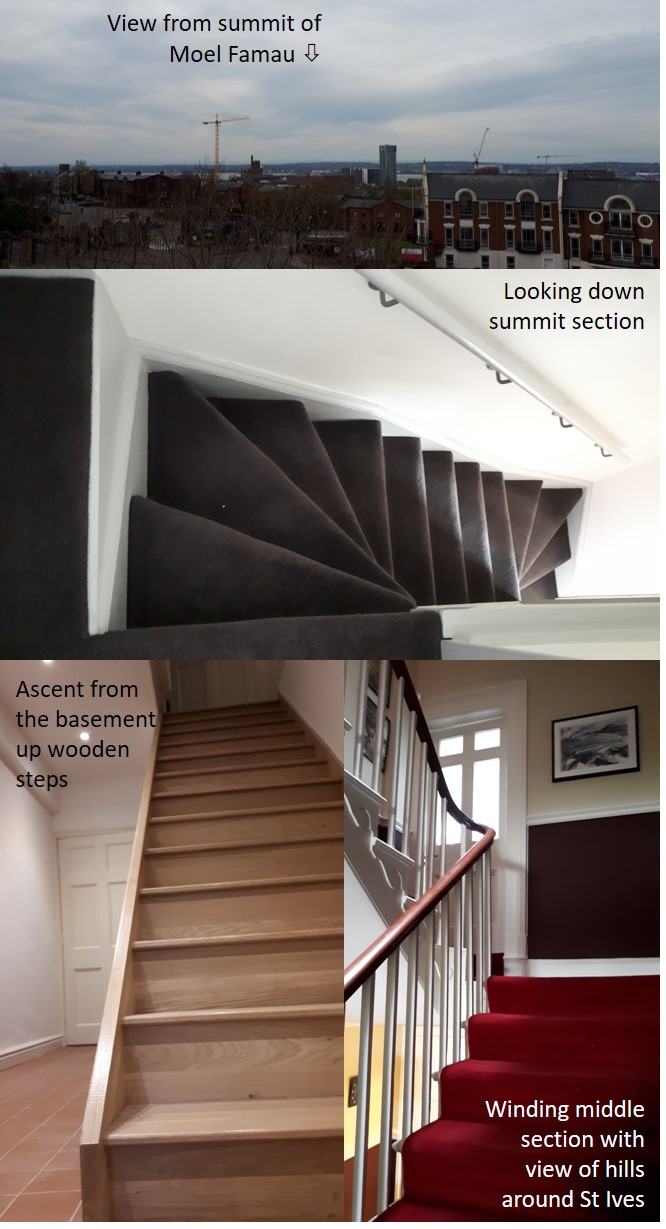
Last week I met with research collaborators in Italy where they have been restricted to their homes for the past four weeks and need written permission to move more than 200 yards from the house; in Urbana-Champaign, IL, USA where they closed down the campus two weeks ago on about the same timescale as here in Liverpool; and in Taiwan where they are able to work on campus wearing masks but they are not delivering undergraduate lectures.  Of course, to prevent the spread of the coronavirus, all of these meetings happened electronically via a variety of virtual conferencing tools.  At the weekend, I climbed the Welsh hill, Moel Famau, that we can see from the upper windows of our house.  We climb it most weekends, but last weekend was different because I did it virtually by repeatedly climbing the stairs in our house so that I could abide by the Government’s directions to not visit the countryside.  I had talked about it during our first weekend in lock-down and calculated how many repeats were equivalent to the climb from Cilcain to the summit. A report of a virtual ascent of Everest inspired me to go ahead with my own virtual expedition from the basement to the attic thirty-five times.  The first stage was like the lower slopes of well-used mountain trail where rangers have installed wooden steps to protect the hillside because we have recently installed a new oak staircase to the basement.  The middle stage was a gentler winding ascent with views of hills while the final stage was steep with awkward steps leading to a hidden summit.  To my surprise, I got some of the same feelings of mental well-being and renewal induced by walking in real hills [see: ‘Gone walking‘ on April 19th, 2014 & ‘Take a walk on the wild side‘ on August 26th, 2015].  As I write this post, a Government minister is saying on the radio that we might not be allowed our daily hour outside for exercise, so my virtual expedition will likely be repeated next weekend.

Gustatory technology stimulates on-line get-togethers

It has been known for some time that over or under responsivity to sensory stimulation encountered in everyday life, such as noise, light and smell, can be a cause of anxiety and stress [e.g. Lipowski, 1975].  Most virtual reality systems provide visual and audio stimuli through headsets and tactile stimuli can be provided through haptic devices; however, that leaves two senses under stimulated: smell and taste.  So, researchers have been exploring how to extend virtual reality to include smell and taste in order to give a complete sensory experience and thus reduce the level of stress and anxiety that many people feel when using immersive reality systems.  This had led to digital scent technology that allows smells to be transmitted electronically [e.g. Isokoski et al, 2020].  So, it’s time to update your preferred communication tool to one that allows you to smell that fresh cup of coffee your colleague has just brewed before joining the meeting from their home-office.  Of course, if they have not taken a shower recently then you might want to ‘mute’ the smell function!  These advances in technology have led a spin-out company, Day91, to start work on gustatory technology that modifies the water in your glass to simulate the after-work drink that your team-mate is enjoying during your virtual get-together online.

References:

Lipowski, Z. J. (1975). Sensory and information inputs overload: Behavioural effects. Comprehensive Psychiatry, 16(3), 199–221.

Isokoski, P., Salminen, K., Müller, P., Rantala, J., Nieminen, V., Karjalainen, M., Väliaho, J., Kontunen, A., Savia, M., Leivo, J. and Telembeci, A., (2020). Transferring scents over a communication network. In Proceedings of the 23rd International Conference on Academic Mindtrek (pp. 126-133).